 |
| The Ascent |
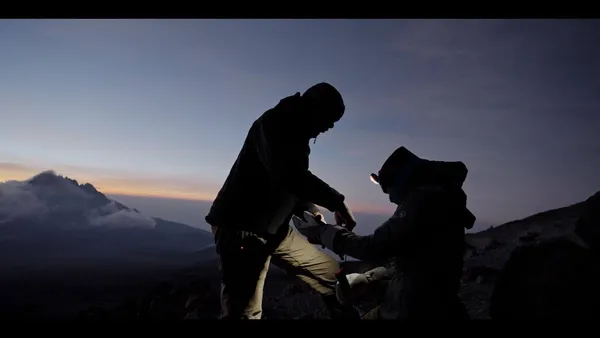
The Ascent, directed by Edward Drake, Scott Veltri, and Francis Cronin, tells the story of Colorado Springs bilateral-amputee climber Mandy Horvath’s attempt to reach the summit of Mt. Kilimanjaro. Africa’s highest peak, it claims the lives of more than 12 people each year. Many more fail to reach its summit. Horvath attempts to do it crawling on her hands. The Ascent weaves into the climb the mysterious circumstances under which Horvath lost both of her legs at age 21, which exposes the depths of human cruelty and the resilience of the human spirit to overcome unthinkable trauma.
Kilimanjaro is one of Horvath's many climbing feats, with seven world records in all. She continues to be an advocate for people with disabilities. Drake comes from a narrative background, whose directorial credits include the Detective Knight trilogy starring Bruce Willis. The Ascent is Veltri's directorial debut, who has previously served as an executive producer on Gia Coppola's Mainstream, John Michael McDonagh's The Forgiven, starring Ralph Fiennes and Jessica Chastain, and the documentary One Road To Quartzsite.
In conversation with Eye For Film, Horvath, Drake and Veltri discussed the exhaustive five-year process of chronicling the record-breaking climb, supported by commanders Julius John White, A.K.A. 'Whitey', Carel Verhoef and Sally Grierson, and a team of porters, as well as an investigation into what really happened the night Horvath lost her legs and the mishandled police investigation in Steele City, Nebraska. They also reflected on striking a deeper connection with the audience, and fulfilling the ambition of making a heist movie.
The following has been edited for clarity.
Paul Risker: A good way to begin would be to reflect on how the documentary came into being and took shape.
Edward Drake: Francis and I connected with Mandy and from then on, it was all easy — there was never one issue along the way. It was an exercise in trust, and while my usual day job is narrative features, this was about working with one person to show that we were going to handle the subject matter with absolute care. We came from a place of wanting to share Mandy's incredible story with the world, but also do it justice and get to the heart of what keeps this incredible modern-day hero going — how she perseveres to inspire others.
Scott Veltri: When Ed and Frank first met Mandy, they were so inspired by her, that they decided to take on this journey. Then they brought me in as the documentary evolved and they looked into what happened to her.
We all played our part. Ed is definitely tech-savvy as a filmmaker and was the one pushing us up the mountain. He continued to push the project forward when it went through its ups and downs. Frank is a very compassionate person based on his background and he was great at working with Mandy and helping her to open up to us. And then, I have a lot of documentary experience and was able to lead us down the path of exploring past events, pushing the investigation and tracking people down. So, we all came together to find the right structure to tell the narrative, and we totally adored Mandy and loved working with her. It was a really great combo.
PR: The way you open up Mandy, and we learn about who you are, takes the audience on a powerful journey. The subject of trust comes up during the film, but what needs to be acknowledged is your willingness to share your vulnerability and trust in these filmmakers.
Mandy Horvath: The documentary is about a climb, but underneath the surface, it's really about me finding myself and coming back to who I was before this traumatic event occurred. Like you said, opening up and becoming vulnerable to allow this story to be told was a tremendous feat in and of itself. But through this climb I really did find myself and I feel that needed to stand out.
PR: For anyone dealing with trauma, me included, listening to some of the things you say in the film Mandy will genuinely resonate. Your words helped me to understand my own psychology and journey to heal. So, the power of The Ascent lies in its ability to communicate and connect with people, going beyond the story of your ascent of Kilimanjaro to offer an introspective, even philosophical insight into the human experience.
MH: When I got to see the documentary for the first time, I also thought that it was very rich. I learned things that I didn't even know. It really speaks volumes to the dedication of the team to uncover some truth and give me a sense of validation. They went leagues farther than I ever imagined, and now I have this solid piece of validation and evidence that what I've been speaking about for the last ten years is not just on me — there's a documentary about it now.
ED: Thank you for sharing that you’re going through a period of change and growth as well. To Mandy's point, that was really at the heart of why we wanted to get into the story and why we knew there were not going to be any half measures on this. It was five years working with Mandy, and with Scott, chasing down leads to try to uncover the truth. But honestly, to get to the heart of what keeps Mandy going and how you can draw some of that inspiration, it shows that after the most horrific kind of violence that people can inflict on each other, survivors can take all of that trauma and actually come out the other side with an appreciation for how beautiful life is. And if we can give anyone in the audience a little bit of light to be able to persevere through their own darkness, then that's the ultimate goal of the documentary.
PR: The Ascent is a reminder of how dramatically the documentary genre has evolved, because even back in 2012, I remember pushback when discussing documentary and narrative in the same sentence. Now, the conversation is open to how the two borrow from one another, and The Ascent is an interesting example of documentary utilising narrative techniques to tell a non-fiction story.
SV: There's nothing fictional in our doc to be clear, but the example I like to use is that a lot of docs can be shaped as a thriller and feel like a thrill ride. We were conscious of that, and we'd say it's Free Solo meets Icarus. It has the inspirational challenge of Free Solo, and it is character-driven, but Icarus is a doc that takes you unexpectedly into a thriller. It's where we never expected to be, but it's where we ended up with the plot about her past, which frankly did take us down a road that was a thriller during the process of making it. It was pretty crazy and that comes out throughout the film.
ED: I love the evolution of genres, and this ability to subvert and remix, especially the animation style that we were able to use. We wanted to create this temporal space where, thanks to Mike Lloyd's animations, you fall into a memory. It's the closest you can get to being in that horrible sense of unknowing, where the memories starting and stopping is this grey, liminal space. And that's obviously drawing from some feature experience and some more narrative stuff.
Personally, I always wanted to make a heist movie, and I feel like we got to make one with this story. Honestly, there are moments when Mandy was training in Colorado, where we had to break into a national park so that she could get experience climbing in the dark and in the cold. But really, it's stealing this joy and this kindness, of falling back in love with life, from the very edge of the abyss of the dark night of the soul. And it's a hell of an experience that changed all of us.
PR: Returning time and again to the past traumatic incident and its consequences makes logical sense, but this structure serves to honour how trauma splits the person between the past and the present. It serves both a structural and thematic purpose.
ED: It's all about living in the present. That's the gift that the mountain gave all of us. There were no easy days on the mountain, from just the climb itself to then seeing what Mandy went through worrying about infection. And just the wind and cold coming at you, really forces you to live in that present. So, living on the edge of consciousness, that trauma and that darkness gets pushed away, and then it'll come back in and crush you again. You just have to find your way back into the light. Mandy, is that pretty accurate?
MH: Yeah, pretty accurate [laughs].
PR: I recall Dutch documentary filmmaker Suzanne Raes telling me that it's important to have time, which allows you to discover things you'll otherwise miss out on. The Ascent had five years to breathe, and so, how invaluable is it that filmmakers can spend time with their subject.
ED: Oh, it absolutely unveils itself. There are scripts that I've been working on for ten plus years that are still revealing their true meaning, and then there are other scripts that were written in weeks or months. With Mandy's story, it wasn't just about Mandy being ready to share, it was also the other witnesses that we had to track down being ready to go into their own trauma and to open up.
And I don't think there was another team of commanders and porters that would have been able to support Mandy. Patience is the hardest virtue to learn, I've found. But we are very lucky that we've been rewarded through this experience.
SV: It's definitely one that took years and years, and it could have been something different — just cut quickly and have been a nice happy puff piece about the climb. But we were able to find all these different layers and there's one point where we made a conscious choice when we were on a certain edit. We thought, 'Oh, Mandy's this hero. Let's just make her look just great and shiny.' But that's not who Mandy is. She's raw and unfiltered. So, we pulled back to show the tough and the sweet and not censor anything. And that's why you see some of the rawest, most vulnerable and heroic moments. That definitely took some time for us to find in the process.
The Ascent world premières in the 2026 SXSW Documentary Feature Competition.