





Eye For Film >> Movies >> Sound Of Falling (2025) Film Review


Mascha Schilinski’s sensational Sound Of Falling (Cannes jury prize winner, Germany’s Oscar submission and a highlight of the 63rd New York Film Festival), co-written with Louise Peter, explores how well cinema is equipped to tell of the experience of standing beside yourself while living in time. Small and immensely large epiphanies take place in and around a rural farmhouse in the Altmark region of North-East Germany.
The same rooms, the same courtyard and hayloft, the river and the fields nearby are populated by families during four different time periods, beginning in the early 20th century, then the Forties at the end of WWII, the GDR of the Eighties, and the present. The film somersaults from one time to the other, following a convincing logic all its own. Whereas four distinct female voices growing up in this place lead us into their worlds, it is the large ensemble cast that makes the magic happen. The lives mirror each other, build on each other, contradict each other, haunt each other.

Words not voiced by mothers and amputated legs for the men both cause phantom pains. How does the pooled sweat in a navel taste, Erika (Lea Drinda) wonders in the 1940s. Why does the 21st Century girl Lenka (Laeni Geiseler, star of Frédéric Hambalek’s What Marielle Knows) know how the doorknob tastes, although she never licked it? Bombastic, swelling and crackling noise, like a hurricane captured on an old record, interrupts the goings-on in interludes when the knowledge may be too much to take in.
The barn holds fun and games and unspeakable horrors. Although we know since Heraclitus that you can’t step into the same river twice, there are new eels in there that remind us of the old ones, the ones before our birth, the ones that snaked around our ancestors’ legs and hold court to this day. Not since Volker Schlöndorff’s Oscar-winning The Tin Drum, have the slithering eels been used in such an indelible way. The image of the fish mouth shoved into the nook between thumb and index finger, I know, will stay with me forever.
Sound Of Falling is a portrait of time in one locality and speaks of a knowledge of women oft forgotten and untold.
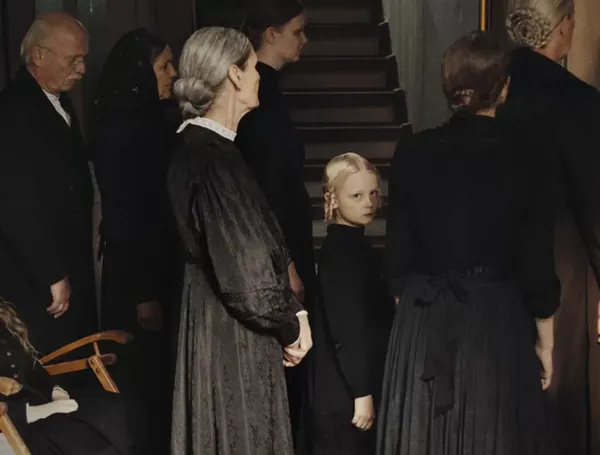
Little Alma (Hanna Heckt) is our guide to life over a century ago. She wears her pale blonde braids in traditional “monkey swings” around her ears, and speaks the Low German dialect of the area. She and her three older sisters like to play pranks on their maid Berta (Bärbel Schwarz) by nailing her indoor shoes to the doorstep. There are moments later in the film, after other pranks during other times, when our mind goes back to these practical jokes in the hopes that maybe another incident was pranksome too, and not grim reality.
You wear black for All Soul’s Day and Alma’s gown is beautiful and lacy with a lovely brooch. In it she resembles the girl in the photograph, that shows their mother Emma (Susanne Wuest of Veronika Franz and Severin Fiala’s Goodnight Mommy), double-exposed, ghost-like, and two-faced (a bit like the Janus cat in Kleber Mendonça Filho’s The Secret Agent, also in the NYFF Main Slate program) and a dead sibling also named Alma, who looks like her double.
Family portraits are photos of ghosts and Alma sees herself as a ghost too. A little blonde boy is dead. Don’t we all have children drowned young in deep wells in our family lore? Fears of being buried alive make Alma wonder what it means “not waking up.” The mother, silent, stuck in permanent grief is gagging a lot and everybody pretends not to see.
Trudi (Luzia Oppermann), their younger maid and one of the most tragic, brave figures of cinema, is chased by a man in the courtyard at night after the festivities. Alma, the little little girl, watches and will never forget. There is something about a sack over the head. What matters is that no one steps in to come to Trudi’s aid. Everything that is noticed and ignored all the time, while happening right in front of us - this is what Sound of Falling means. The same dining room in all its incarnations summons the spirit of place.
In the present day, Lenka and her little sister Nelly (Zoë Baier), just moved out to the farm with their parents from Berlin. Renovating it themselves, they enjoy the calm surroundings, thrilled by their new home, the girls sleep in the same bedroom that was shared by Alma and her sisters over a century ago. The inertia of the Real, as Slavoj Žižek called it in Sophie Fiennes’s The Pervert’s Guide To Ideology, is palpable in every wooden beam, every remnant of furniture and windowsill.
When mother Christa (Luise Heyer) demolishes gleefully with a hammer a very ugly ochre-tiled stove from GDR times, we float back to meet Angelika (Lena Urzendowsky), a teenager in the 1980s who just got new glasses and whose uncle Uwe (Konstantin Lindhorst) has his hand on her exposed thigh under the table. Angelika and Uwe’s son, her cousin Rainer (Florian Geißelmann) go swimming in the river at the same spot where Lenka in the present will meet her new friend Kaya (Ninel Geiger), a contained girl whose mother died recently, the same spot where the eels gather and where in 1945 a great tragedy occurred.
Angelika speaks to us about pretending not to notice that the men are looking at her body in her bathing suit. “I was the one who wanted them looking at me.” Lenka will second part of this observation decades later. She knows about the pretending, but does not want to be in this “shared secret between him and me.” The whistling wind, the crackling sounds come and go. What is the pattern? Is there a pattern? Schilinski re-invents a tone fresh and new to reveal ancient wounds of abuse and silence. Looking from the inside and looking from the outside, where from and where to - memories and secrets of the past make characters go back to the water as if pulled by unknown forces. The past speaks this way, through objets, through surroundings that remain and bleed fragments of the stories lost.
Vanilla or strawberry ice cream? Mundane choices, minor details remembered forever can encompass an entire relationship of belonging or being scorned. Lenka’s favorite smells in order: 1. Cellar smell, 2. River skin, 3. Nail polish. Angelika describes to us how her mother, Irm (Claudia Geisler-Bading), never knew when to laugh and suddenly burst out in laughing fits when somebody died. Irm’s sister Erika had tied up her leg to feel closer to the amputee in their midst when the war was ending, and her strong will made her do what many women did with the Russian Army approaching, something Angelika’s mother herself crawled out of with lingering shame. So much is passed on through the body. We carry the dead with us all the time. “Work accident” repeated often enough loses its meaning, but the horror never ceases. A harvesting machine, a dead deer curled up like a sleeping angel in the middle of the field, how long can you play at happiness?
The mother’s legs give in in the 1910s, but you can’t will your heart to stop beating. Trudi feels that she is living in vain. Because tradition has it that maids are there to be used by the men and when an “accident” occurs that would make them less capable to work, they are sent off to be “taken care of” and “fixed.” Like a broken tractor or a defective stove. Alma in her tunnel of straw half understands the systemic rape of the maids and when her older sister Lia (Greta Krämer) is to be dispatched to another farm, the children’s game of crawling out of the barn takes on an even more bitter smell, because “the last one out will be dragged in the realm of the dead.”
For a moment Lia takes over the narration from Alma, who waited all summer for the inevitable. Strategically placed stones protect against the evil eye, a ribbon of lace is tied so it closes the mouth and keeps the flies away and the face of grandma is washed with vinegar and nettles before the wake. Folktales abound with drowning women. Rocks in pockets, they resist systems that say: You are for the taking! Sound of Falling makes us recall the many untold lives that came before and all the voices never heard. Like Hans Christian Andersen’s The Little Mermaid, it feels as though Schilinski’s protagonists are joining the Daughters of the Air on their quest to attain an immortal soul and enlighten us about all the ghostly presence in our midst.
Reviewed on: 29 Sep 2025


Director: Mascha Schilinski
Writer: Louise Peter, Mascha Schilinski
Starring: Luise Heyer, Filip Schnack, Lea Drinda, Susanne Wuest, Lena Urzendowsky, Luzia Oppermann, Lucas Prisor, Konstantin Lindhorst, Gode Benedix, Martin Rother, Hanna Heckt, Bärbel Schwarz, Florian Geißelmann
Year: 2025
Runtime: 149 minutes
Country: Germany
Festivals:
Cannes 2025Karlovy 2025
Toronto 2025
London 2025
New York 2025
Black Nights 2025
Palm Springs 2026
IFFR 2026
Search database:
