




 |
| Testimony |
It’s widely acknowledged today as Ireland’s great shame. Some 30,000 women and children were confined in the country’s Magdalene laundries and its mother and baby homes during their 231 years of operation. An official apology was issued by the state in 2014, and a few hundred of the survivors have now received financial compensation, but there’s a good deal still to be said. Aoife Kelleher’s Testimony, opening in cinemas across Ireland and the UK this week, makes a contribution to that, bringing new voices to the fore as it explores the process of truth and reconciliation, its shortcomings and its ongoing potential.
Aoife is in good spirits when I meet her, sitting by her fireplace, above which a picture of a white horse carries all kinds of symbolic weight. She begins by telling me what the story of those women and children has meant to her over the course of her life, and how she came to be working on it.
“The story of the Magdalene Laundries and the mother and baby homes has really been part of the backdrop of my life since I was very young. There's been increasing awareness ofthese issues in Ireland and most particularly from the early 2000s. I mean, the extent of the abuse that took place, the extent of the trauma, the separation of mothers and children and just how many people. I mean, the fact that at one point, 1% of the Irish population was incarcerated in institutions like these, it's really shocking.
“In 2012, I was making a documentary based in what's described as Ireland's national necropolis, Glasnevin Cemetery, which is a very famous cemetery in Ireland. Every year in Glasnevin there was a commemoration service for women from Magdalene Laundries, and so I was hoping to include that story in the film, but our central subject in that film died very suddenly, and so the course of the film changed and it was impossible to include the Magdalene story. I always felt that there was unfinished business there, and so I spent a long time working with Justice for Magdalenes and speaking to survivors and trying to get this film funded. And it took almost 10 years for that to happen, so I'm really delighted that the film is about to come out in the world.”
Other films on related subjects have been released since – she shares my appreciation for Margo Harkin’s documentary Stolen – but it’s a huge area, and we agree that there’s still a lot to be said.
“I did feel that there were aspects of the story that hadn't been told, and Ireland still really needs to engage in a comprehensive process of truth and reconciliation. I really wanted to focus on what remains to be done.”
Even at this stage, some organisations decided not to cooperate with the film.
“It was important for us to try to speak to representatives from the religious orders who had been involved in the Magdalene Laundries and the mother and baby homes,” she says. “We had noted, for example, that none of the religious orders involved in the Magdalene Laundries have contributed to the redress scheme. Only a small number of the orders involved in the mother and baby homes contributed to the redress scheme. But yeah, they declined to cooperate, and I think they should make more of an effort to defend their actions. They still have a lot that they should do. I mean, I think more pressure should be placed on the religious orders by the Irish state to make a more meaningful contribution to the redress scheme and also a more meaningful contribution to the process of reconciliation here.”
The film addresses the difficult process of securing enough direct testimony for the various hearings about what happened. Obviously, Aoife had to do something similar herself, so I ask her how that worked. “I think one of the advantages of having the film in the ether for so long and having spent a lot of time thinking about it, meeting with survivors, meeting with the members of Justice for Magdalenes, it meant that we connected with a lot of survivors who we knew were interested in participating,” she explains. “It also meant that we'd Spoken a lot to Justice for Magdalens about their process in connecting with and dealing with survivors, insofar as the sensitivities involved and, you know, so that we could put our own procedures in place to ensure that we weren't going to be re-traumatising people through their participation. But it was really amazing.
“There's one of our contributors, Madeleine, who lives in London now. When I first spoke to Madeleine, she wasn't sure that she would take part in the film, although she really wanted to tell the story of her son William and what happened to him in Bessborough Mother and Baby Home. But she still felt so much shame and stigma that she wasn't sure that she would have her face on camera, that she would include her name in the documentary, because she was still really anxious about how her extended family would respond to her telling her story.
“We spoke many times during the pre-production phase and when we were meeting with survivors. I had said to Madeleine that it would be absolutely fine if she didn't go face-to-camera and if she didn't include her name, but her story was so powerful that I hoped that she would consider including it. And it was only on the day of filming that Madeleine decided that she would own her story, that she would have her face in the film.
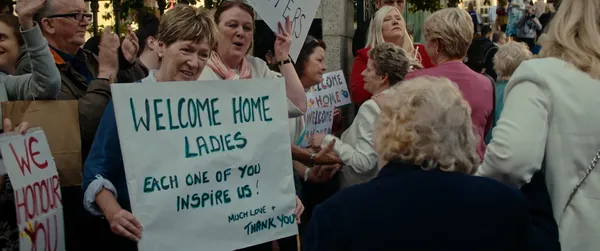
“I was astounded by know that shame and stigma still exists. You know, we've had these events like Dublin Honours Magdalenes, which is included in the film, where there's been this outpouring of empathy and this sense of a collective apology on the part of the Irish people and this celebration of the survivors. And yet there are women living alone in London, for example, who are still living shrouded in shame and trauma and grief and stigma. How awful is that?
“So since taking part in the film and since having her identity included, Madeleine has spoken publicly at Bessborough on one occasion when we were there. Also I know that she's spoken publicly on several other occasions since, and that it has been a very therapeutic experience for her, which is very reassuring for the team and for me as a filmmaker because, you know, there's always a sense that when you're asking people to talk about the darkest moments of their lives, that it's a huge responsibility, and you really don't want to be causing additional trauma to people who have been through so much.
“Madeleine said that it was very significant for her to be in a room telling her story, owning her story, and to have people respond with empathy and positivity – that she was being celebrated for all that she's been through. But also that people were collectively astounded by the extent of her suffering at the hands of the Irish state and Catholic Church. So, you know, I think that when you tell your story and there's a positive experience in the room, that can be very cathartic.”
It can also be tough on a documentary-maker to work with a subject like this, I note.
“I just felt really genuinely very privileged to be able to tell this story,” she says. “It took a long time to get the film funded and there were times where I felt it wasn't going to be made at all. So throughout the process, I just felt really motivated and really just genuinely very honoured that the film was going to be made, that these stories were going to be told and that I was going to be able to help with that process. That was very important for me and very powerful for me.
“I think that we haven't really been through this process of truth and reconciliation that other countries have. It has all been so piecemeal. It has all been very unsatisfactory, and yet, at the same time, there's been this ongoing sense of ‘Oh, well, we're doing something – you know, that the Irish state is doing something. We're dealing with this. We're talking about this. We've established commissions and we've written the reports and we've made the findings. So, you know, we're doing something, but none of it has been really satisfactory. The redress schemes haven't been satisfactory. The terms of reference for the commission of investigation wasn't satisfactory, you know?”
She’s also unimpressed by the way that the redress system has worked to date.
“You have these bizarre systems put in place whereby, for example, people who were only in those institutions for six months don't receive anything at all. The idea being that it's about the duration of time that you spent in these institutions as opposed to the fact that you were separated from your mother, you know? There have been so many failings, while also creating the perception that these things are being dealt with, that it's complicated to make a film in this area.”
I suggest that the balance of different testimonies in the film helps to put across the different ways that people were damaged by it.
“Yeah, that's true. And I mean, we have all of these examples of incidents where there was collusion between Church and state. We have women like Gabrielle, one of our subjects, who speaks about the fact that after she escaped from a Magdalene laundry in Seán McDermott street, she was escorted back by the police. Extraordinary collusion by the state in this issue – women who had committed no crime being returned by the state to these carceral institutions.
“We have stories like that of Elizabeth where she suffered physical abuse at the hands of her stepfather and as a result she was placed into industrial schools and Magdalene laundries. And again, she escaped and was escorted back by the ISPCC. So all of these stories combined to create this sense of a society that was theocratic, misogynistic and very cruel – and the extent to which Church and state conspired to really destroy these people's lives.
“These institutions have closed. I think there can be a sense now that Ireland is much more secular than as recently as the 1990s. We've had these extraordinary shifts within our society. We had referendums in relation to marriage equality, you know, and also in relation to abortion and reproductive rights. So it feels like we're a long way from all of these issues, and yet I meet people now in their thirties and forties who have been through these institutions. It's so recent. So I think that we haven't done all that we could to come to terms with our past. I hope that this film will help to emphasise that.
“I hope that we could be both an inspiration and a cautionary tale for any other countries who are experiencing these kind of issues and have been developing their own investigations or redress schemes, and to really learn from Ireland that the more comprehensive these investigations are and the more inclusive these redress schemes are and the more generous they are, really, the more cathartic the whole process is... You know, I think there's no sense from the Irish people as a whole that they want to be anything other than generous in their treatment of survivors. And yet there's always a sense from the state that everything must be limited.
“We saw the extent of the international interest in the story of Tuam, of the burial site. And yet, despite the fact that the Irish government knows that more children died in the mother and baby home at Bessborough, that there are more bodies that are unaccounted for, there's a focus on Tuam because that's where the media interest was.”
So after taking on such a huge subject and devoting so much of her life to it, where will she go from here as a filmmaker?
“I'm writing a book at the moment, which is a nice change,” she says. “I'm jointly writing a book with a member of the Irish police force who was a victim of domestic violence at the hands of her husband, who is also a member of the Irish police force. I'm interested in human rights and also areas in which the state has failed its citizens, really as well. I'm interested in challenging topics, but also in meaningful stories, and hopefully making a difference. So a little break from documentary, but you know, still very focused on human stories.”