 |
| Hellcat |
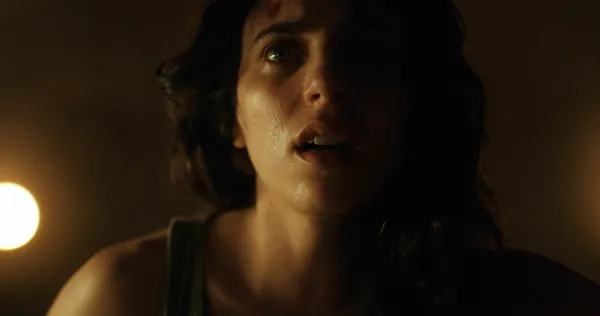
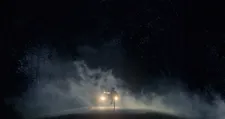
Actress and filmmaker Dakota Gorman takes on her first lead role in Brock Bodell's tense horror, Hellcat. Gorman plays Lena, a young woman who wakes up in a moving camper trailer. Clive (Todd Terry), the driver, tells her that he's trying to help her, and they are in a race against time — they only have one hour to reach the doctor who might be able to save her. As Lena begins to comprehend her new and horrifying reality, a tense battle of wills ignites between her and Clive. Can she trust him, or can she even trust herself?
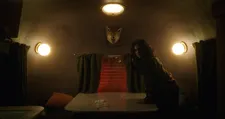
Hellcat is a captivating film that meticulously plays with the spatial. The inside of the camper trailer is a claustrophobic prison for Lena, but even as Bodell and cinematographer Andrew Duensing open up Hellcat's world, one claustrophobic space gives way to another. It's an unrelentingly oppressive vision that finds a way to be both a beautifully tragic and hopeful tale.
Gorman delivers a performance that leaves behind a part of her physical and emotional self. Ahead of Hellcat playing the Discovery Screen at Frightfest, Gorman and I sat down in a quiet corner of the West End to discuss her first leading role in a feature film. Previously, she has appeared in episodic dramas, short films, and pulled double duty both in front of and behind the camera in her directorial feature, the comedy drama Natural Disasters. Since then, she has directed The Girl In The Pool, about a man who must get through a surprise birthday party, while secretly preoccupied by the corpse of his mistress.
As our conversation unfolds, you can see the cogs turning in Gorman's mind. Her eyes are piercing, as though they're staring through you, into your soul. There are few people that have the presence to make you feel seen and heard, and Gorman has that gift in abundance. From the short time we're together, you can discern that she's interested in processes and alternative points of view that come from her contemplative nature. And as much as she's there to talk about Hellcat, she has a way of putting you at ease. She encourages a free-flowing exchange of ideas and is open to discussing her creative process and wider thoughts on storytelling and cinema.
The following has been edited for clarity.
Paul Risker: How would you describe your relationship to cinema?
Dakota Gorman: Taking out any inspirational moment, there's something I really connected with when I was growing up watching movies. I realised they can shape the way I see the world and what kind of person I want to become. Outside the storytelling or visuals, it was the power to influence and broaden my view. All the other elements are attached to this, but that's the underlying core of it.
PR: Sometimes you use other people's stories as a prism to express yourself, and in other moments, it's coming directly from your own imagination. Whether acting or writing and directing, these are all imaginative acts, but is there a juxtaposition between the personal and less personal?
 |
| Hellcat |
DG: Anyone in this industry loves variety. Being able to do those different roles, you not only have a different perspective on how you're approaching a particular project, but it activates different parts of your brain and creativity. And I love showing up to other people's stuff and asking, "What is the thing that I can hyper-focus on here?"
Playing Lena, that's what I'm focused on, whereas when I'm directing, I'm not focusing on the characters in that way. Instead, I trust that every other actor is doing that. So, it kind of reminds me of the introvert, extrovert thing, where sometimes I love being around people, and sometimes I love being alone. And that's how the personal and impersonal feel different.
PR: Is the director the introvert and the actor the extrovert?
DG: Absolutely! With directing and writing, you're inside your head. Your wheels are turning, and yes, you're taking in everything, but you're thinking about what the edit is going to look like; you're thinking about creating a story, and you're seeing something through from start to finish. And even when the edit is done, how you market it is its own story.
You have a lot more solitary time as a writer and director. You get to work in dark editing rooms, which is nice. You get to show up to work in your pyjamas and not shower, which is also nice. Whereas acting, you've got to be aware you're in the limelight, and the attention is on you, and you just have to lean into that.
It's sometimes hard to answer these questions because it's based on feeling and intuition — it's not something I actively think about.
PR: When you first read the script for Hellcat, what was the appeal?
DG: That's a hard question to answer without giving a spoiler, because when I first got the sides even, I just opened them to skim them, and I saw one specific word that made me so excited to throw down a tape for this. Then I got home, read through it, and there were other aspects that were challenging that I didn't anticipate. But I will say, broadly speaking, there was something fascinating about the sides where Lena is in the ultimate victim position. She's trapped; she's not in control of anything, and how fun it would be to not play into that victim mentality. And if I was in the audience watching this female character, or if I was ever kidnapped, that's who I'd want to be. That's how I'd want to take charge of my life. I'd want to be someone that I'm proud of, that doesn't just sit back and say, "Woe is me," or break down. Instead, I'd ask, "What can I do?"' And that's very indicative of this industry even. When things are challenging, and it feels out of your control, ask "Okay, what's my next move?"
PR: Hellcat's hero and villain dynamic is interesting because it's constantly shifting. It challenges our perspective to create feelings of paranoia and suspicion, as well as doubt that we've read the characters correctly.
DG: Absolutely, and I love films like that. Shows like Succession did a really good job of endearing us to someone who then does something so shitty, you respond: "No, I love you so much." I think that distrust keeps us on our toes, but it's not just about what's good and bad because I don't think anyone in the film is in only one of those lanes. We all cross those boundaries, and we can all do unlikable things but still be good people, and vice versa. And what I like about Lena and Clive is that is blurred, and it changes shape based on context. It's so easy to build up assumptions in Hellcat and then see a shift once the relationship forms, and you learn about their backstories.
PR: Speaking with director Eric Owen about In A Cold Vein, he said, "Anytime a film has any sort of discussion or debate about a character, it makes for interesting cinema and storytelling." To my mind, it's about activating the audience and creating a space for them to enter the film to reckon with the thoughts and feelings the film compels.
DG: And build expectations and break them. I think that's life and that's relatable. We are constantly disappointed by people we love and choose to forgive, and that's no different in film. It activates those internal experiences and past histories we have in our own respective lives.
PR: Part of the joy of cinema is the way a story can immerse us in its drama, without us even realising that it's happening.
DG: It goes back to your first question about my relationship to cinema, and that's the fascinating thing. It's not only the power of influence, but how I'm emotionally affected. My body is taking this in and that can live with you the way a memory lives with you throughout your life. There's something fascinating about that to me, and I don't have the weight of the words to articulate it.
PR: I recall a quote that said by explaining why you love a piece of music, you undermine the experience because it's something you feel. So often we seek to explain how a film made us think and feel, but sometimes it's better to be content to sit with whatever feeling a film stirs inside of us.
DG: This whole thing is based off feeling. It's based off our emotions and how they affect the way we think. I know we're not talking about the inspirational moment, but quite honestly, I don't have an inspirational moment. I come from a family that's very embedded in the arts, and I remember sitting with my grandma. She would play silent films, and she'd say, "Tell me the story that's happening." And that is so tied into how my brain formed. She said, "When you were a baby, before you could even speak, you would take photographs and spread them out and align them in certain ways." That was so cool, but I didn't know what I was doing. I gravitate towards the cinema, and I don't have a reason why. I just know I light up when I'm around it.
PR: Often, we are guided by our instincts, and I think this is especially true when it comes to any mode of creative expression. The contradiction, however, is that we will watch a film from the point of view that everything is a deliberate choice.
DG: There is something so intriguing about that because how I started out directing was having this feeling where I can't explain why, but I know this feels wrong. And then you realise: 'No, it's right.' And, of course, that's tethered to your taste, but there is something deeper to that.
Times in my life I thought because I can't articulate something does not mean that I'm bad at it, or I'm not as well-versed. And then I watched a documentary that featured William Friedkin, who directed The Exorcist. He was saying everything I was feeling, and I thought, 'If he's saying it, then I'm on the right path.'
PR: Playing Lena, were you able to draw on your experiences as a director, and familiarity with the cinematographer's process?
DG: Well, I honestly tried to extract a lot of my director's brain from it, only because this was a situation where Lena has so little control — with the director's brain, you're controlling everything. It wasn't my job to direct this, but I trusted Andy and Brock so much, not only because I respect them as people, but because of the kind of music they listen to and movies they love. I know whatever decisions they make; I'm in good hands.
What it did help with contextually, was you see how much you don't know on the directing or writing side. You can't write in every character description on a script page — it just takes up too much space, and you can only envision so much when you're visualising the story. It's really the actor's job to realise I can take a leap here.
There were a couple of things we were all talking about, and I asked, "How far are we going with this?" We pushed the limits and because we like it, we said, "Let's run further with it." And that's something that I gave myself permission to explore, because those behind the camera don't have all the answers.
PR: I remember talking to Pablo Larraín who said he finds the film in the final cut. Then there's the idea that you make the film three times: once when writing the screenplay, then on the shoot and finally in the edit.
Filmmaking is supposed to be a journey of discovery where you don't have the answers. The final destination might not be where you intended to end up, but you have to embrace the journey, give up some control and let the happy accidents and good fortune guide you.
DG: That's a huge thing with the acting in this film. My acting coach, Margie Haber, is big on the mantra, "Every mistake is a gift." When you fuck up, that's the best thing that can happen, because it either snaps you into being more present or it creates a life or mannerisms — something that you weren't in control of. And that is the backbone of this film — how we deal with things we're not in control of, not only externally, but internally. This was another fun thing on the acting front, because the camera was so intimate, and we were moving so quickly.
I had very little idea of what the footage actually looked like. They'd say, "Here are your limits", but I had no idea what it looked like. I only knew how close they were. And so many times, when you're in mediums or wides, it's about the movement — it's all internal thought. And it was really fun to be able to play with Lena in that way where it's like, 'What's in this cabinet? If I open it, is it gonna make a noise?' I just let myself focus on that, which is what helped me ground her.
 |
| Hellcat |
PR: To delve a bit deeper here, do you utilise the camera as a tool in your performance?
DG: It mostly circles back to knowing we were so intimate, proximity-wise. It allowed me to explore that journey in a different way. In a lot of horror, especially things that start with a woman being kidnapped, there's frantic energy, and we're all over the place. In Hellcat, there was a stillness.
I never really played to the camera other than directing my energy in that general direction. I wanted to specific inside my mind and trust that the camera is catching whatever thoughts I'm having. And even if you don't know what I'm thinking, the camera is still catching it. And I knew Andy would have told me if something wasn't going right. So, it's something I didn't have to think about.
PR: Speaking with filmmaker and actress Pollyanna McIntosh, she told me it can be the tiniest detail that allows an actor to unlock a character. Would you agree with this sentiment, and what was the key to unlocking Lena?
DG: I definitely agree with the sentiment, but it's just hard for me to pinpoint a thing that unlocked it because it was almost like harvesting different pieces. I'd find one thing that felt like it fitted, and then I'd find this other thing. When I put those two things together, they came to mean something else.
I spent a lot of time journaling as Lena, and that gave me a perspective into why she feels the way she feels outside and inside the trailer. And why she was where she was when she was kidnapped. It was about all the things in her life outside that trailer, because our relationship to those things dictates how we deal with the new elements in our life. What are you fighting for? What's your weak point? And it's an endless well of why? And it was just so fun to go down that rabbit hole.
PR: Hellcat's writer and director, Brock Bodell, doesn't expose his characters. Instead, he allows them to reveal themselves. Come the end of the film, there are still layers of the characters to explore, which echoes Billy Wilder's sentiment that the audience continues the film after it has ended.
DG: We're coming into the film at the start of a journey with two characters. However, their respective life journeys we come in at the middle or end of, and it's nice to have that balance. I'm glad that Brock didn't lean too much into their emotional Achilles heels, because they've had time to heal from that. That's not at the forefront of what's going on. But again, it's that context of why they are where they are, and we don't need to indulge in that. And that's life.
If I'm talking to you about my trauma, I'm not going to ask you to let me walk you through every detail. It's in the past, and it comes up, but then it goes away. And that's the heartbeat of the film. He let that be internalised and not, "Let me tell you everything."
PR: There's the idea that all art is political. While Hellcat isn't trying to be directly political, given the current climate and its emphasis on scrutinising our sources of information and how media consumption influences our choices, there is a political edge to its story.
DG: It has been fascinating hearing the conversation around that. And I don't know if that's something that gets threaded in, because those are things we're experiencing and that's how it comes through. I'm so glad it did, because that is a huge reason art exists. But even reading the initial script, there are themes of femininity in there that I didn't pick up on until well into the shooting. It wasn't part of my character creation, but it became part of the driving force day to day once it had a certain context.
PR: Could we describe Hellcat as Lena's hero's journey, in the context of confronting and overcoming experiences and memories?
DG: It's a hero's journey in the sense of transforming into a stronger version of ourselves from a weaker point. I always saw the arc of Lena's character as feeling a certain way about life because of unfortunate circumstances that have happened. And her response to that is that she feels disconnected from her identity. And identity was a big topic of conversation between Andy, Brock and me.
For me, Lena has her whole life that was built on this one element that is suddenly gone. It's about who you are after that? And it's that decision that I can't emotionally disassociate because that's not living, and I'm not ready to die. How do I accept that I am in pain and move through it to then come out the other side? In the beginning, it's a place of angst and anger, and at the end, it's a place of empowerment. And that, to me, is heroic. I think we go through cycles of that continuously throughout our lives.
PR: Is filmmaking a transformative experience? And is the fun of acting the opportunity to lose yourself in your imagination and try on these different masks?
DG: Absolutely, and this particular experience was so cathartic for me, and I wasn't anticipating that going into it. And it helped me empower myself as a person in a lot of ways, because I almost felt like I was able to release the restraints I imposed on myself. It just gave me a different perspective by being able to step inside of someone who's so physically driven. I thought, 'Oh, that's what that feels like.' I'm not walking around in my day-to-day life being like: 'Let me see what it's like to feel like this today.' But you do it on set.
And how could you not walk away feeling different when you have an experience that's unlike anything you experience in your everyday life?
Hellcat screened at the 2025 edition of London FrightFest.