 |
| In A Cold Vein |
Filmmaker Eric Owen's first two features suggest an inherent interest in characters embroiled in violent situations.
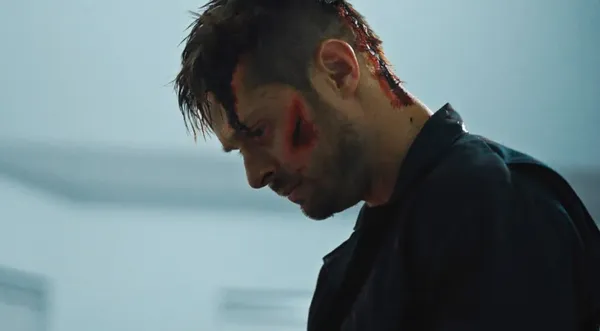
The small-town-set thriller, Thirst, saw a couple escape to an abandoned ranch where they are besieged by villainous characters that claim the land as their own. His sophomore revenge and noir thriller, In A Cold Vein, follows professional criminal Dean (Evan Gamble), who goes on a violent hunt for those behind a botched attempt on his life.
In conversation with Eye For Film, Owen who is one-half of the rock duo Black Pistol Fire, discussed telling a story without a traditional hero, and provoking conversation. He also reflected on the influences behind his sophomore feature, learning by doing, and strokes of luck.
Paul Risker: How do you compare and contrast the experience of trying to make your feature début versus this, your sophomore film?
Eric Owen: I would say this one was way more difficult in that on Thirst, I actually had a lot more time — four or five more production days, which adds up. With this one too, there were so many scheduling conflicts between actors and crew, and the fact that we were shooting almost entirely at night really made it extra difficult. But I would say, having done Thirst, the things I learned while shooting that made this easier from a creative and sometimes a production standpoint. I kind of knew what we could cut out, or we wouldn't or that we'd do a certain type of coverage instead or a really good zoom in two shots.
Thirst was my film school and it's how I learned the craft. So, again, in a lot of ways, this was way more difficult, but easier. It was more difficult from a time standpoint, but then it was also easier because I knew some of the challenges that we'd be presented with, and I had some idea of how to solve them.
PR: What was the genesis of the idea for this story?
EO: Someone asked me whether I set out to write a crime thriller? I didn't, but I do love crime and revenge thrillers.
The way I write is, I basically have an idea that will sit with me for either a couple of weeks or a month and kind of move around. It's not based on a theme or a genre, and it's just one idea. Then, one day, I'll just get out a yellow legal pad and just start writing.
The idea was the very first shot of the film where we're zoomed in on a character, and we pull out as they're waking up. And the audience realise at the same time as the character that they're waking up in the back of a van, bound and gagged. I thought, 'Oh, that's an interesting way to start a movie.' Where does it go from there? Why is he bound? Maybe he has been kidnapped because these two guys are trying to kill him. Then, it just morphed from there as I built the world.
One thing I'd thought about before that I wanted to incorporate into a movie was the idea of creating a world where everyone is a villain. Obviously, Dean, our protagonist, is someone that we're rooting for, but he's done some bad things — he clearly knows how to kill people. But that's how it all came about, and I just built it out from there.
PR: There's a tradition in storytelling of the need for sympathetic characters. However, some of cinema's most captivating characters have been the unsympathetic kind. Should the priority be interesting rather than sympathetic characters?
EO: Interest and conflict because it's not black and white. There are a lot of good people, but human beings are flawed. It can be a very small flaw, but people make mistakes. Henry Hill in Goodfellas is the protagonist who we're rooting for, and he's killed multiple people — he has done some terrible things. So, it's good to create someone that's interesting that you want to root for in that you want to see what they'll do next.
I think Dean has some sympathy, in that we see how much he clearly loves his son, and that's an emotional bond that a lot of people can relate to. That really helps the audience empathise with him and helps justify all the things he's gonna do because it's all about his love for his son. And regardless of his faults, he is clearly someone that has been wronged.
PR: There comes a point in the story when the audience has to make moral choices in how they read the film. They are, of course, entitled to push back against what you, the filmmaker, are communicating. All of this equates to giving up control.
EO: Absolutely, and that's an interesting way to do it without spoon-feeding the audience, and telling them, "Hey, this is how you should feel." Anytime a film has any sort of discussion or debate about a character, it makes for interesting cinema and storytelling.
PR: Aside from the films you've mentioned, were there any other films you drew inspiration from?
EO: Two very different ones for very different reasons. Tonally, Barbarian was a big influence, and I actually still like to pitch this as a reverse Barbarian from just a tonal standpoint. The first half of my film is dark and intense, and there are a lot of comedic moments that help ease us into what ultimately is a pretty grim second half, whereas Barbarian is the opposite. It's a very grim, intense first half, then Justin Long pops up, and it's funny, and it lets the audience catch their breath for a second and enjoy themselves. I definitely wanted this to be intense but also entertaining at times.
From more of a performance standpoint, Training Day, and I actually told a lot of the actors to watch this movie. Certain characters had a bit of Denzel's cockiness and I wanted a bit of that mixed with Ethan Hawke's desperation, like when he's in the bathtub and those guys are gonna kill him. I told Evan especially to watch that scene because that was the kind of desperation we wanted. We don't want you to die, but you're just trying to figure out ways for that to not happen. So, those are two immediate references that I like to cite for very different reasons.
PR: The opening scenes begin trying to capture that feeling of desperation that you're talking about.
EO: I just wanted us to be straight into it. There's no build-up; we're just in this intense moment that's gonna last longer than a lot of people think it would. So, from frame one, I wanted it to be pounding.
PR: There's an interesting use of an unbroken wide shot in this sequence that effectively heightens the suspense.
EO: That helps the audience to, if only for a split second, turn their minds off, so that it's not like you're watching the movie, but you're actually in the bushes watching this thing happen.
PR: You're essentially playing around with a voyeuristic technique.
EO: Totally, and it also helps the performance to stand out more at that point. And it's very dependent on the performance hitting the tones and emotions that it should.
I love that shot, too. I just lucked out with the timing of the night, finding that location and everything else. It was such a hard movie to make, but everything just happened to line up and work out how it ultimately should have.
PR: In the opening scenes, the gang are told they haven't passed the point of no return, and they're warned about who they'll be answerable to. This moment reminds me of the sentiment that no matter how tough or bad you think you are, there's someone worse out there. This encapsulates the core of In A Cold Vein.
EO: No matter who you are, there's always someone you have to answer to. So, yeah, there's someone meaner, there's someone tougher, there's someone more powerful than you and that's definitely a big part of it.
In A Cold Vein had its world première at the 2025 edition of London FrightFest.