





|
|
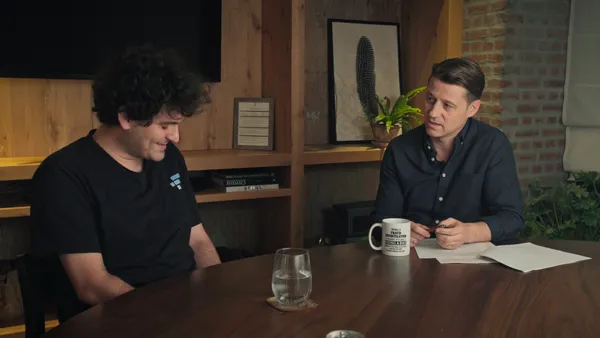
Sam Bankman-Fried and Ben McKenzie in Everyone Is Lying To You For Money
Photo: courtesy of The Forge
|
Meeting Ben McKenzie to discuss his awards-tipped documentary Everyone Is Lying To You For Money, I feel obliged to confess that I have never seen The O.C., the series that made him a star and to which people are constantly referring in the film. I have seen him in Gotham and in Motor City, playing the fictional cops which he sees as his comfort zone. In the documentary, he ostensibly appears as himself, but being an interviewer myself, I noticed something else there, a certain hapless, amiable quality that puts people off their guard. Was there a bit of acting going on there too?
“Yeah,” he says. “I think I was definitely playing a part when I was trying to elicit a certain response from a prominent member of the crypto industry who was engaged in questionable behaviour, whether it was Sam Bankman-Fried or Alex Mashinsky, the guy that was running Celsius,” he says. “It's a gift to be an actor. I mean, first of all, you have a skill set where you can pretend quite easily to be the naive showbiz kid stumbling into crypto, but also, you know, the expectations are low. I think it's a real gift, to be underestimated.

|
|
Ben McKenzie
Photo: courtesy of The Forge
|
“Obviously I've spent a lot of time talking to media, so I'm familiar with the basic parameters of interviews. This is a different kind of interview that I was doing, a more investigatory interview, but a lot of the dynamics are the same. You know, you're trying to set your subject at ease so they'll talk to you, and you have a back and forth so that they can get beyond the talking points that they're used to regurgitating. I was trying to both be very friendly to Sam, for example, but also to have my fraud mug there so that he was thrown off at the same time and didn't go quite which direction to go in. It was a lot of fun to prepare for these and to imagine what it's like on the other side.”
What those on the other side clearly don’t realise is that he has a degree in economics. Did he ever think about a career in that area?
“The thing that was holding me back with economics is I'm not that good at math. I’m just okay, and that's hard if you want to get into the profession of economics generally – or at least that was my perception back then, so I never pursued it after graduating from college. But I did always love behavioural economics, how people make decisions, and was always interested in that. The stories that we tell ourselves and each other about this thing that we made up called ‘money’ in this other thing we made up called ‘the economy’, living under this other thing that we made up called ‘the government’. I mean, all of these are collective fictions, and they're all predicated on trust. I was always interested in those concepts.
“Crypto is wonderful because it was challenging all of those things. It was saying ‘You don't need to trust each other. You can just trust the computer code. You shouldn't trust the government. You should only trust what you can control, and this is this amazing thing called cryptocurrency, that you will be in control of.’ I was fascinated by that line of thinking and who believed and what were their motivations. Spoiler alert: a lot of guys.”
There are lots of people out there who struggle even with the concept of money being a fictional thing, I note. So where does one begin with a lay audience? How did he work out how to explain those things?
“I started in the movie with pretending to be in Mesopotamia and tricking the audience into understanding that this trust is very fragile, that I've led you to believe that we're in Mesopotamia, where money began, and yet I'm not. I'm lying to you. This trust can be shattered quite easily. It is hard to explain concepts like money. I remember sitting in Econ 101 and reading ‘Money is not real. We made it up,’ and my head kind of exploded, because it was both obviously true and yet seems to be so significant that it immediately made me see fragilities everywhere. Stuff could fall down very quickly if enough of us no longer believed in it. I think crypto is the sort of most extreme version of that lie, that you could have this private form of money and that you could trust computer code and not people. So it was quite a journey to watch that lie fall apart in real time, in 2022, when crypto last crashed.”
Is it because it's positioned as something alternative that people find cryptocurrency so appealing? They feel they can't trust the old authorities, therefore these new people must be telling them the truth.
“Absolutely. I mean, it's a time honoured con man tactic, is to point to somebody else and say ‘Oh, you hate that guy, right? That guy's terrible.’ Meanwhile, they're picking your pocket. I think crypto really does appeal to guys who are struggling to get ahead, whether they be young and ambitious or even quite seasoned but sceptical of the government and inclined to a certain libertarian viewpoint on life. You know, we make so many compromises in life and society. I think there's a lot of frustration with that that guys have. And so this lie that you could have your own form of money that was private to you and couldn't be taken away by the government and also, you know, makes you a bit of a rebel against the system, that's a very compelling pitch for a lot of guys.”
The film feels very organic in the way it's edited together. It feels as though he’s wandering around, discovering things as he goes. Is there any truth to that, or was it something that he structured carefully from the start?
|
|
Ben McKenzie in Everyone Is Lying To You For Money
Photo: courtesy of The Forge
|
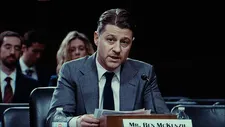
“It wasn't constructed carefully from the start and it wasn't easy to pull off,” he says. “I just turned a camera on. I documented a bunch of stuff in 2022 and some things in ’23, and then I turned to making all that footage into a movie in ‘23, ‘24. And it was hard. It was hard because they were different pieces. There was interviewing these two guys who are now in jail, going to El Salvador, testifying to the Senate, but not a narrative thread to tie them all together. And so that's where it was ultimately quite enjoyable to kind of realise ‘Oh, I can do anything I want. My wife's a great actress. I can just put her in a scene where she says the thing that we need to move the story forward, whatever beat we need.’ I thought ‘Oh, this will be easy.’
“It wasn't. It was very hard. But that's why you hire great people, particularly great editors, is to make it look easy, to trick the audience into thinking in a way you can trust. Literally, even though I'm lying to you at the top, like, you can trust me that I'm going to tell you a fun story here and I'm going to also keep it tight. I'm very proud of the fact the movie's 90 minutes. I saw You Can See Everything yesterday and I liked it, but it was really long.”
I tell him that I saw the Musk movie the other day and it's four hours long. He expresses his sympathies.
Were there any major pieces that you filmed but had to leave out in the end?
“Oh, God, yeah, tons. I didn't really get a chance to talk about the kind of other criminal activity in crypto. I was really focusing on the retail investors and the frauds because that was the most salient and the thing that I think the public could grasp. It also was quite emotionally moving to talk to victims of these frauds and to hear their stories because they're often not really amplified by truth social media. The crypto industry doesn't want to talk about the guys that have lost money. They want to talk about the guys with Lamborghinis who are, I'm sure, making their crypto honestly.
“I had to leave out the other criminal activity, how these global criminal cartels use crypto, so more of that is in the book. But, you know, under the right circumstances, there's plenty of material for a sequel down the road, as we kind of enter this new era of crypto being sold everywhere, you know, by the President of the United States. All these rules and regulations being ripped up in America. It'll be really interesting to see, with the changing of the guard here, what happens there, but it wouldn't surprise me if there was another crash on the other side and there was a lot of stuff the public would be shocked to find out.
Cryptocurrency is very smoothly marketed. In making a film like this, he has to sell his story as a counter story to that. How did he go about that and make sure that he could actually engage people? A lot of people are really quite afraid of anything that seems too close to maths.
“Yeah, humour was really our godsend, was the way were able to demystify the industry, because as you said, it is very slippery marketing. There's a lot of technobabble that's thrown around that I think really is intended to confuse people and to make them kind of go ‘Oh, you know,’ kind of nod along in feigned comprehension, but actually going ‘What is this? It's a non fungible token. What does that mean?’ It has this self-selecting aspect to it.
“One of the tricks of crypto is to convince you that the only way you're going to be able to understand this kind of impenetrable technobabble is if you're smart enough, and if you're not smart enough, then I guess it's not for you. And so people that select into it are convinced that they're very bright and they understand this brilliant technology that the rest of us don't. And it takes on aspects of a cult, it really does, because you're outside of the normal rational investing, if you want to call it that, and you're into these sort of self reinforcing dynamics of people being convinced over and over again to put more and more money in this thing that they largely don't understand.”
We talk about cryptocurrency and the film industry.
“I don't know how tied it is. I mean, I know that the crypto industry splashed around a lot of money with advertising, obviously, and they've produced their own documentaries. They're quite positive towards crypto, I'm sure. Shocking. But I don't know if they've really made inroads into the film industry itself. There's a movie about bitcoin coming out that Doug Liman directed. I'm curious to see that, but I don't know if the industry was actually involved in it.
|
|
Ben McKenzie in Everyone Is Lying To You For Money
Photo: courtesy of The Forge
|
“Showbiz has to interpret the events of real life and turn them into a digestible narrative for the public. I think it struggles with crypto because the dynamic for a long time was ‘Oh, it's magical, it's wonderful.’ I've seen many documentaries that are pro crypto in the past. Well intentioned, you know, people that really believed in it – but now the picture has gotten murkier. There's so much obvious fraud and criminal activity and people have lost money, so Hollywood doesn't quite know what to do with the crypto story anymore. It doesn't fit into a neat narrative.”
There is a section in the documentary where he’s told that cryptocurrency can be useful in some countries where people don't have access to regular banking.
“Yeah, yeah,” he says. “I think that story is really easy to sell to Westerners because we haven't gone to those countries and experienced firsthand what those people are dealing with. But then of course, I do when I go to El Salvador, try to pay for things with bitcoin and no one will take it. They look at me like I'm crazy. And so I think both things can be true in the sense that there are people all over the world who are struggling and would benefit from being brought into the financial system so that they can have participation in it, but also the story that crypto is doing it in any way that benefits them is a lie. If anything it's exploiting them, manipulating them, but you would only be able to see that if you actually went there, and the industry knows most people are not going to do that. So it exists as a sort of fiction for Westerners with the reality on the ground is something else.”
When he was at the conferences and meeting people who were selling various crypto schemes, were they trying to get him on board as an actor?
“You know, kind of, sort of.” He shrugs. “I mean, I think they were sort of feeling me out. I never got approached. Well, actually I did with blockchain-related projects and people trying to convince me that no, this blockchain project is different from the others. I've never paid much attention to those. I've never gone down the road with any of them at all because I genuinely don't believe anything they're saying. Even if they believe it, which is fine. You know, people believe all sorts of different things. But everything that I have seen, everything that I studied in school, leads me to believe that this cryptocurrency stuff is really toxic, and if history is any guide, you're much more likely to lose money with these switching schemes than you aren't.”
The other thing that comes through strongly in the film is how unpleasant some people are once one starts being seen as somebody who is against crypto. Has that been something that's been ongoing for him?
“It has. But in the movie, I point out that negative because I do think it's worth dwelling on just how artificial the whole thing is. These are synonymous accounts tweeting out the same thing over and over again. All of these accounts tweeting the exact same thing. Pretty clearly bots of some kind, but what I didn't fit into the narrative was what I've experienced online in a positive way, which is hundreds of thousands of people liking what I'm doing and saying nice things about the movie.
“I'm no longer on X which is great – I mean, my account is there but I can't access it and I'm very grateful, but my experience on the other social platforms is actually quite positive and reaffirming that the majority of the public is actually on my side. They just don't quite know why they don't trust crypto. They can't necessarily articulate it, but I made the movie to say ‘Trust your gut,’ you know? You can rest assured you were right, and take some comfort in that.”