




|
|
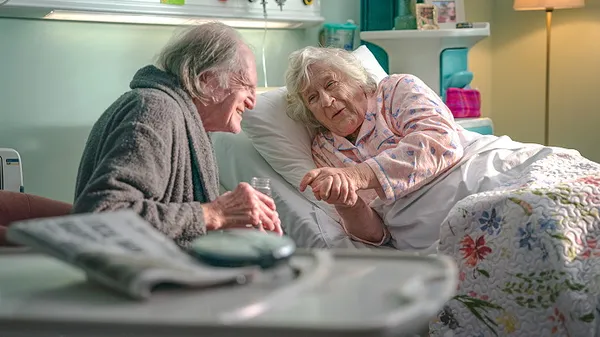
David Bradley and Maggie Steed in Life Goes On
|
Lying in a hospice bed during his final days, Bill (David Bradley) is profoundly irritated by everything around him, not least the people who are trying to cheer him up, and it only gets worse when he finds himself “stuck in one of those time loop thingies.” This is Oscar-qualifying short Life Goes On, and it’s based on real experiences. When I met with Kat Butterfield and he co-writer/co-director Daniel Audritt, she explained why the setting was a familiar one for her.
“I used to work in a hospice in Lancashire. I was in the fundraising team and there's a character in the film that takes pictures of people for a newsletter. That was little part of my job in the fundraising team. I always felt a bit awkward asking for pictures, so it was partly me wondering what the patient on the other side of that thought about me asking for a picture. And then also just generally being in a hospice and seeing what it's actually like there compared to what people perceive a hospice to be.
“They think it's this horrible, miserable doom and gloom place. From my experience, it was very warm and loving. There's so much joy in a hospice actually, and so I always kind of was annoyed that whenever you saw them on camera they were depicted so negatively. I did want to challenge that perception, as well as setting a comedy in a hospice, because I felt like there is a lot of comedy to be had in dark moments in life. And I felt that it was a good area, despite it being kind of a taboo and no one wants to talk about death and end of life. That's almost why I wanted to tackle it as well, because it felt like a challenge and it felt like a way to make a topic more accessible to people, if you were able to add lightness to it.”
“Absolutely,” says Daniel. “I thought it was quite an audacious idea. We were talking about trying to do a life affirming comedy set around death, which felt like a fun challenge to try and write. But one thing we have found from the responses that we get – we always get loads of messages from people, which is really nice. Whenever it's screaming somewhere we can't be, we wake up the next day to at least a message or two, which is really nice. It's people basically saying that essentially, without humour they wouldn't have got through it with their loved ones, that their loved ones ended up getting this really dark sense of humour towards the end, which is something we can relate to in our experiences.
“I think humour allows us, as humans, a way to get through things. If we just wallow in the sadness of everything, like, that's just not our way of doing things. I think some kind of dark sense of humour kicks in with all of us, and we wanted to find the light and the joy and the heart in this place that's known for being the opposite of those things.”
I like the time loop idea, I tell them, because for many people in situations like Bill’s, the world gets smaller before actual death comes along. Days often become very similar.
“Yeah, I think so,” says Kat. “We have even a line from Lizzie who says, when he says he's in a time loop, she says, ‘Oh, I know this place can feel like that. It's not that bad really.’ And I can imagine as a patient, you do feel like all the days blend into one and you're seeing the same sights over and over again.”
“It heightens that feeling,” says Daniel.
“Yeah, the feeling of it. But also the idea of having second chances to do things that you wouldn't have done before, say things you haven't said before and all of that. It gave us a really good structure to be able to show what it feels like for him because we're always trying to be from his perspective. We use the camera as well to show how he's feeling at all times.”
“It gets kind of intrusive with the camera because we’re feeling how confused and scared he's feeling,” Daniel adds. “We always wanted to have that sense of like you weren't 100% sure if this is actually happening or if it's his end-of-life hallucination. You don't really know if it's real or not, because that's how it must feel to him.”
“And if people ask, we just go ‘That's completely your decision,’” says Kat.
“Yeah,” he nods.
“The time loop idea is just something that we found very interesting at first,” she continues. “Then the more we explored the idea by talking about it, the more we realised it was a way to talk about these things as well. Because sometimes as well, in some illnesses, you have this kind of prolonged goodbye feeling.”
“As a family member as well,” says Daniel. “So from the daughter's perspective, you could say that it's what she's feeling as well. She's feeling like it's a prolonged goodbye. It's that sense of being alive and dying at the same time and we wanted to have it feel like that from both sides.”
We talk about the various people who visit the ward to try to entertain the patients, and Kat notes that they heightened these things to convey Bill’s perception of them.
“We worked with a composer for the first time on this film,” says Kat. “The first time for us and first time working with him [JérémyVelez]. He's a fantastic composer, but what was really interesting with him is in our first chat with him. He said back in France he used to do that job, so he really related to this idea of just having to sit there and play to an audience that, like, half of them really want you there and half of them absolutely don't.”
In showing us all these little incidents that we see repeated, did they have multiple cameras for each scene and just reuse bits of footage, or did they recreate and restage all the time? It was the latter, says Kat.
“Every camera shot is very specific,” Daniel explains. “We have done shoots before where we've shot with multiple cameras. It can be really helpful from a time point of view, and also if you're capturing lots of, say, improvisation and stuff like that, it's a really handy tool. People like Judd Apatow do it a lot, and we've certainly done that our fair share of that before. With this, the script and performance were doing a lot of the work, but the camera was so specific because, as Kat mentioned, every day of the time loop is the same but different, every time. When we first wrote the script, we thought we would be able to reuse stuff, and we thought it was a really clever idea. It ended up being incredibly complicated.
“We literally don't repeat a single shot. Everything is done slightly differently, every single time. So it's kind of interesting for lots of the actors. They'd have to do exactly the same thing, and everything around them would feel exactly the same. We would change a lens. We'd make them do it down the lens instead off off to the side, make it handheld one time. They just basically had to trust us that there was some grand vision to all of this, that it would all really make sense once it was cut together.”
David was brilliant at handling this, Kat says.
Daniel agrees. “You know there's the famous phrase ‘acting is reacting, ‘ but with David, everybody else is doing exactly the same thing. So he's not reacting because he has to drive the change every time. As far as everyone else is concerned, it's exactly the same thing. He was fantastic. We’d just change his motivation slightly every time. It was a lot for him. You know, you work with fantastic actors, but when you're working with someone that fantastic, you really see where they got to the level they did.”
How did they get him on board in the first place?
“Well, were very fortunate. We’ve written a few feature films in our time, and one of them, which we still intend to make, we wrote a part in it for David and we sent it to him. He was gracious enough to attach himself, which was great. So we've always wanted to work with him. This film's funded because we pulled together two inheritances.”
“The first thing we thought when we got that money was we knew we wanted to make a film with it,” says Kat. “We made a lot of, like, branded content and sketch comedy things, and we wanted to make something more meaningful and more emotional and more like us that was very much our voice and we said the things that we want to say and put all of our hearts into. So this was the story we wanted to tell, and we wanted to tell it with David. So we wrote it for him, very specifically with him in mind.”
“We sent it to him on the Monday, and by Tuesday, he had signed on,” says Daniel, smiling. “It was that quick.”
“I think he said ‘The script hit me right between the eyes, which is the reason I needed to say yes,’” Kat remembers. “And then he said, ‘I've got an idea for who could play the Lizzie role: Maggie Steed.’”
“Actually, in that script we sent him, we didn't even know they were friends, but we wrote a part for Maggie Steed,” says Daniel. “We've been fans of hers for just as long. So when he said ‘Oh, I sent this to Maggie,’ we thought we lucked out because, you know, we would have loved her to play this role, but because we had no connection to her, I don't know if we would have even had the guts to send it to her. And what was lovely, actually, we had a screening last night where Maggie saw it for the first time and it was so nice.”
“It was amazing,” Kat agrees. “Yeah, she really loved it. She was crying and then we got her up on stage and we got that reaction in front of everyone of her having seen it for the first time and she said such lovely things about it. It was really special.”
Daniel laughs. “Kat made a joke last night, which is completely true, that we know she liked it, because – if you met Maggie, you would know – she would tell you if she didn't. So that was really special. And then, yeah, once we had David and Maggie, it was relatively easy to cast the rest, if I'm being honest, because everybody wants to share the screen with those two. Some people were really new people that we cast and then we got very lucky and ended up getting Matt Berry to do almost a glorified cameo.”
“We promised him we'd have him in and out in an hour,” says Kat, “and we did. Yeah, we got him because we made things for Movember, the charity, for the last five years. And we got asked to do one and it was only 10 days before the shoot. We did say to them ‘We're too busy. We're in pre production. We're the production team.’ But they said ‘It's got Matt Berry involved,’ and then we just said ‘Okay, we'll make time for it,’ because we're such big fans of his, we'd never met him before, and we. We said to each other, ‘Let's ask him to be in our film.’ And it coincided with an actor that was meant to do that role that dropped out, couldn't do it anymore. And he said yes. And we couldn't believe our luck. He liked the script. He liked the idea of working with David.”
“Matt was an incredibly nice guy and very generous, but you wonder if it would have been such a good sell to say ‘Would you like to be in our short film?’ if it didn't have the words ‘David Bradley’,” says Daniel.
We talk about their history of charity-focused filmmaking which, Kat explains, began with Comic Relief.
“That's where we met, in fact,” says Daniel. “Kat has a background, as she said, in hospice care and in the charity sector, in PR and marketing. My background is purely in film and TV, just the making of stuff. I was making lots and lots of YouTube sketches for no money and they were being seen by absolutely nobody, apart from, it turns out, a producer at Comic Relief who then hired me to basically make comedy sketches at Comic Relief.
“We were both at the same film school but didn't know each other, and then my boss said, ‘You know, Kat would love to be involved with this.’ We started working together, and we've worked together ever since. From that first sketch, we became an official partnership. It just worked really well. We love comedy. We love making people laugh. It's the best that if you can make people laugh about something important or something that's got a little bit more depth to it, rather than, you know, I love films like Airplane and Naked Gun and stuff like that – they're really funny – but they're very much just jokes.
“ I feel like where our sensibilities lie is we love trying to make humour out of other situations you wouldn't really laugh at, or just things that feel really big in life. Anxieties you have or fears you have and things like that. If you can find humour in that, I think it's for real. When I've seen other people do that, I find it a real skill, and that's what we try.”
But have they ever been in a position before where they've been in BAFTA and Oscar territory, coming from this background?
“Absolutely not,” he says.
How does that feel?
“I mean, yeah, like...” Kat trails off. “Our background is comedy sketches.”
“Mainly online sketches,” says Daniel.
She nods. “Online stuff. Like, we've had a few viral hits and stuff, but you don't get to hear the response from people like we are now when we're going to festivals, seeing people, and the audience afterwards telling us their response and being moved. And when you're doing an online sketch, you don't get any of that reaction. You just read a few comments.”
“When you get a view count or something, at the time it’s really fun, but it's not quite the same,” Daniel observes. “And to be honest, we made this short because we wanted to make the best thing we felt we could make, but we had no real frame of reference. What the landscape was like, the short films, you know – and where we would sit in that landscape. I think the first time we realised we had something, you know, good, because we literally had no idea. We sent it some friends and we specifically asked all of our friends to be as brutal as they could.
“We didn't know what we had at all. And then we sent a work in progress to the Dallas International Film Festival, which is an Oscar-qualifying film festival. It was a work in progress. It didn't have the score on, it wasn't graded, the sound was all over the place. But their deadline was closing, so we thought we might as well just send it to them. Let's get our rejections. And they accepted it.
“We were accepted into Dallas before we had even finished the film. And then all of a sudden we had this feeling. Then we started thinking ‘Oh, maybe we actually might have quite a good run with this film. That being said, we didn't assume that a good run meant we would then be doing field consideration screenings for the Oscars. But then we won a prize at Dallas.”
“We were completely taken by surprise winning that grand jury,” says Kat. “We won the Best International Short Film.”
“That's not the Oscar. We qualified for another festival,” Daniel corrects her. “But that did make us sit up a bit and be like, ‘Oh, God.’ And then from there people started saying to us ‘Oh, so you're going to go for the Oscars with this, right?’ And we were like, ‘We just finished it two weeks ago. We don't really know.”
They explain that they were never aiming for a Oscar, and neither were they making a short film as a proof of concept.
“We always saw this as a standalone short, and that in 20 minutes we could tell the whole story,” says Kat. “The features we want to get off the ground are actually different stories.”
“We had one goal which was just make the best thing we can make,” says Daniel ‘Then everything that will happen or not happen will come from the film. We didn't have connections, we certainly didn't have pre existing relationships with festivals because that's a huge thing. You see a lot of filmmakers who say ‘Oh, you can only get into Oscar-qualifying festivals if you know the programmers.’ Well, we didn't know anyone. Every connection we've made has been either going to a festival or people reaching out to us as a result of the film.”
Has it changed the way they feel about their filmmaking work now?
“Without a doubt. Kat has got 100% addicted to the sound of people crying.”
“Yeah. I have,” she concurs.
“I think that what the features we make, we will always try to make sure that we're hitting on an emotional level as well as on a comedic level,” says Daniel. “Both things are important to us. We might not make the Airplane type films. Or maybe we will, I don't know. If the world desperately needs a laugh.”