




 |
| Reading Lolita In Tehran |
Israeli director Eran Riklis' Reading Lolita In Tehran is an adaptation of Azar Nafisi's bestselling memoir of the same name, first published in 2003.
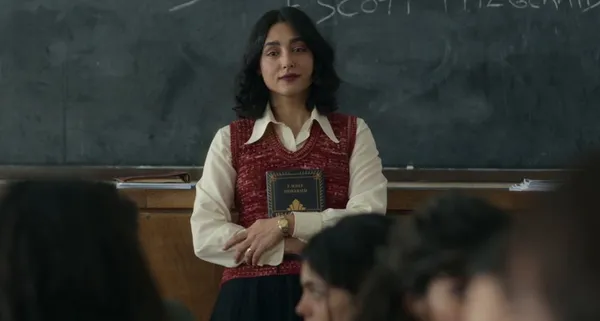
Nafisi (Golshifteh Farahani), a counterculture English Literature professor, gathers together seven of her female students to form a book club, among them Sanaz (Zar Amir Ebrahimi). With Nafisi's apartment offering a quiet corner of the world to liberate themselves from the Iranian government's fundamentalist rule, led by the Ayatollah, Ali Khamenei, they shed their veils and discuss a collection of Western literature: F Scott Fitzgerald's The Great Gatsby, Vladimir Nabokov's Lolita, Jane Austen's Pride And Prejudice, and Henry Miller's Daisy Miller. These form the four chapters of the story, which takes place over nearly a quarter of a century, beginning in 1979 and jumping back and forth with each book representing a specific year.
Riklis has previously directed Lemon Tree (Etz Limon), about a grieving Palestinian widow whose tree grove is threatened by her new neighbour: the newly appointed Israeli Defence Minister. He has also directed the sports drama Playoff, which tells the story of Ralph Klein, known as 'Mr. Basketball', who led Maccabi Tel Aviv to the European Championships Cup in 1977, and Zaytoun, set in Beirut in 1982, about an Israeli fighter pilot who is rescued by a young Palestinian refugee.
In conversation with Eye For Film, Riklis discussed cinema's place in the contentious present-day, learning to love metaphor, hidden complexities, clichéd truths, and more.
The following has been edited for clarity.
Paul Risker: Why filmmaking as a means of creative expression? Was there an inspirational or defining moment for you personally?
Eran Riklis: Oh, at birth, I guess [laughs]. Well, I partly grew up in New York, so I was one of those kids. I watched a lot of television where Clint Eastwood, Rawhide, and all these kinds of things became part of my DNA. Then I went back to Israel when I was five or six years old, and Israel had no television in the early Sixties — that was crazy. But then I became the kind of kid who went to the cinema every week, which excited me.
It all started because of a book. When I was 14, I read One Flew Over the Cuckoo's Nest, which blew my mind. It's an amazing story, of course, and it was something I would have loved to make as a filmmaker. But Miloš Forman had made it with Jack Nicholson, so I blew it [laughs]. But it was when I read that book when I was 14, that I said to myself, "These are the kind of stories I want to tell."
I was already into cinema because I was too lazy to write books. Filmmaking is difficult, but it's not as difficult as writing a book — well, actually, it might be worse. So, the drive came from there and then it just went on. And I grew up with a camera in my hand.
I was 19 years old during the Yom Kippur War in 1973, which is a very traumatic war for my generation. After my military service, I had this feeling that I wanted to tell stories and I thought, 'Let's see who's going to stop me', and nobody did.
PR: What do we need most from cinema at this moment in time? What purpose does cinema serve?
ER: It needs a sense of understanding, respect for each other and compassion. There are a lot of words that I could use, but there are so many things missing from today's global dialogue. Not all, but most of the dialogue today is about hate. It's about people being against each other, not to mention, of course, violence and death. So, because cinema is able to bring people into the cinema itself before it's later shown on television, if it's a film that grabs you, then maybe it has a small chance of not necessarily changing your mind but at least opening you up to new ideas.
We live in a world where the headlines are creating our world and our understanding of it. I try to go beyond the headlines, not to say the headline is black and white or very simplistic, but the reality is much more complicated. So, I try to go to that place while respecting my audience, who I see as sophisticated.
The audience is exposed to so many things these days and here you come with your own ideas. You try to find allies in the audience who, even if they think in a different way to you, will make them rethink things. That's all I expect, and it's about thinking again before you make your final decision, if there is such a thing. So, I think that's what's needed, and it's about creating a debate and opening minds.
PR: Thinking about not only Reading Lolita in Tehran, but also your previous films, like Lemon Tree, they are driven by a search for the humanity behind desire and human interaction. At their heart, there's a simplicity, but that's not to suggest they're lacking in emotional depth.
ER: Simplicity is probably a key word, but we all know that behind simplicity lies complexity. I'm not preaching amd I never say that I want you to think like me. No, I'm telling you a story, and like you say, Lemon Tree, Reading Lolita or even The Syrian Bride, many of my stories are about complicated situations, the complexities of the political world and the world in general. But I try to go the emotional and humanistic way, and like I said before, the open-minded way. Even if you form an opinion, remain open-minded because things are always changing.
It's funny because when I arrived in New York, I was lucky to see the Argentina and Egypt match. Despite the whole complex relationship between Israel and Egypt, I was rooting for Egypt, God forbid — all my respect to Messi. And it's funny because my granddaughter is five-years-old. She called me and said, "I want Messi to win because I love Messi."
In the end, even in a simple thing like a football match, the world of politics and the world of class and social issues and a country's history come into play. And America is also a conflicted nation.
At the end of the day, it's about good people trying to maintain some control over this crazy world, because the world is really deteriorating into a horrible place on every level. You try to do what you can and hope that things change because throughout history, it has always been about change. There are these static situations that people are trapped in, but then you try to break out of them.
PR: One of the first things an autocratic regime does is restrict access to books and information, which we're seeing in the US right now. So, while your film is set in Iran, it's a global story, especially given this rising threat to democracy.
ER: In a nutshell, what you're saying is exactly what I mean. There's this old saying, and it's a cliché, that the more local you are, the more universal you become. I always thought it was true.
You have to be true to your story; you have to be accurate; you have to have knowledge of and respect for your subject. It's not like an elephant in a china shop. I have to be very delicate and respect different points of view. On the other hand, if I'm accurate and if I respect my story, I think it will reach a global audience. The test is always; will this be understood?
It's not only about the international factor. Not everyone reads books and not everyone is aware of what's going on. When you say Iran, they say, it's women in veils. No, it's more than that. And especially now, we're talking after a year of crazy wars. I was thinking about this when I was in the shelter in Tel Aviv during Iranian rocket strikes: 'My God, where are we? This is like World War II. Am I in London, and it's the German blitz?' It's crazy, it's sad, and it's chaotic, and yet we move on.
I landed in New York, which is a chaotic city in its own right, and here I am to show the film. So, something is still working in this world. Opinions can still be expressed, and, of course, I have huge empathy, and I'm disturbed by the fact that so many people in the world are not able to say what they want to say and are oppressed in such a brutal way. That's the real struggle. Forget films for a minute; forget everything. I make films and you write. We all do what we can do, but at the end of the day, there are so many people who are hit by violence that cannot be stopped and that's the main concern right now.
PR: What for you, is the broader context of the books referenced in the film and how it feeds the film's intentions?
ER: These are the particular books that Azar Nafisi chose when she wrote the book. Lolita itself is still a controversial story, and The Great Gatsby itself is. You could say it's about American imperialism, like they do in the film, during the fake trial at the university. And, of course, Pride and Prejudice and Daisy Miller. All these books represent certain facets of both oppression and freedom and that's what makes it interesting, because if you think about Lolita, it's a story of oppression. It's about this man who oppresses a young girl. And if you think about all these stories, they have this complexity and that's why they work so well within the story of Reading Lolita, which is about the complexity of a torn and an oppressed society.
PR: We should never underestimate the power of metaphor, and how they allow us to understand not only the story but ourselves and the wider world.
ER: In my last couple of years at high school in Israel, I was the only boy majoring in literature. So, of course, I was a prince surrounded by all these girls — it was fantastic.
We were studying literature in a deep way and, of course, discussing metaphors was like a daily thing. I was learning, and I'm still learning to be in love with metaphors and yet not to impose them on anyone. Like I said before, I'm trying not to hammer the message into the movie, but of course, I'm not naïve. All directors are manipulators, but I'm trying to be gentle about it.
The beauty of metaphors is that every viewer or reader can take the metaphor and bring it into their own world. I don't aspire to understand what every person in the cinema thinks when they see something on screen, and how it connects with their own life. That's always a fascinating process. You are really jumping into a deep ocean of emotions and history of every individual spectator. It's the same way it worked for me with my actors, because when you talk with an Iranian exile [Zar Amir Ebrahimi] about her experience in jail, as a director, you want to be helpful. So, when talking about this horrible scene where she's being lashed, you ask her, "What can I do to help you?" And she says, "You don't have to help me because I've been there. I know what it's about." That's when you get a sense that this is a mixture of personal, social, and global experience. It's about how you take all these elements and fine tune them and streamline them into the story to make people feel emotional about it.
Reading Lolita In Tehran opens in New York on Friday, 10th July, and opens in Los Angeles and in select markets nationwide on Friday, 17th July.