





Eye For Film >> Movies >> A Woman’s Life (2026) Film Review


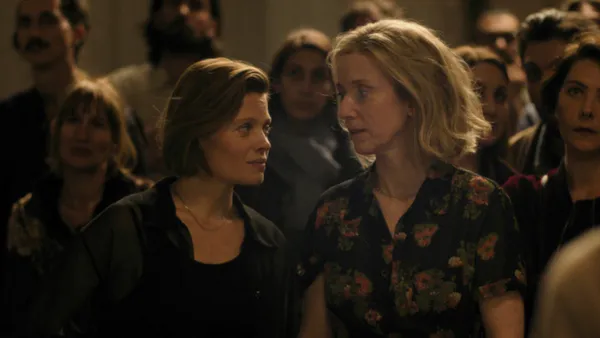

Léa Drucker impressed last year as the stressed nurse at the heart of Cannes medical drama Adam's Sake and she's back on commanding form and in a hospital this year as a maxillofacial surgeon in A Woman's Life. Charline Bourgeois-Tacquet’s character study unfolds episodically in appropriately uneven chapters that dip in and out of Gabrielle Conti’s life over the course of a few years as she juggles pressures and desires at work and on the home front.
Director Charline Bourgeois-Tacquet – who collaborated on the screenplay with Fanny Burdino – weaves an intricate life for Gabrielle without making it feel like a melodrama. The 55-year-old may, as the film proceeds, have doubts about some things and a forthright attitude but she is never less than competent and compassionate.

There is stress at work as Gabrielle is in constant demand, perfectly illustrated by a kinetic early scene in which we see her steering her way through several phone calls as she drives to work. The barrage continues after she reaches the hospital, where she also meets a young writer, Frida (Mélanie Thierry), who is there to observe her for writing research.
Driven by her work, and not ashamed of that fact when she talks to her husband Henri (Charles Berling), she makes it clear that her own space is non-negotiable, even as she has, at least in their formative years, welcomed her stepchildren into her life. She’s also dealing with her ailing mother (Marie-Christine Barrault) and the fact that her most trusted surgical colleague Kamyar (Laurent Capelluto) is about to take paternity leave.
What Frida brings with her is attention. Gabrielle’s impressive ability to handle everything anyone throws at her, no matter how many do it at once, has led those in her immediate orbit to become accustomed – the French might say, blasé – about it. Although she is in a very specific position that few occupy globally, Gabrielle is emblematic of many women who love their work while not seeing it as the be all and end all, no matter what others might think. There’s also a nod to ingrained everyday sexism that many are up against, even from their loved ones. Frida’s interest sparks something inside Gabrielle and their relationship starts to shift as Gabrielle begins to discover new facets of herself.
Gabrielle is written as a fascinating, complex character and lent verve and, when necessary, vulnerability from Drucker. The female gaze is also central, especially in intimate scenes which spring up between Gabrielle and Frida. Bourgeois-Tacquet, aided by graceful camerawork from Noé Bach, knows how to make rhythm work for her, moving from the fast pace of Gabrielle’s worklife to more languid, heady moments that she shares with Friday, most notably during a dance performance.
The chapter titles may sound like snappy labels, including “Pity”, “Reconstruction” and “I Want It All” but Bourgeois-Tacquet is interested in the discursive possibilities that lie beneath. Frida, unfortunately, feels rather thinly drawn by comparison to Gabrielle, which doesn’t always make it easy to see the surgeon’s fascination with her – but then, the title is the singular “a woman’s” life after all and Gabrielle’s, though singular in many ways, contains multitudes.
Reviewed on: 08 Jul 2026


