 |
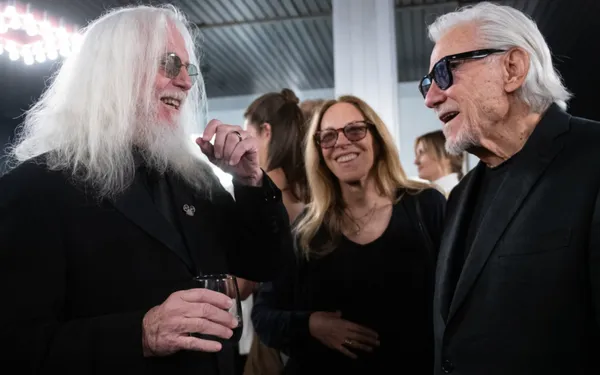
| Harvey Keitel met 'big bad Bob' Richardson when he was presented with a Crystal Globe award. Centre Keitel’s wife Daphne Kastner Photo: Courtesy of Film Servis Festival Karlovy Vary |
At the Karlovy Vary International Film Festival, where he was presented with a Crystal Globe for Outstanding Artistic Contribution to World Cinema by acting legend Harvey Keitel, he admitted that all the attention left him a tad non-plussed.
The persistent caller who persuaded him to tell all was Jana Hojdová, a former cinematography student at Prague’s film school FAMU. She contacted him out of the blue for her master’s degree project and convinced him to collaborate on White Devil, which was given its world premiere as part of Karlovy Vary's 60th anniversary line-up.
 |
| Robert Richardson with his Crystal Globe: 'At the time of Salvador I was only 27 years old and it was a massive opportunity' Photo: Courtesy of Film Servis Festival Karlovy Vary |
“For JFK I was at home with the family, and, of course, I was elated although I was convinced that Bugsy Malone would take best cinematography because it was a better shot film, or so I thought. I reflected and felt that I could not shun the ceremony again so I decided that if I ever got nominated again I would attend. And I have been to every one as required since then.”
He was present when Brad Pitt affectionately called him “big bad Bob” in his acceptance speech for best supporting actor Oscar in Tarantino’s Once Upon A Time … In Hollywood.”
Richardson, 70, served his apprenticeship shooting second unit on Repo Man (1984) while filming television documentaries for television and the BBC. His television work led Stone to hire him to shoot Salvador and Platoon (both 1986), with both requiring a cinema verité style.
“At the time of Salvador I was only 27 years old and it was a massive opportunity. I had chosen to go to film school as a cinematographer. I guess I was insecure about my capabilities as a director and also I knew I had a visual eye and could work with people.”
With a roll call of some 59 films, although he has not been counting, Richardson rarely instigates collaborations. He said: “The choice has to be the director’s choice and not mine. I started working with Oliver Stone early on and because he was a writer/director, it was always about the story. It was the same with John Sayles and even Marty [Martin Scorsese] wrote a lot of his own material or was very hands-on in the writing process.
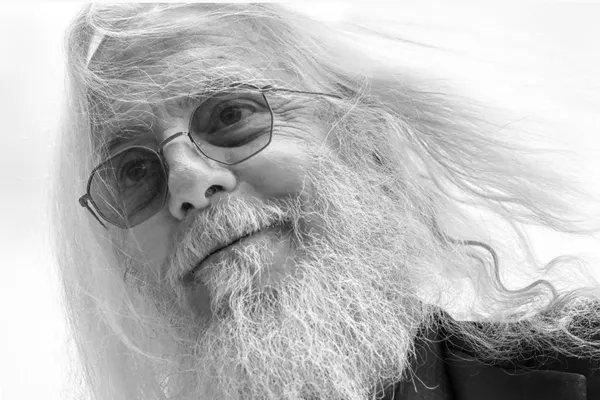 |
| Robert Richardson: 'I always read any script in detail and unpick it but I never tried to visualise how it would look'' Photo: Courtesy of Film Servis Festival Karlovy Vary |
Where does he place cinematography in the hierarchy? “I think every department can make a film better – cinematography is one aspect but editing is extraordinarily vital. Most directors rewrite their films in the editing and it is one of the most vital parts of the process.
“Production design for me is more important than cinematography. Cinematography has to capture what is there in front and if what is front of you is that wall behind you then I am going to have a hard time. If you build a box and I have no place to light from I am going to have a hard time. So it is essential to have a brilliant production designer. You have to form a team and that is why when you see Bernardo Bertolucci’s films he had one of the greatest teams in the world at that time. And they could create from the best costume designers, hair, production designers, and cinematographers.
“They were a team that created some of the best films of that time. I once asked Marty who he thought in the history of cinema was the best and there was no hesitation: Bertolucci. I think that Bertolucci’s cinematographer Vittorio Storario is one of the greatest cinematographers of our times.”
Richardson, who recently completed work on Madden by David O Russell, has no issues with keeping up to speed with technology. “I love moving forwards or backward to film and I have no issues with AI. One way or another it all comes down to using any tools that are available. I have difficulty, however, with people watching films on small screens which is bound to be disappointing.
“Distribution is the main problem the industry is facing. We need the streaming services to allow a bigger choice of films. There are so many great filmmakers out there who deserve a chance. Not every film, however, deserves to be seen on a big screen.”