 |
| Tangles |
American director Leah Nelson's Tangles is an adaptation of Sarah Leavitt's 2010 graphic novel Tangles: A Story About Alzheimer's, My Mother And Me.
Set in Nineties San Francisco, the story follows Sarah (Abbi Jacobson), a young illustrator for an alt-weekly queer magazine, who lands the opportunity to do the cover art. Meanwhile, Sarah's personal life also enters a new chapter when she begins dating the captivating Domino (Samira Wiley). All the pieces appear to be falling into place until she becomes aware her mother, Midge's (Julia Louis-Dreyfus) health is declining. She sounds the alarm to her father Rob (Bryan Cranston), younger sister Hannah (Beanie Feldstein) and immediate family. However, they all appear to be in denial that anything might be seriously wrong. After Midge is diagnosed with Alzheimer's, Sarah returns home to care for the mother who has always been her hero.
Tangles is Nelson's feature début. She has previously directed the short film Swiss Chalet: A Helping Hand, and executive produced the documentary, Precious Leader Woman, about Canadian female snowboarder Spencer O'Brien, whose diagnosis of Rheumatoid arthritis set her on a journey to discover her indigenous heritage.
In conversation with Eye For Film, Nelson discussed her documentary roots, using the film's visual language to look inward, and honouring Leavitt's real-life experiences.
The following has been edited for clarity.
Paul Risker: How would you describe your relationship to cinema, not only on a professional but on a personal level?
Leah Nelson: The last few years feels like it has been a fair-weather relationship to be honest with you, just because I've been pretty heads down, and so, I've missed some stuff. I'm going to spend a lot of time in the next six months watching things.
In addition to being fair weather, my relationship to cinema is pretty eclectic. I'm not only into animation, which I love. Having spent a lot of time working in documentary, it is a genre that's also very dear to my heart, and it's a space I feel comfortable. In the beginning, I approached Tangles as if it were a documentary.
I know I'm supposed to be talking about myself here, but this story has been a huge part of my life. I optioned it in 2010 and the author, Sarah Leavitt reminded me that it was over a quarter of my life that I had been working on her family story. And that's when we first met, in 2010.
At that time, I approached it as a documentary because I was working with Sarah and I needed to draw from her experiences. Regardless of what was on the page in the novel, I was trying to create a narrative. And so, there was a lot of me using my interview chops and trying to get to the heart of the story or find new things that maybe weren't in the novel. But that all comes from my love of documentary film and my experience of documentary filmmaking.
PR: How does animation serve this story, and if told in a different style or format, how would that have shifted the film tonally?
LN: Of course you think about what it would look like if it was a live action film or even a different style of animation. It was never a question for me that this was going to be animated, and the key was that we were telling a story about our central character's experience. And everything that we see in the film is based on how she remembers it.
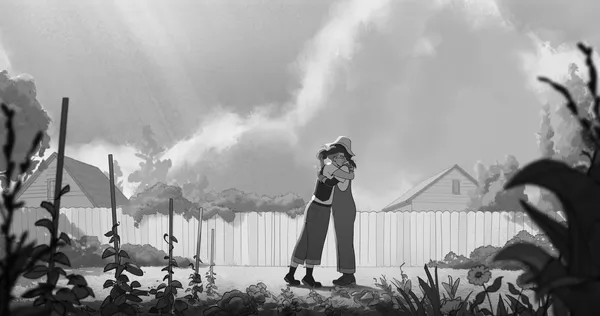
She's an artist, and she works through her emotions and her thoughts on paper with a pen and ink. We made the movie this way because when we go inside her psyche, that's what it looks like in there. It was important to be able to have that visual language translate into the film, but in a really exciting and dynamic way. And I don't think you could have done that in live action. You could have certainly done other things, but to honour that part of her story, and with her being an artist, I wanted to show the hand of the artist.
When you're going through something in your life that's this challenging, tumultuous, and emotional, it can feel surreal. There are moments when you will think this isn't happening, which Sarah does. So, getting into her psyche and seeing what that looked like was something only animation could have done at the level we wanted.
PR: There are moments in films that are driven by the aesthetic that can interrupt the narrative's logical flow. There are examples of this in Tangles, especially when we enter Sarah's mind, which asks the audience to detach from, and sit in these surreal and dreamlike interludes.
LN: It all started with a little drawing in one panel of the novel. Sarah's artwork is very sparse with thin and simple lines. The drawing is of Sarah and her father, Rob, right after they receive the diagnosis. There's just a line that represents the ground, and underneath, it's rendered as if the ground is crumbling — there are these little stones. It's very simple and when I saw that panel, I said, "This is what I want to do with the movie. I want to show the audience what it felt like, not just tell them what happened." And with the talented animators I had at my disposal, we expanded on that one panel, or its idea. I let them off the leash and said, "Let's go inside her body, heart, and mind, and let's show the audience what it felt like for her."
Through the whole tenure process of the adaptation to the production and all the pre-visualisation, that was our North Star. You can see that in the casino scene, when we're in her psyche, which is dynamic and bombastic. And also, in subtler moments, for instance, when she's walking up to the house. In one shot, she's walking waist deep through water, because that's what it felt like to be walking heavily toward the house and not knowing what she was walking into.
So, there was that one panel that locked that idea for me and I could never let go of it.
PR: The story is told from Sarah's point of view, which not only honours the source material but, regardless of how much science can explain Alzheimer's, it's impossible to truly understand what it is to live with the disease. The point of view needed to be from the outside looking in.
LN: I drew a very hard line. I said, "We can't go inside Midge's brain. We don't know what's going on there, and we're not going to pretend that we do and just make it up." Hopefully, one day soon, with research, we'll understand more about what that experience is like, but I was never going to go there.
We could, however, tap into Sarah's mind, psyche, heart, and body — I could talk to her about that. And that's why the point of view is from the perspective of the daughter losing her mom. We see the other family members through Sarah's eyes as well, and we can sense what they're going through, but not for Midge. We just focused on Sarah's memories of her mom and making sure that we were honouring this intelligent, fiery and passionate woman. These things were all we needed to learn about Midge and to then see them gone, you'd understand what that loss might have been like.
PR: There's what I'd describe as an attitude and irreverence to the film, especially in the airplane sequences. The humour offsets the heavier dramatic tones and complements the youthful spirit of its protagonist, who wants to take on the world as she tries to find her place in it.
LN: It was a dark comedy that we were trying to make, and what's beautiful about the dark comedy genre is you can inject humour and levity in very darkly intense, sad, and emotional moments. And if they work, it feels very human, and we can relate to that, particularly with experiences of dementia and Alzheimer's, because it's not brief and intense; it's a long journey. Most people you ask will tell you that humour is essential; you have to find it. So, this was truthful for Sarah and her family.
By wanting to make this a dark comedy, you have to experiment in moments and see if humour fits there. And if it doesn't, you don't have to put it in. It's also okay to just be sad or intimate or go to those dark and ugly places. By being able to show what caregiving is really like through the rawness and those ugly bits, we also find a beauty in it. That is a tricky balance to find where we're not belittling the caregiver or the person with Alzheimer's — we have to be very intentional here.
PR: In telling a story about a relationship between mother and daughter, you emphasise the privilege of the parent to share and the child to absorb, and then for the child to reciprocate. At its heart, there's a sensitive philosophical perspective to the drama, and you effectively use metaphors, like the Armadillo incident, to make broader points.
LN: I don't know what the right expression is. It's not really passing the torch, but in the beginning of the film, Sarah really sees her mother as a hero. Starting the movie with that moment was essential to set up who Midge was to Sarah, so when that shift happens, and Sarah becomes the caregiver and her mother's hero, you can feel that. And we have visuals that remind us of this.
People often talk about the child and parent relationship flipping. It's a common experience and that was certainly Sarah's experience. We also feel the loss of that part of Midge as well.
I'm so glad that you could feel that because we can talk about it all day, but for it to come through in a subtle moment, without having to explain everything is what I hoped for.
Tangles screened in the main competition of the 2026 Annecy International Animation Film Festival.