 |
| Last Man Up |
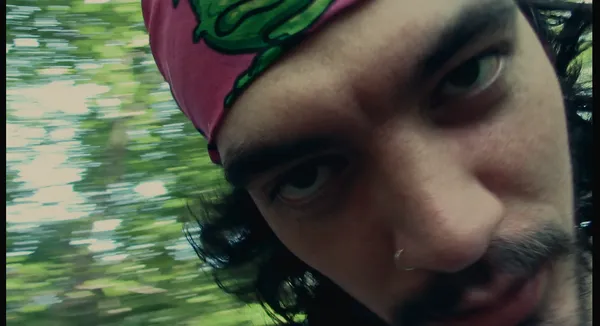
Director Hazel McKibbin and co-writer Robert R Palmer's short film Last Man Up follows the trio of Tye (played by Palmer), Ross (Joseph Basquill), and Stretch (Armando Rivera), who set out for a day of trail running. When yet another foreclosure notice arrives, Ross and Stretch's blissful ignorance about the imminent threat of losing their home is shattered, igniting tensions within the group. The heat and recreational drugs escalate these tensions towards a life-changing climax.
McKibbin's previous credits include the short films Doublespeak, about a woman's experience of reporting sexual harassment in the workplace, Border Line, which sees a mother drag her 10-year-old daughter on an illegal errand; and Low Tide, about a woman who retreats to a beach house after a breakup, only to find her mind unravelling when sculptures wash up on the beach.
Palmer has starred in the short films Nude, a coming-of-age story about the violation of an adolescent's privacy when nude photos are shared without her consent; Last Words, a horror about a hiker awaking in the desert to find she has been separated from her friend; and Alan At Night, about an internet prankster and his quirky roommate. He has also co-written and produced the upcoming short film Cuck.
In conversation with Eye For Film, McKibbin and Palmer discussed the solitary and social sides of filmmaking, pursuing curiosity, masculinity, creating something a little different, and more.
The following has been edited for clarity.
Paul Risker: What led you down these creative paths? Was there an inspirational or defining moment for you personally?
Robert R Palmer: I actually have a vivid memory. I've always been a film lover, which has always been apparent. I studied business in college and at one point I was thinking I'd work for a production company, but I always wanted to be an actor and a filmmaker, only I was too scared to go for it.
My first summer after graduating from college, I was saving up money before going on a Euro trip with friends. I was doing yard work for neighbours and family, and I got into podcasts. This was at their inception, and so, I was relentlessly listening to interviews with actors and filmmakers. It became an aspiration to be like the folks that I was listening to and the rest is history. It was just a moment of realising: Wow, this is who and what I want to spend my time around. And then it grew from there.
Hazel McKibbin: My story is the opposite: growing up, I wasn't allowed to watch movies or television. My mom was no screen, super strict, although we would occasionally watch a family film on a Friday together.
I studied English at university and then, when I graduated, I got a job at a postproduction company working as an editor or really, I mean the assistant to the assistant. I worked there for a couple of years and that was my way into film. Then I went to grad school for writing and directing, and here we are.
PR: Even if writing can be quite solitary, you'd naturally assume filmmakers, like actors, would be more extroverted than introverted given the nature of film production. Is there something about the process that creates a bubble for introverts to explore the extroverted sides of their personalities?
HM: Writing's very solitary and, for me, editing is also very solitary — a lot of the time is spent in a dark room. But then the process of being on set is not introverted at all. So, there are two sides to it. You spend so much time thinking and generating alone, but the process of film is ultimately collaborative. And it's nice to have both sides of that.
RP: Ultimately, the appeal is you can go wherever your curiosity wants to take you. You get to obsess over what it is that you're curious about and that's where the solitariness comes in. It's just you sitting there, letting your curiosity take you wherever it goes, whether it's writing or whether it's acting. It's all part of your brain; it's the same muscle.
PR: What was the genesis of the idea for Last Man Up, and what compels you to tell this story now?
RP: Masculinity is such a broad theme, but I've been particularly inspired to investigate masculine binaries just because the rules of what men are allowed to do or what they should do are so rigid. But life is extremely complex and fluid, and it cannot be defined that easily. And so personally, it's something that has been important for me to investigate, and it's relevant right now.
I wouldn't say this film was born from a desire to investigate this, rather it was just something that I felt compelled to do, which came naturally. It was a combination of just wanting to make a certain kind of film and wanting to get to work with a certain kind of collaborator. I was thankful that Hazel was willing to come along on this ride, and she eventually took it in her own direction, which was beautiful.
HM: Robert reached out to me with a cold email. Even if a project doesn't necessarily feel right, and I don't know that this one did from the jump, I always want to chat.
My films are about feminism and women, and this film doesn't have a single woman in it, so it wasn't a natural fit. But I'm always interested in pushing myself as a director and doing something different. And ultimately, the process of writing and rewriting the script together, and then directing it, I got to do a lot of things that I hadn't done before, which was exciting.
PR: Last Man Up is not necessarily narrative driven. Instead, it's comfortable with ambiguity, drawing its audience in and asking them to sit with the characters and pull out of the ambiguity some form of understanding.
HM: […] I never think about shorts as a three-act structure or as being driven by plot. Obviously, there's a plot, but what I love about shorts is you can create these little moments, and what we were trying to do here was driven by the tension of what the characters are not saying to each other, what the audience knows, and what both the characters and audience know at different times.
I also love triangle dynamics in film because it gives a lot of opportunities to push and pull in small ways. I'm into subtext, and so, it's always in these small ways. But the idea is to push and pull to create conflict and, hopefully, when you watch the film, you'll feel the tension that the characters feel, where you're not sure quite what's going to happen, but you know something will. So, what is driving the film is this underlying tension and this thing that's building between them.
RP: We were both very driven to have a filmmaking process that felt freeing and creative, that felt different, where it wasn't let's do our wide-shots, close-ups, and let's get our coverage and move on. Especially given who we looked up to as filmmakers and the different visual languages we aspired to incorporate into the film, we were both driven to have an experience where we made a film a little bit differently, which would create that satisfaction.
PR: There's a certain chaotic vibe to the cinematography and the editing, that complements the psychology of the characters and the predicament they're in.
RP: It's a perfect piggyback to what I just said, because we both felt that something like that would really lend itself to telling the story in the best way that we could.
HM: Bradley Credit, the DP and I often work together. I have a type of film that I like to make, and he has a way that he shoots. But ultimately, the style of the film is so dependent on what the story's about and what's happening, it's very different from anything Bradley and I have done previously. But it's exactly right for this story.
When I think about the way that we shot or even planned the shot list, I created rules for each of the characters about how the visual language shifts over the course of the film. They're always in diametric opposition to each other because I think that's what creates conflict, tension, and drama and therefore the film.
PR: Cause and effect is one of the film's themes, but here, you explore the layered nature of cause and effect, and how it's constructed from these interlocking layers that reveal its complexity.
HM: Yes, and it therefore feels more human or real because it's specific. And it hopefully creates this feeling that you're living this with them.
RP: It added to the intimacy of it, and the goal was to make it feel as intimate as possible, and make it feel like we were there with them.
PR: It's the type of film that you pick apart afterwards, and the one character that strikes a nerve is the quiet one of the trio, who suffers the unfortunate fate.
HM: We went back and forth on who would be the one who suffered most, and it made sense for the person who's the least involved in the direct conflict to be the one who is the victim of it. He deserved it the least, and hopefully that means something.
I also think there's a heightened anger, and part of what we wanted is that at any moment something could go wrong. And I think that's very true of these heightened environments. But also, my stepbrother's 21, and boys that age, they're on the edge of violence at all times. So, it was important to really have that in the film and then have real consequences.
RP: And it was an accident too, and that was the best way to paint that picture. I think it would break Tye's heart the most knowing that Ross was the little brother of the group and someone that he had spent his entire life looking after. For drama's sake, it was important to paint that picture, and it was about how do we make this story as heartbreaking as possible? How do we make the conflict as heightened as possible from a purely storytelling standpoint?
PR: I like the adage that if is a small word, but it means an awful lot. It's a sentiment that haunts the film and its characters.
RP: That's what the film is about too — how much a little thing can change the course of your life, and obviously the little thing is no little thing, but it was just intended as such. And it's obvious how that will go on to impact the rest of his [Tye's] life. He has definitely been changed forever.
Last Man Up played at Palm Springs ShortFest.