 |
| The Long Haul Photo: Tribeca Festival |
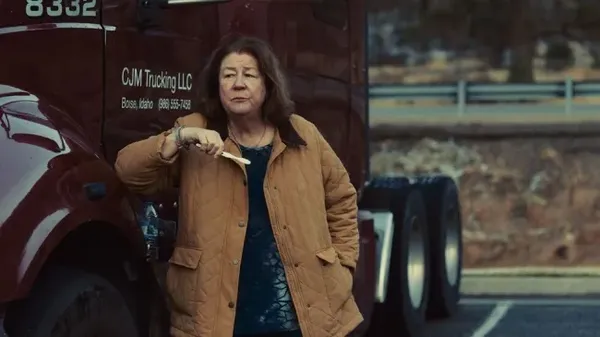
In UK-based director David Drake's The Long Haul, veteran truck driver CJ (Margo Martindale) finds herself being left behind by a changing world. The old way of doing things is being phased out by technology. CJ, who has spent decades hauling loads across the American Southwest, is too much of an old-timer to embrace change. In one scene, frustrated by the hoops she's being asked to jump through, she sticks her phone in the freezer.
For decades, the road has been an escape, but now, the prospect of retiring and what that next chapter in her life looks like coincides with an unwanted correspondence that forces her to revisit her past.
Drake describes himself as a self-taught filmmaker and photographer. The Long Haul marks his feature début. His short films include Party Wall, about a stay-at-home self-help vlogger who becomes obsessed with her neighbours, Early Worm, in which a man's attempts to straighten out his life are derailed by a chance encounter, and the documentary Post 398, about an underground jazz club in Harlem whose future is uncertain after its owner passes away. Drake's photography has been published in publications such as Teen Vogue and NME, and he has directed music videos for the pop band, The 1975, and the rock bands Glass Animals and Django Django.
In conversation with Eye For Film, Drake discussed leaning into intuition, giving up control and embracing the dead ends in his writing process. He also reflected on working with his talented and down-to-earth leading actress, his love of food and cooking analogies, Kelly Reichardt, Darren Aronofsky, and more.
The following has been edited for clarity.
Paul Risker: With a background in photography, how did that transition to filmmaking happen? Was it a series of choreographed choices, or did the two naturally bleed into one another?
David Drake: My photography background stemmed from my interest in visuals, and I always wrote too. So, when I was growing up, I would borrow the family camcorder that was used for Christmas, and my brother and I would shoot skits and all sorts of other stuff.
I always loved movies and stories, but I had to find work, and so, I ended up working as a photographer in my mid-twenties to thirties. And because I didn't go to college or uni, I'm self-taught, and that was a way that I could make a living and also enjoy what I was doing. I started with weddings and newspaper photography but eventually did a lot of album covers for bands and the music industry and that’s where I found my footing, which led to directing music videos. So, I kind of wheedled my way into writing and directing in my thirties.
I was always accused in my short stories of writing too visually by over describing — basically the camera positions and stuff like that in my descriptions. Unconsciously, I wanted to write scripts and shoot things and when I eventually started doing that, it just felt more natural, like I could control the story and the visuals.
PR: A director's first feature is a milestone moment. It must be a surreal experience, because you go from looking towards it, to suddenly being on the other side of it.
DD: That’s a great way to put it, because it's all leading up to it, and then, it's afterwards. The actual experience itself is like a crucible that you pass through and the time on set was so short: 19 days. And it was 6 years in the lead up to it; from the moment I had written the script to the moment principal photography started.
The actual experience itself was such a whirlwind, but I was being held by very experienced producers who I'm very close with, an incredible cinematographer and a professional and seasoned cast that have done this many times before. So, even though I was very inexperienced on set, I was held up by all these people.
Giving myself up to that process and having to just roll through it, was in itself a big learning experience for me because you have to really lean on these other people. You can’t control every aspect as a director. You might want to, but you can't, and so, you just have to give yourself up to this collaboration. And my takeaway is that I was lucky to work with some of these people.
PR: There's the idea that there are three versions of the film: the one you write, the one you shoot, and the one you edit. Do you agree, and would you describe the film as a journey of discovery?
DD: That is a good way to put it. I say when you're writing the script, you're making the shopping list. Then you're running through a supermarket pulling things off the shelves. When you get home, that's the edit. You're cooking dinner, but you need to ad lib because you forgot stuff, or they didn't have it at the supermarket. So, that's how I see that process.
The running through the supermarket part is terrifying and almost a sensory overload. But then, you have that time to adjust and do your work in the edit. There's an analog aspect to the scriptwriting and the edit, whereas the actual production side is more chaotic and fast-paced, which is also enjoyable for its own reasons. And that's the collaborative part with the cast and everything else. So, it's exciting, but the writing of the script and the edit have more in common.
PR: Working with an experienced actress like Margot, were there things she revealed to you about the character and story that you hadn't realised when writing the screenplay?
DD: There was a lot of that. Margot's face is so expressive, and she does so much with so little movement. On set, I was sitting at the monitor watching 20ft away from her. I was sometimes surprised by what she did. I'd think to myself, 'I didn't know you could do that… that's great.' And then I'd rediscover that in the edit, where you'll even discover those smaller and subdued moments that you don't necessarily notice during the rush of production that works well and changes the tone. Margot gives you so many options to work with.
When you do your takes, you start in a way where everybody can find their feet, and then you start drilling down to smaller things. But these actors just try things out and sometimes that's the stuff that makes it into the movie. This cast were so experienced, and Margot, she just knows what to do with trying things out. She'd say, "You might want to try this" or "You might want to do that. I'll give you options." And she did. It was a phenomenal experience working with her and I can't tell you how much she taught me. Being that talented and that down earth, those two things don't usually go hand-in-hand, but she put me at ease.
PR: A frequently used turn of phrase is that the camera loves the actor. Watching The Long Haul, you can sense the camera is drawn to Margo. The phrase is an ambiguous and simplified take on a more layered aspect of the production process. How do you piece together your understanding of the connection an actor forges with the camera, and what role do the director, cinematographer and crew play?
DD: I'm not an actor, so I can't say for certain, but having worked with actors who the camera loves, Margot is one of those people. I think it's very much a self-awareness of her physicality in the frame. Maybe she can project herself to the audience, and she knows how to express herself by changing angles and such to catch the light. She just has a real awareness of it, and Mika, the cinematographer he's brilliant. He operates the camera and builds a rapport in a way that puts the actors at ease. He's always there within arm's reach, but he can make himself incredibly small and disappear, allowing them to act to a camera while not feeling like there's somebody leaning on top of them. So, that's part of it, too.
What's the profile of the camera and the people behind it? Do we allow the actors to have space? And does the actor know how to use that space, how to use the light and know what lens we're shooting with? Margo's a pro; she has done it for so long, and she just knows what we are doing. The camera loves her because of her experience and knowledge. On this film, behind the camera, we kept things small and stayed hidden.
PR: The Long Haul stays in CJ's space and doesn't allow itself to be distracted or even chase external drama. This gives its narrative a lean focus. And yet, CJ is a fully realised character who has lived life.
DD: I hate to keep going back to food and cooking analogies, but the ingredients should speak for themselves. And you don't have to over spice it or jazz it up and serve it on a wooden plank like you get in some restaurants. You just need to have the freshest and the best ingredients and be prepared to enhance those. It's probably because I cook dinner all the time for my family that I'm thinking this way. But to me, that's what I had. They were very simple ingredients, but having Margot and this cinematographer and these landscapes, I wanted to just let those parts of the puzzle speak for themselves and allow them to do their own thing and not interfere too much. You don't want to over edit or overwhelm it with other things and get too fancy.
Coming from the still photography background, I love reading photo books where you have one image and you turn a page. The edit tells you the story, or image by image you get a feeling. They may not feel related, but it's very minimal, and those were also the movie references I was looking at, like Kelly Reichardt's Wendy And Lucy, which is a slow type of cinema, and Darren Aronofsky's The Wrestler. Those two films were big references to me because they were very close-up and unadorned character studies shot in 16mm. But the ingredients were very strong and that's what I wanted to do with this. I wanted to get that right actor in the right circumstances and just let that do the talking.
PR: The film doesn't try to telegraph its themes and ideas. Instead, they're woven into the film in a way that trusts the audience are going to reach in and pull them out.
DD: That's a nice way to put it and that's definitely the way I like to watch movies. I like to have my own interpretation of things and not to have it over explained. I like to come away and have some ambiguity about what I feel, rather than an unambiguous answer to everything — I like to ruminate and think about it afterwards.
The movies I love do that and because people and emotions are messy, and they blend, if you can really decipher what each emotion is and if they're all separated, then that's a little less realistic and authentic. And what I really wanted from this was to have that stripped back, spare, vulnerable character with some messy and ambiguous feelings about what's going on to allow the audience to figure things out. That's how I love my movies to be, and so, I wanted to make one like that.
PR: Is your approach to let the characters reveal themselves rather than exposing who they are? And does the ambiguity you appreciate lend itself to this approach?
DD: I write in a way that I don't work from plot because I think that's putting the cart before the horse. That's just a weird way of doing things. I like to immerse myself in a world and then allow the characters to emerge, so the main character tells me what they do, and they lead the dance.
That writing process leads me a lot down a lot of dead ends, trust me. But I try a lot of stuff out and I let the characters tell me what the story's about. I don't go in there really knowing. It's more intuitive because the way I like to feel a movie is through the character's perspective. The characters are the ones that pull me through the writing process, and like you said, I'm not forcing them to do anything and that's by design.
PR: That must be pleasurable, even if it takes you down dead ends and takes you longer to finish the screenplay.
DD: Oh, absolutely, I love it. And it's the same thing with acting, where you want to let your actors go down dead ends and do multiple takes. You want to give them space to try things, and the writing process is not dissimilar. I step into these same shoes. I don't see how, if you go through that process, you will want to force your actors to do one thing and one thing only. You want to allow them to breathe and to figure things out. And one of the most exciting and enjoyable things to do when writing is to figure things out. It's frustrating too, and I oftentimes bang my head against the wall, but I do get a lot of pleasure out of that.
PR: Is the experience of making a film a transformative experience, where you exit the film a different person to the one that entered it?
DD: Maybe it's too soon for me to know whether it has or not. I was like a dog with a bone. I wanted to make a movie my entire adult life, and I zigzagged my way to a point where I could.
I've lived another life where I was married at 21; I was a dad at 23. So, making ends meet for most of my adult life was my focus. And a lot of my life experiences are tied to that, not the making of the movie. But I had this goal all along, and I was hyper-fixated on it for 20 years. Having now made it, and coming out of the other end, I still feel like the same person.
That has taught me that the journey was the important part. The end result is obviously an expression, but the thing I'm expressing is that journey. So, I wouldn't say it changed me, per se, but it maybe reinforced the fact that the change doesn't come from the thing, it comes from the whole long journey. And that's probably what I learned after making the film.
It has also geared me up to want to make more. I haven't been put off because of how hard it is. It takes a lot of perseverance and a lot of time, and it's still an incredibly fortunate experience. I know most people don't get to do this, so I feel very blessed, if I can say that word, to have been able to experience making a film. Even if it's the only one I ever make, which I hope it's not, what I will take from it is gratitude for the experience and for the collaboration with all these people.
The Long Haul premièred in the Spotlight Narrative strand of the 2026 Tribeca Film Festival.