 |
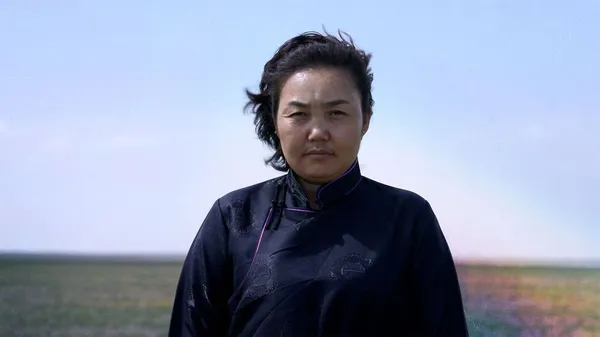
| Maikhuu Sengee in Colors Of White Rock. Khoroldorj Choijoovanchig: I approached her through social media first and she was really welcoming Photo: Petite Maison Production |
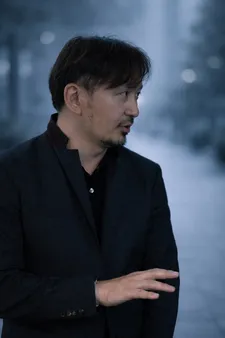 |
| Khoroldorj Choijoovanchig: 'I really enjoyed the truthfulness and the challenges' |
Khoroldorj Choijoovanchig: I knew my country was really dependent on manual exports and especially coal, which is half of the country’s export income. But I never thought about what was happening within the industry before. I was fortunate to be working on a project in the Gobi Desert and I saw these trucks queuing at the border and making a long line. I was flying a drone and I thought this image of trucks lining up towards the border looked like a giant iron snake.
Passing by the tracks, I looked at the drivers and they looked like really passionate people about what they're doing, but even though they were looking passionate, they looked really tired, with sadness in their eyes. So I was interested in the situation. Then I was in Paris and I had an assignment to make a short documentary piece and I was looking for characters. I went back to Mongolia and I met different people and I'm among them was our character Maikhuu. That's how it started.
How did you convince her to take part?
KC: She is really open and very caring, a really happy and fun person. She was also very active on social media and sometimes she speaks about what's happening on there. I was doing online research, and I saw her on social media. I was meeting different drivers but in the end, I came to her. I approached her through social media first and she was really welcoming.
Maikhuu seems to be quite heavily involved in the script of the film, the vital narration that we hear. How did you work with her on that?
KC: The idea of having Maikhuu’s voice-over narration came in post-production. We decided that she's the one. We had extensive interviews from the location footage and based on those exchanges, we wrote the narration together. Maikhuu always approved what we were trying to say through her voice.
Kate Kennelly: I worked largely on the first treatments and versions of the script kind of before the filming took place and then on an ongoing basis as the filming was in its early stages. But then kind of more of the writing of the finer details took place during the editing, and then me, (and co-writers) Tessa Louise Salomé and Chantal Perrin would provide feedback based on the rough cuts that would then be incorporated into the editing and rearranging sequences. It was Tessa, who actually largely worked with Maikhuu and the translator on crafting the voiceover to make sure that it was true to what Maikhuu wanted to say about the coal mining road and about her life.
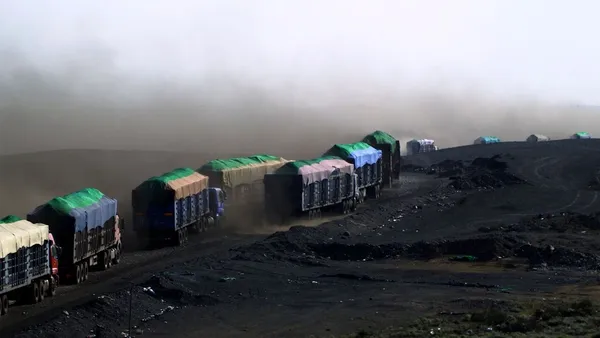 |
| Khoroldorj Choijoovanchig on his inspiration for Colors Of White Rock: I was flying a drone and I thought this image of trucks lining up towards the border looked like a giant iron snake Photo: Petite Maison Production |
How long did you spend with her in the cab of her truck and on the coal road?
KC: It was about five-and-a-half years of shooting and I was there many times even though I'm based in Ulambatar. The coal roads are more than 1000 km away from Ulambatar. I had to travel back and forth. There were more than 10 filming sessions. Sometimes I went for a few days, sometimes I went for three weeks or a month.. For example, during Covid, I had to stay a month because I had to isolate myself first for two weeks and then continue shooting with her. But before and after Covid it was easier.
Covid cuts through the middle of your film and I wondered was there a moment when that happened where you thought you might have to stop filming completely before you were ready to?
KC: There were some moments in the early filming sessions it was really difficult, especially at the beginning of Covid. Coal is the backbone of the country. That's why the government took measures to close the mining areas so people drivers would not go in and out. They stayed in the coal area and they didn’t let us enter the coal area. I was at the border of the coal area and there were military police protecting it. They wouldn't let me in sometimes, even though I had permits. In those moments, I thought, ‘What should I do?’
How do you personally feel about the situation in the country now?
KC: We understand we have to, in some ways, use the minerals. Because that's what really makes the country function economically. It's not just about our truck drivers, there are a lot of other people who are relying on the income of these minerals. So, I understand it, but Mongolians should not forget there is a lot of environmental and human costs behind this. They sometimes turn a blind eye to the problems, especially companies and the government. One reason to make this film and tell this story is to say, ‘Hey guys, look, you are neglecting these people.’
You obviously saw the accidents. I was, in a way, unfortunate enough to experience that horrible thing, but also, in a way, as a filmmaker I was lucky to capture it and share what's really happening with the audience. Accidents happen often because of the bad management and bad roads.
Is that why you wanted to feature a union leader, Gray?
I met him in the beginning and he was a really interesting character but the story was formed in the editing. Actually, I had another two characters I had to lose. We had another female truck driver, and one herder/male driver as well. You saw this guy who is cooking in the truck and changing a tyre, we had a lot of material with him too but we decided to keep the focus on Maikhuu.
Kate, were there things that surprised you through the process?
KK: When I saw the initial images that Hogo had taken during his location scouting sessions, it's just just the sheer magnitude of destruction in the Gobi, it was surreal honestly. I had read about Mongolia as the land of the Eternal blue sky, you know, its nomadic traditions come to mind, one thinks of a very spiritual country, of the breathtaking natural beauty. And to see this scarred, colourless borderland was just surreal. You could see how the mining industry had essentially drained this region of its colors, which is how I interpret the title and why we chose that title.
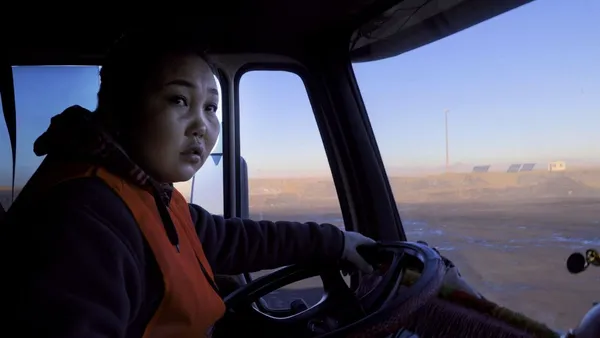 |
| Maikuu at work. Kate Kennelly: Maikhuu’s story was just so compelling that we chose to focus on her. Photo: Petite Maison Production |
Maikhuu was kind of the focal point of interest for everyone who saw footage of the film. At the very beginning, they said, you should focus on her. As Hogo mentioned, we were going to follow and ex-herder-turned-driver, who had ironically been driven to the highway because his flock had been wiped out by mining pollution, by toxic waste dumping. And there was another woman driver who lived in a yurt along the highway, named Okanzaya, but at the end of the day, Maikhuu’s story was just so compelling that we chose to focus on her.
What now Hogo, because this has been a big part of your life with the feature and the short before it?
KC: I had a few short films and a fiction feature before I made this documentary but I really enjoyed the truthfulness and the challenges. I learned a lot making this documentary. I actually have another documentary idea already within me. I'm thinking of continuing to make documentaries as well as fiction. I’m also writing fiction stories connected to the current Mongolian situation, concerning migration and people’s rights and general global change and what has been happening in the country since the 1990s. We became a new country because of the system change from socialist to capitalist, so there are a lot of stories I want to share.