 |
| Fairyland |
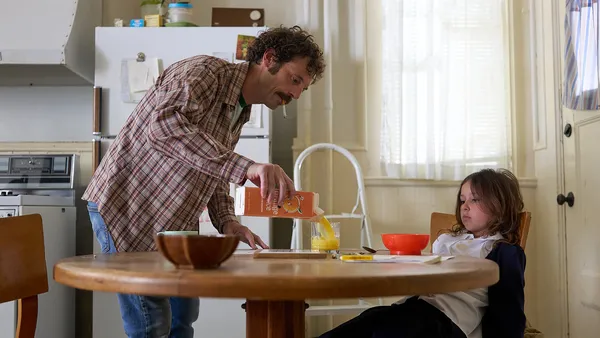
Director Andrew Durham’s début feature Fairyland is an adaptation of Alysia Abbott’s memoir, Fairyland: A Memoir Of My Father.
After the death of her mother, Alysia (played by Emilia Jones), finds her life uprooted when her father Steve (Scoot McNairy) relocates them to San Francisco. While the Seventies West Coast culture allows him to explore his creative voice and sexuality, dating other men, the Bohemian lifestyle struggles to synchronise with traditional ideas about parenting. As Alysia comes of age, there’s an inherent friction between father and daughter as the dynamics of their relationship shifts.
Durham has previously directed the short films Mi Pollo Loco and Bed, Bath And Beyond, and has also worked in the production department on David Lynch’s Twin Peaks: Fire Walk With Me and Wes Craven’s Scream.
In conversation with Eye For Film, Durham discussed the personal parallels with Abbott’s memoir, portraying an imperfect father, industry pushback, and tonal experimentation.
The following has been edited for clarity.
Paul Risker: How would you describe your relationship to cinema, not only on a professional but on a personal level?
Andrew Durham: I always loved going to the movies with my parents, but at one point, when I was about 12-years-old, I was given a little movie kit, and this became my obsession. We set it up in my garage and me and my friends used it as a sound stage. We’d build sets, and I had all the kids in the neighbourhood under contract — we had a sort of mini-Hollywood thing going on.
From an early age, I loved this whole process of bringing things together. I guess it's the same with kids in theatre. They get together and put on a play. My tastes were geared more towards cinema, and so, I was making movies with my friends. And it's so nice that we still have all of those films — they're these little time capsules.
Of course, these movies were primarily mimicking what we saw in theatres. We must have made so many Jaws movies in the lake with a giant styrofoam shark, and they were all very gory. You can imagine with 12 and 13-year-old boys, everyone's getting their heads cut off and blood is shooting everywhere. And we'd even write to filmmakers like George Romero and ask for tips on how to make a squib. We were really obsessed with horror movies.
So, like I said, my relationship with filmmaking started at a very early age, and later, when I graduated from high school in the Eighties, film schools weren't as popular as they are now. My parents were adamant that I go to college, and I remember speaking to a high school counsellor. I said, "Are there any colleges that teach filmmaking?” I found some, and I ended up going to one, and it has never left me.
I can’t pinpoint what it was when I was super young that got me interested in film. Maybe it was one of those activities, like with athletes who find a sport they love or musicians that find an instrument they love to play, and they just stick with it. For me, it was like, well, this is all I know and all I love, so I'm just going to pursue it.
As soon as I graduated from college, I got as much work as I could on movie sets. I didn't know if I wanted to be a writer, a producer, a director or a cinematographer, but I just loved that world of movie making and the magic it creates. Tricking the audience with all sorts of smoke and mirrors is so much fun and editing and just sculpting something from pictures and turning it into reality has always been a passion of mine.
PR: How did you come across and then decide to adapt Abbott’s memoir?
AD: Well, Fairyland was a book that was given to me by Sofia Coppola, a dear friend and producer on the film. We had been looking for something to collaborate on for many years. I knew that if I was going to actually devote some time now and direct a movie, it had to be something I was really in love with, otherwise, it would have been too easy for me to walk away from it. I know how long it takes to do this, and you get a lot of nos in this business.
The book was originally sent to Sofia because the author was interested in having her adapt it. Sofia knew that I grew up around the same time as Alysia Abbott. I also had a gay dad, and we both lost our fathers the same year, in ‘92. There were so many similarities between my life and Alysia that when Sofia read the book, she said, "Well, this isn't my story to tell, Andrew. This is the perfect one for you.” And she was right. I found the story so beautiful, and it was so personal that I knew I was fine weathering the highs and lows of trying to get this made.
It was a real great gift from Sofia. She could have gone and made it herself, but she's one of the most generous people I know, and I've seen her do this with so many other people. She's a real collaborator.
PR: In listening to you speak, the word that comes to mind is “humility.” There’s the idea that a story belongs to the storyteller, but I’ve always appreciated the idea that the story belongs to no one. Novelists like Ray Bradbury and Stephen King have spoken about the writer being like antennae for ideas, and Sofia recognising that she wasn’t the right person to tell this story shows her humility as a storyteller.
I’d be curious to gauge your thoughts on the need for humility in the creative process.
AD: Specifically for this project, this wasn't necessary. I could relate very well to the story because I grew up in a similar situation, but it still wasn't necessarily my story. I owe so much to Alysia Abbott for having the courage to write this book, which is about a complicated relationship with a parent who wasn't perfect. And sometimes, when you're dealing with people in marginalised communities, you tend to present them in a perfect way. You don't like to show their flaws and that was some of the criticism I got when I was shopping this project around. “We don't really like this portrayal of a gay father. We need something a bit more positive, because there's too many people that want to shut down this world.” But I just didn't feel that was honouring Alycia Abbott's story at all, and I couldn't do that. Also, that’s not what attracted me to the book.
I did my best to serve Alysia’s story, and Alysia did her best to serve her father's story. So, what we have here is something a little bit like Russian nesting dolls. And the actors did the best they could to serve mine and Alysia’s story. When you want to talk about humility, ownership is a great way to say this, because I don't think any of us were looking to own this story. Instead, we wanted to share it, which was important to me because of my father and the community.
PR: Would cinema benefit from getting to a place where things are not conceived as black and white. For example, you don’t need to have a counterpoint between two characters. Instead, a single character can make choices that we don’t approve of, but that doesn’t become the totality of who they are.
AD: Those are the films that resonate with me. The ones with ambiguity in the storytelling are the ones I’ll leave the theatre thinking about a lot more. And when a filmmaker or a storyteller is able to present you with a scenario that raises questions instead of answering those questions, I personally find that a more fulfilling experience. And I think a lot of people do. So, I'm not quite sure why within the studio system or the television networks they think that people need every question answered, and why we need endings that are so complete. Life doesn’t end like that. Or the binary situation of good and evil. I love it when those worlds collide, and it just makes for better storytelling.
It confuses me when you get these notes that say this needs to happen, or we need to resolve this. We all like a payoff at the end of the movie, but that payoff doesn't necessarily have to be a plot-driven tidy ending. That payoff could be an emotional revelation, or it could open your eyes onto another world. There are different kinds of payoffs, and I wish that writers and filmmakers would think a little bit more about that.
PR: There’s a gentle vibe to Fairyland, which plays around with optimism and cynicism, and other juxtaposing tones, but not in a heavy-handed way. This allows the film to feel truer to life.
AD: When we talk about tone, I tend to be interested in contrasts. It’s thought-provoking when, instead of having a sad scene, sad music or happy scene, happy music, you flip those. It gets you thinking about things, and it’s more evocative. It’s a difficult thing to do and what I'm trying to explore in future projects is how do we do that, and how do we not undermine expectations? We tried to do that in Fairyland, especially with some of the characters and situations, and it's something I want to explore further.
I'm not sure if that answers your question about tone, but this is an interesting thing that film can do. There are these formulaic expectations in visual storytelling, and it's nice to play with those. It can make for more powerful storytelling, at least visually and emotionally.
Everything plays off of each other, and if you do something different, it refreshes the more formal or traditional approach. You've got to have variety.
Fairyland is in UK cinemas from 29th May and will play throughout Pride Month in June.