




 |
| I’ve Seen All I Need To See |
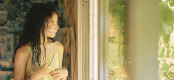
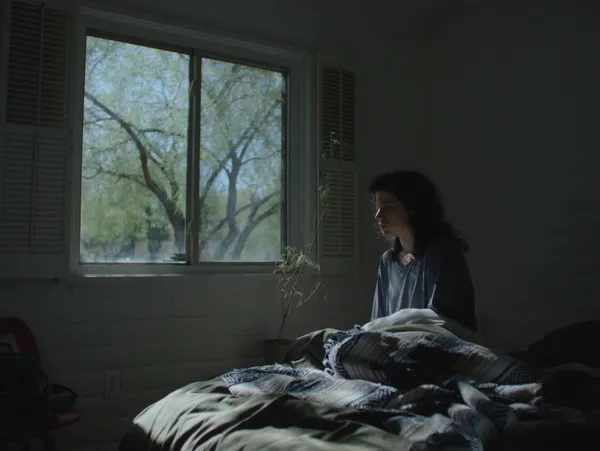
Director Zeshaan Younus’ noir thriller I’ve Seen All I Need To See follows Parker (Renee Gagner), an actress, who returns to her desert hometown after the sudden death of her estranged sister Indiana (Rosie McDonald).
I’ve Seen All I Need To See is Younus’ sophomore feature. He made his directorial feature debut with the desert-set horror The Buildout. A story about two women encountering something strange, it has echoes of his sophomore feature as well as his sci-fi short film Grey Canyon, where a couple encounter a force beyond their comprehension in the wilderness. Meanwhile, Renee Gagner gave an enthralling turn as the antagonist in Ariella Mastroianni and Ryan J. Sloan’s mystery thriller Gazer, whose story revolves around a young mother suffering with dyschronometria that affects her perception of time. Gagner has also co-written the short film Ca Y Est.
In conversation with Eye For Film, Younus and Gagner discussed grief and the introspective nature of art. They also reflected on opposing conventional filmmaking, traversing time and space, the poetic and meditative rhythms of the film, and a love of the desert.
The following has been edited for clarity.
Paul Risker: Why filmmaking as a means of creative expression?
Renee Gagner: I'm curious about human beings and our psychology. Why do we do the things we do and how do we embody those things?
It allows me to explore things in life that I, as Renee, don't always get to. And it also allows me to process things I’m going through, tangentially. There might be things that I don't even know I need to process, and so, it has a spiritual quality that I love too.
Zeshaan Younus: A rocky childhood and not a lot of opportunity to self-express in my household. So, being able to see myself through the films that I was watching was important. The first time I watched a Terrence Malick film, I felt something in my body that I had never felt before. There was this resonance that stuck with me, and for a long time after that, I used cinema as my own religion.
It was really helpful for me to exercise my own feelings, and now, I have a career completely unrelated to film. I make films as a means to understand myself and the people around me better. And I think a good film is one that you will know the filmmaker better once you’ve watched it. I hope that when people watch our film, they get to understand me and Renee a little better.
PR: What were your broader ambitions in telling this story?
ZY: This film is really about losing yourself in the maze of grief, and for me, I obviously like the subjectivity of art. As a society, we're becoming more objective with art, where it's telling you what it is, and that this is all it can be. And if you don't experience it this way, then you're wrong. All the films that have affected me are ones that leave a lot of room for interpretation.
The ethos of our film is that memory is a mirror, and the more you think about the things that have happened to you, the more you learn about yourself. And that's a specific humanistic quality that is so special. The more time we spend thinking about the things that have happened to us, the more power we have in who we are today. That's just a really personal thing, and everybody's going to walk away from this film with something different, or so I hope.
RG: As humans, we are so nuanced and even working on this film, you have an idea of what it’s about, but then you start exploring it, and you find these unexpected layers that you had never really thought about before. So, art is a way to see but also learn and see the layers of humanity in you. And this film is especially quiet and slow, and it really confronts you. You have to be willing to sit with it and let it hit you.
PR: I found this to be an uncomfortable watch, in part because of its quietness. The characters nor you, the filmmakers, are telling us what we should think and feel. Instead, it creates the opportunity for us to consciously switch off and sink into our own minds, sacrificing our concentration and leaving holes in our memory.
ZY: The film leaves so much of a void and it requires the audience to fill it. There comes a certain point in some of the longer shots, where your hearing becomes more acute, and your eyes see things in the corner of the frame, or it feels like maybe the frame is warping a little bit. It changes your chemistry for a short period of time, just enough for you to ask, ‘Am I here with it? Am I missing something?’ And then we go into the next part.
Putting you off balance is part of the process, because grief can feel like it's never ending. And I think that's why the ending of the film is so powerful because, for a moment, we see hope. We don't give it to you fully, but we do let you know there is a page to be turned, and we're here to turn it with you. But the whole film is really a blank page in many ways, and it asks the viewer to project themselves onto it. So, it's collaborative, and that's what makes it unique and also challenging for people, too.
PR: In an interview I did with Karan Khandari, the director of Sister Midnight, he suggested cinema lacks mystery. Have we reached a place where we’re more comfortable when everything is explained or are we too accepting of being told we’re content with a lack of mystery and uncertainty?
RG: It is a part of culture today to intellectualise and want to understand everything or think we understand everything, rather than just allow ourselves to experience something and not know or have the answer right away.
ZY: There's a rationalisation happening with art right now that is detrimental to vulnerability and expression. Artistically, I have an allergic reaction to conventional filmmaking that you can see in this film with the lack of coverage and the long takes. That is kind of waging an opposition front to conventional filmmaking because I do think it is more important to take a big swing and hope that's felt and appreciated.
At the festivals that we've gone to, the audience is very still and introspective. And then, the next day we'll have people come up to us and say, “I have not stopped thinking about your film” or, “I was close to tears because it reminded me of losing my grandfather.” It has even reminded people of a relationship that was no longer a part of their life, and it took a while for them to reconcile that. The strongest compliment you can give this film is that it makes you think about and reflect on other aspects of your life.
The world would be better with more texture and emotionality and vulnerability on screen. And when I can experience it through other people's work, it's motivating and inspiring. And hopefully our film is on that same wavelength for other people as well.
PR: With how the words and images complement one another, could we describe I’ve Seen All I Need To See as being a form of cinematic poetry?
ZY: The film has a rhythm, and you're right, it does have a certain poetry to it. My editor, Matt Latham, and I edited it to a musical tempo. I’m a musician as well, and we were tapping our feet when we were watching the film and rhythmically building towards certain crescendos or narrative apexes. But the film was very steady, and it does lull you into a certain cadence.
We had many instances where we moved a line of dialogue around, and suddenly there was something in our bodies that told us that was correct. And I do think that’s the confluence that you're talking about of image and voice and how it creates a brushstroke.
It's very much about when an artist puts a brushstroke on the canvas. Sometimes you don't know why, but you feel like you’re seeing something in that brushstroke — it matters to you. And that's a universal experience that can't be quantified, because it is something that innately exists between the artist and the person perceiving the art.
Working with Renee on her incredibly nuanced performance, there was such an interesting mechanism between getting Renee into character to emote that voiceover and the feeling through actions while she is saying nothing. So, there's that handoff between the words and the physicality of it that only someone like Renee could have accomplished on screen. She actualises that feeling of the brushstroke from the canvas to now being perceived.
It was a really fine line, and it was a hard one to walk. It was scary in an exciting way to see if we could pull it off.
Renee's capability as an actor to embody herself in those words without saying them is such a skill, because other actors have the benefit of being able to say how they’re feeling, and the audience understands. But Renee didn't have that capability. She had to film scenes and then days later, record a voiceover and connect those two in space and time.
RG: The film is inherently poetic, and in my experience in the liminal space of grief, it brings up poetry in ways that I don't know that I can necessarily define it as such. But I was trying to embody a state where you're experiencing grief.
There are so many textures to grief that it’s just inherently poetic, and I'm not sure if I can play it with words because it’s just how I feel about grief. Thinking about it, the themes and the structure of the film, just lend themselves beautifully to each other.
PR: Parker is a character in a constant state of flux, who, through gestures, words, and even the space she’s in, can contradict what we already feel or know about her and offer a new way of seeing and understanding her.
RG: As an actor, you want to try and live inside or embody things. And I do think that not having much to say allows you to be present, because you just have to let yourself be seen, use all of your senses and feel the space around you. The long takes also allow you to just be, and however it unfolds is how it is.
ZY: Renee is such an intuitive actor, and I remember feeling she was capable of creating universes with nuanced looks. The way she can adjust her eyes is like a lightning strike — we all felt it at the monitor. And the tight 4:3 aspect ratio contributes to these micro expressions because it gives you the space to invest in a face and recognise its certain curves or adjustments. And Renee just has this capability of being able to easily touch the void through her eyes and her gestures, while not falling into the traditional trap of here’s the void. I'm going to jump into it, and I'm going to see where it takes me. Instead, she felt its power and pulled back. That requires a lot of strength, but Renee is so steadfast, relentless and powerful.
PR: On the subject of the spatial, the desert is a striking presence. It’s one of those spaces that can exist as a metaphor that can reach into the soul of a character and a story.
RG: A big part of this film is the desert, which is still, but it's also very much alive. And Parker grew up in the desert. She's a product of her environment; she’s a product of this broken home she has lived in with her sister and family. They obviously feel very deeply [for one another] but have trouble connecting. The desert is such a present character in the film, and it really shapes who these people are and how they express themselves. So, there's that connection, too.
ZY: Certainly the utilitarianism of the desert is important. Everything that is in the desert is crucial to its own existence, and that is a very important part of this film. But also, it's a very bleak and simultaneously adaptable ecosystem, right? Anyone that looks at the desert and says it's lifeless can quickly find, with a little patience and attention, that there’s a lot to be discovered, like finding out where life can exist. That is what the film is about — slowing down, taking a deep breath and finding out how we survive and how we help one another survive, because it is a transaction. We don't exist independently; we exist as part of a tapestry of other people and other things. And it's hard to recognise that, but when you do, it allows for a better quality of life, and I think that's the place we reach at the end of the film. Parker is this independent island and through the grief, the pain and the frustration, she realises that connection has to exist, and that's important. And that is also reflected in the desert.
I'm a desert dog. It’s my favourite place to be, and if I could be anywhere, this is where I would want to be. So, to be able to reflect that in the film and express it as beautifully as we could through light and time, was special.
PR: The film compels a reflection on friendship, and how these relationships don’t end simply because our paths part ways. Instead, these bonds can transcend time and space.
ZY: There are very important people in my life that I do not have a relationship with. Their absence has created such a meaningful presence because of the choices I've made or the person I've become because they are not around. So, you have an interesting transaction there of who am I because I do not have something. And yet, the desire to have that thing is driving decisions. So, it's almost this nebulous feeling and nebulous desire to change your own trajectory based on the importance of a relationship.
Time is so wrapped up in that process because you're working on the end goal of trying to get somewhere. But you don't know where you're going, how you're going to get there or what it will mean when you arrive. And maybe you’ll never even arrive. But that is a really critical part of this film too, because the amount of time Parker and Indiana share on screen together is only 90 seconds total, out of almost 90-minutes. We’re left to feel the echo of that relationship and its importance across time and space.
There's a line where Parker says, “We are already drifting in cosmic nothingness,” and that is her talking to herself. She’s asking where she is in all the feelings of grief and frustration, and how she is to get out of it.
Time is a special thing, and it's one of the things that makes us human, not only being aware of it but wanting to control and change it. If I were to think about where I want to be in six months, I'm going to make different decisions today to get there. And that’s a specific humanistic thing that this film in many ways represents.
RG: I meditate a lot, and my process is, however long it lasts, you simply allow yourself to experience it and to let it take you wherever it will. Most of the time, this can be to places that you were not anticipating. And then, afterwards, you allow yourself to journal about it, explore and integrate it.
This film is a meditation. It is that structure of having gone somewhere unanticipated, and in this case, I had to let go and allow myself to be present. I didn't really want to do that; I wanted to think about something else. But the scene was still ongoing, and I was being confronted by it. So, to me, it feels like meditating, literally and figuratively.