 |
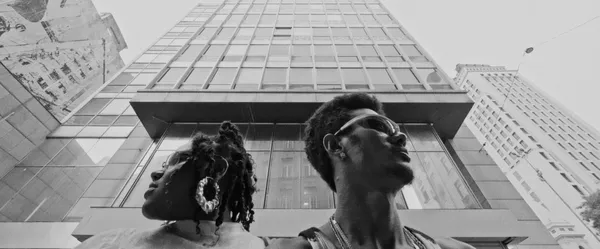
| Iraci Estrela and Kelson Succi in Tony Odyssey |
Tony (Kelson Succi) cleans toilets in a bar in rural Brazil. One day his best friend Ivy (Iraci Estrela) turns up, takes his boss hostage, and enlists him in a robbery. Her plan is to steal not just money, but also a mysterious drug which will enable them to set out on a quest to meet God. This is Tony Odyssey, the trippy début feature from Thales Banzai, and it’s set to screen as part of Fantaspoa 2026. Thales took the time to meet up with me and explain how it came about.
“It started with me wanting to do something that I could do on my own, a completely independent film that we could shoot during Covid,” he begins. “I wanted to try something that I was able to create on my own, with close producer friends also. The core of the film came when I got connected with Kelson, who plays the protagonist and is also the writer of the film.
“We created the story together, and we had never met before in person. I had watched a play of his here in São Paulo, Brazil, but we only got connected by my casting director, who felt that we would be a good match. He was always insisting for us to try to work together. From there I had just the initial draft of what the story was, the first part of it and the robbery and the two best friends, then going into a more surreal and subjective journey into his memory. And just some loose ideas of scenes, of themes that I wanted to tackle in the film. Together, then, we developed the script.”
I remark that a lot of the challenge of this kind of filmmaking is bringing those ideas together in a way that, while it's surreal, still makes a certain kind of sense and still keeps people engaged.
“Yeah, this was my main concern since the beginning. Kelson is mostly from theatre. He works as a director, writer and actor for theatre, so he's not very familiar with the process for writing for film, which I thought was a great thing, actually, because we could collaborate and bring these roots of theatre also in Brazilian cinema into this film, which was something that we wanted to do. But I also felt that we were running the risk of the film being too loose. My main collaboration for the script was always getting the text that we had and going back to structure and trying to structure it, so we were always able to follow the thread and to bring the audience with us.”
The drug idea might make that easier, I suggest – but how did he persuade actors to agree to having it dripped into their eyes?
“The drug idea was something that came later on,” he says. “It was more an excuse that we wanted to have to be able to go into his character's mind. We wanted to distance ourselves from like a specific kind of drug, to create something that was more about the ritual than the drug itself. So she [Ivy] preps the paste that she steals, but she also adds some stuff that she has on her own. We don't really know what she's prepping there. She's kind of a witch in a way.
“The eye thing was because it changes the way you perceive the world, and also distanced [the story] a little bit more from the idea of drug deals in a more obvious way.”
I won't give away the ending, but note that it does connect well with the idea of people watching a film. There's a lot in the film that relates to that.
“Yeah, yeah, a lot of that. The metalinguistics of the film, the ending. We had many different possibilities, and in the end, the best one was the one that tied with cinema, with the language itself and with the changing of language towards the end of the film. It was the one that we felt was the best solution. Something that we knew since the beginning that we wanted to do was that we wanted to start the film in a way that it felt like a Brazilian film in a way that you imagine at first – guns, robbery, violence in a bar – but then we get you and take you in a different direction completely. We felt that if we started already in the middle of the trip, it wouldn't work. We had to create some familiar situations so people would lean into the film and then we take them with us.”
The opening is very cinematic and very beautiful, particularly because of the black and white. But was the choice to shoot in black and white mostly about making it possible to do other visual things and bring colour into it in relation to the drug trip?
“The colour for the drug trip came later on as just an accessory. I would say during post production, we were thinking of ways of doing that in analogue way that also connected with the theme of the gods and computers et cetera, but the black and white itself was something that I knew since the beginning that we wanted to do. One, because I felt that we could create a more magical world easier, as we didn't have a big budget to work with. With the black and white, we could be more expressionistic, more artistic, and also it would help us with the production value of the film. So it worked in that way.
“Also I felt that artistically since the beginning, you understand that you are in a different world, and it's not a naturalistic Brazilian drama that you're watching. Since the beginning, you know you're going to something different. I feel that black and white helps in that way. And I personally love black and white. I take a lot of black and white pictures, analogue photography, so it's something that I'm very familiar with.”
At the start, the soundtrack makes an immediate impression. It's a powerful way into the film, I say.
He beams. “I don't know how we managed to get some of the greatest Brazilian musicians involved in this, but we have some pretty strong names that worked in the soundtrack. I feel everyone was a little bit tired of working just for streaming, then doing some more commercial work, and they wanted to do something different. But the music, I think it also ties with the black and white idea because we didn't want the film to feel black and white. Your memory of the film is colourful, and we felt that music was the main place that we could work with that.”
Though I don’t mention it at the time, because he’s speaking fast and enthusiastically, I reflect that I had in fact just realised that I was recalling scenes in colour which were not shot that way.
“I think music and the wardrobe [helped] our chances in to bring the colourful idea into the film,” he continues. “It's mostly original soundtrack, besides the jazz parts from the coffee shop in the middle of the film. We have the lyrics translated also, so you can understand what they're singing about. We had the drafts for the music, and I was able to shoot the film mostly for the music, kind of in a music video way. And then we just adapted it later on, the duration, and finished it properly. But, yeah, the music was the big heart of the film.”
I recall that he has a background in music videos.
“A few that I directed,” he says, “but some that I produced for France and here in Brazil also. So yes, it's something that I really enjoy, just closing my eyes, listening to the music and trying to imagine what's going to happen. This process was really rich in this way because I would give some ideas of the scene and the characters for Kiko [Dinucci], the composer, and he would work in a version, then he would give it back to me. So I would try to write the scene with Kelson for this moment, and we would be back and forth until it ended up that way in the film.”
I tell him that I'm interested in the way that the film explores the nature of memory and the fractured memories that Tony has as he's trying to find out more about how he came to be trapped in that miserable job, or trying to understand his reality.
“Memories was the initial thought of the film,” he says. “My main conversation with Kelson was ‘How can we access memories faster in the film? How can we jump to memory?’ Because I think this was the part that interested me the most. Him looking into his past – and what does he remember? How does the drug effect change your memory and let you access it, but sometimes, like when you're having a bad dream, at some point, you exit it and you don't access the full memory. So you go out of the door and then you go to another door. There's a new memory in a new language, that is presented to you in a new way.
“I thought it was also a good way to explore cinematically different ideas of how to light a scene, how to rehearse with the cast and explore the deep soul of the character. I think it was something that was interesting to me as I knew I was going to edit the film. I knew how to shoot it so it would work. Also some of the transitions, and as you go deeper and deeper into his memories and go back to their journey in the city, I was interested in that.
“I feel that the past decade in Brazilian film, in which we had amazing films, it was mostly more naturalistic dramas. We also have like horror and we have many different dramas, but the overall picture, I feel it's more in that direction. For Kelson, I think it's maybe the essential part of this, because he's a black kid from the slums in Rio. He's always used to people asking him to talk in a very specific way about racism in Brazil, so he always feels trapped in a box.
“This film is also about race and also about poverty and about many different things, but in this very specific way that is surrealist and more open ended in a way. So he was very excited to work on that. I think this was the glue that glued us together for this project. I wanted to try something different. He also wanted to try something different, and we ended up working in this more fractured way for the film.
“I feel that his background in theatre was great. When were writing the project, I did not tell him that he was going to play the character, so he was not too concerned about it. He learned about this later on. But I think all of the other cast members had a background in theatre or they were now acting in theatre also. I felt that it was easier to create this sense of family on the set and also to try different things and not be too concerned about how it's going to play for the camera – which is good and bad in a way, but I think for this particular film it worked the way that we wanted. It led to working with these ideas more freely.
“I felt like working in a more theatrical way also with the acting. Everyone was suggesting many ideas that we were able to incorporate in the film – mostly in the middle sequence in the coffee shop where it's more improvisational, when they have more of a theatre performance, I would say.”
The thing that anchors the film and keeps all this together is the relationship between Tony and Ivy. We don’t see many male/female best friends in cinema.
He nods. “In the beginning we thought maybe they should be a couple. We had this idea for a while, but then we understood that friendship was way more powerful for them together in the film. We knew that Ivy was like the counterweight for him. They needed to work together fluidly. She also had to ground him. And they kind of change roles. In the beginning she's pushing him and in the end he's guiding her. That was something that we knew was going to be tricky, but as we had Kelson, we knew that the partner should fit him.
“We were very, very lucky because Iraci, the actress that plays Ivy, she was the first one that submitted a self tape for us. We did not have [much] time for auditions. We had preselected 10 to 15 actors that we already knew that we enjoyed – we wanted to see how they would rate this character – and a few other actors that we had never heard about. And Iraci was one of them that we didn't know before, and she had never worked in a feature film before. But the way she gave her reading of the character, that is more playful, it was the perfect thing that we did not reach when were just writing the project. That was the key for her character and was perfect. And then them getting together was easy because Kelson also loved her and they are friends now for life.”
I ask about the practicalities of shooting an odyssey, because obviously it involves lots of different locations and sets. It must have taken an enormous amount of time, just moving around and setting everything up.
“Yeah.” He smiles, slightly abashed. “We did the opposite of what people tell you to do in your first film, which is going to one house with two people and making a horror film. In the beginning I thought I was going to do that, but in the end we had, I don't know, 15 locations and a huge cast and a lot of things. But people were really involved in the film. They put their hearts into the film, so it was also a joy to work with everyone and to make this happen. I feel very blessed because we were able to put together a crew that, like, everybody was in sync. Everyone wanted to make this film. I also left a lot of space for collaboration for every department.
“Many departments of the film are from different regions of Brazil. The production designer is a friend of mine that lives in Belém, which is in the north, in the Amazon. So he came to São Paulo. I'm not from São Paulo. Also, Kelson is not from São Paulo. So it's kind of a different reading of the city. Also the odyssey, I think, is, in a way, São Paulo. Because most Brazilians come here to the city, and it's a little bit like their experience – like when you arrive there are huge skyscrapers and your first day here will definitely be somewhat chaotic. I feel that São Paulo was the blending of all the ideas and what made this all work.
“I had been living here for ten years, so it was, in a way, also a love letter to the city. It's something that I really enjoy about the city, the strangeness of it and the very specific characters that we find every day that we go out in the streets. And the sense of community and people getting together also and having fun, but also being dangerous. So it's this balance that I feel in itself, it's an odyssey, every day that you’re living in the city. I'm not living here anymore, but whenever I come here it’s many mixed feelings, because I love this place so much. It's very energetic and chaotic, but I love being here. The city was what tied it all together.”
He’s thrilled to have the film screening at Fantaspoa.
“I feel amazing because I had many friends that screen there – mostly short films - and they always told me that it was an amazing festival. I haven't been there prior. We'll be screening on the 24th and we are going to be there. The actors are coming too, so it's going to be a proper screening. I feel it's the right festival for the film here in Brazil, also in Latin America, so we're very glad to be premièring there. We have other friends that will be there also so we’re happy to be able to share the film. And I'm curious about what the Brazilian audience will feel about the film because we screen only outside of Brazil now. We screened in the US in Slamdance and Ann Arbor. So this will be our first Brazilian screening.”
There will, no doubt, be many more to come.