 |
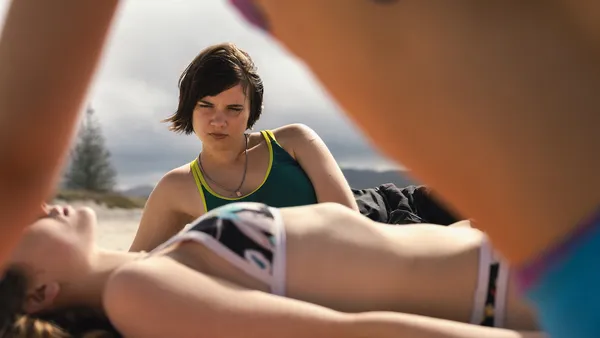
| Big Girls Don't Cry Photo: BFI Flare |
New Zealand director Paloma Schneideman’s début feature Big Girls Don’t Cry follows 14-year-old Sid (Ani Palmer) as she wrestles with her burgeoning sexual curiosity and desire for acceptance from an older group of girls during the summer holiday break. Meanwhile, her sister Adele (Tara Canton) returns home from college, accompanied by her American friend Freya (Rain Spencer).
Over the course of the summer, Sid forms a sisterly bond with Freya. The newfound connection is welcome, even intoxicating for Sid, whose absent mother and cantankerous father Leo (Noah Taylor), who struggles to connect with either of his daughters, leaves her short on human connection. The pursuit of acceptance and growing curiosity risks Sid’s one genuine friendship, leading to a transformative summer where life lessons will be learned.
Schneideman’s previous credits include the short films Memory Foam, about a married couple shopping for a new bed, whose relationship is put in an unexpected context, and Gate Crash, which follows a group of teens celebrating the end of high school, that escalates when they cross paths with a stranger.
In conversation with Eye For Film, Schneideman discussed using cinema to explore the human condition, showing her flawed but human character’s empathy, and making an offering to the coming-of-age genre. She also reflected on her own upbringing, divine intervention and healing.
The following has been edited for clarity.
Paul Risker: Can you remember the moment when you realised you were creatively driven?
Paloma Schneideman: I remember as a child, my favourite thing to do was lie on the floor in the living room and write stories. And I remember I got really excited by computers, especially in the Nineties or the 2000s when they had all those really shitty slideshow creators that you could do in Microsoft Word. I would spend my weekends building stories on slideshows, and it was just always an urge and an instinct to tell stories because of the way my dad could command the attention of a room when telling a story.
Stories are a potent and powerful currency, and I've just always loved storytelling, be it music, film, theatre, or dance. And I was just raised by TV. I lived in the beautiful countryside surrounded by nature and all I did was watch TV all day. So, it has definitely informed who I am.
PR: Watching Big Girls Don’t Cry, I have the impression you’re somebody that is inherently curious about human nature, and for whom, cinema offers you the opportunity to channel this curiosity.
PS: I'll forever be trying to understand the human condition, I guess. There’s that recognisable feeling when you're watching a film, where for a second you feel like you've received some sort of gift or secret code from the filmmaker. You think, ‘I’m pretty sure they made this just for me.’ What I hope to give back to viewers is that moment of epiphany or clarity, even if it’s just for a second that you feel a little bit more understood, or you feel like you understand the world a tiny bit more. I'll forever find humans fascinating and try and zoom in on the little details about them.
PR: While this is a film about a teenage girl, I was still able to see something of myself in Sid. Human beings like to categorise and create rigid definitions to understand ourselves and our world. Films like yours use empathy and emotional resonance to remind us to keep an open mind because life is complex.
PS: That’s so lovely to hear because, telling this story about a young woman, when talking to the audience, sometimes there’s not the pressure, but [the feeling] that it's a film for young women or a film for young queers, and I don't think that’s the case. It’s certainly not going to be for everyone, but there's something here we can all see in ourselves, particularly men and dads. And some of the most meaningful responses are seeing how dads react.
What I've tried to do with the characters in the film is to have them all mirror each other. Freya, Leo, and Sid, they all just really want to be loved, right? And they're all sitting on some sort of intrinsic shame that they're moving through. I just see the film as a bit of a fun house, where everyone can see a version of themselves. And it's not a very pretty version at times, but that's life — we just do our best.
PR: We all have a shadow complex, meaning we are all inherently flawed. It’s important to acknowledge this and the film would be doing itself a disservice if it didn’t lean into these different sides of its characters.
PS: What was important when writing the script was clocking that I wasn't judging the characters. You really have to love all the characters or at least have empathy for them, even the boys who are acting from a toxic masculinity mob mentality. That's why there are little story beats that actually try to shine a light on the pressure that they're under, because I believe we do our best and no one's inherently bad. We're just products of our environment and everyone's complicated — most people are good but flawed. So, I tried to love all the characters and show their different sides.
PR: It’s a commitment to make a film, requiring you to give up a period of your life, that requires everyone to believe in it if the audience are to do so. What compelled you to believe in this film and decide to tell this story at this particular point in time?
PS: The idea came to me like it was divine intervention. I wasn't trying to come up with a story or anything — I wasn’t sitting there doing my teen ideas. I was with my ex-partner at the time, and it just came like a vision.
I'm a believer in the theory that ideas are floating around in the ether and no one owns them. But sometimes they come to you, and you have to grab onto them, because if you don't, someone else will. So, it just came to me in the form of a strong vision. I worked backwards because I knew how it ended, and so, the rest of the journey was building it up to get there.
I'd be lying if I said it wasn't based off quite a bit of my own upbringing. Those things of living in a small rural community and then the city folk coming, I always thought was a great premise for a story. In New Zealand, the summer is such a special time and as teenagers, we all place this importance on New Year's Eve. You start planning your New Year's Eve the year before, and often you go away somewhere to a festival, camping. It's where you do your first drinking, drug taking and have your first sexual experiences. So, everyone puts all this weight on New Year's Eve because who you come out as on New Year's Eve is who you're going to be for the next year — everyone is trying to evolve. I liked that as an idea for this young girl, who is having her first taste of identity and sexual awakening and really wants to belong. I also liked the idea of using a six-week break as a metamorphosis for her.
All those elements were pretty true to my life. I was in my twenties when I wrote the story. I’m 33 now, and I realise that once I found my community of artist, actor, and writer friends, we would all talk about coming-of-age and our first experiences. And it was only when we started to collectively talk about it that we could name those things that happened. There was just a lot of, "Oh, wait, that happened to me too.” There was this collective healing and sharing of power by just naming the thing. And so, I felt almost a duty to tell the story and make an offering to the coming-of-age genre through a very specific New Zealand lens.
I always say it was the film I wish I saw when I was fourteen, and I think making this film was a little bit of healing that inner child. And then for people in my community to say, "Yeah, some of the stuff that happened was not good. Let’s talk about it, let’s find the language and hopefully find some collective catharsis.”
PR: What’s striking is the way you create tension between the personal and the universal, because what you’re offering to the coming-of-age genre is personal to the character of Sid, but is also a common experience.
PS: The coming-of-age genre is a funny thing, right? It's probably why there are some defined conventions that come up all the time in these films. I remember when I showed my friend the first cut of the film, during the quite potent and sad scene in the sand dunes, she said, “Oh, this reminds me of How To Have Sex.” And for a moment I panicked because I thought, ‘Oh, shit, I wrote this before that film even came out.’
I don't want to ever feel like I'm copying someone or something. Then it dawned on me that, of course, it does feel like that because at any given time, in a hundred corners of the world, there is a person like Sid doing something she doesn't want to do in a bush somewhere. And actually, that's the strength of the film, not the weakness of seeing a version of something you've already seen — I almost felt a sense of pride.
With mimicking and the building of identities, we are all trying on so many masks at that age. And I thought setting it in 2006 was such a potent backdrop for that because not only is it a loss of innocence for our protagonist, but it was really a loss of innocence for the nation. We had just got the Internet and MTV and all of a sudden, we could look up anything we wanted to know.
We had a lot of people from the age of 14 to 22 playing our teenagers. And when we'd rehearse, I'd be like, "Surely it's better now that everyone's talking about things and regulating…” They said, "No, it's just its own version of the same thing.” Yes, kids are more clued-up, but it’s different versions of bullying and pressure. I thought, maybe it never gets better.
PR: Big Girl’s Don’t Cry is driven by the characters, but a film is constructed from multiple layers. As a filmmaker, you are trying to create a harmonic cohesion between the aesthetic and these other layers that emphasise character, emotion, themes and ideas.
PS: I've always prioritised performance and tone. We spent a lot of time working on this story and I felt confident about it. So, when we were in that edit space, we really let tone lead the telling of the story, which looked like we were trying to drop you into a very visceral space of feeling.
I will forever prioritise those things over how a film looks. Luckily, we had a great cinematographer, and we had a plan around how we were going to mirror the emotion, the feelings and the psychology of the film. But I've always thought I could watch something filmed on a three-megapixel camera if the performances felt honest and real.
Big Girls Don’t Cry premièred in the World Dramatic competition, and went on to screen at SXSW and BFI Flare, ahead of its release in the US later this year by Blue Fox Entertainment.