





 |
| Body Of Our Own |
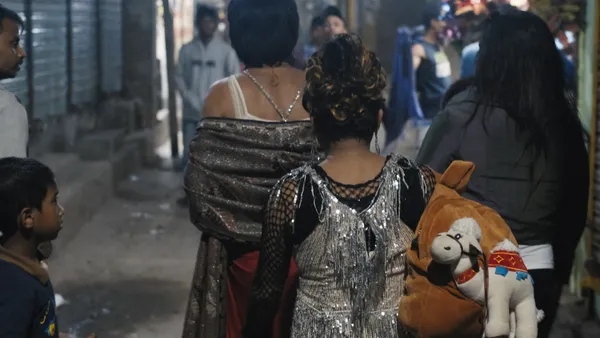
“When I was working in Bangladesh in fashion, I came across a group of hijra women,” Rahemur Rahman tells me as we sit down to discuss his film Body Of Our Own. “It actually started with an altercation. They were trying to rob my bag, which had my passport, my money. We had a kerfuffle and then I did get my bag back. But then what that started was just lots of inquisitive questions from my side.
“I felt like, as someone who's very visibly queer and quite calm in my demeanor, I would be a safe space for them, but it was understanding why. Lily [has done some volunteering] with Human Rights Watch, so when we came back to London, we started having much more contextual conversations, and through all of those conversations, the film was born. And we always wanted to make this documentary the most ethical way that we could. Before we even started shooting, myself and Lily were just doing loads of research. We were watching every documentary out there around the trans community in South Asia, so that were more informed in how we wanted to make this film.”
Body Of Our Own is screening at BFI Flare, and they’re taking it as an opportunity to try to increase public understanding of hijra experiences. It features three hijra women – Neshi, Momo and Jannat – with very different lives, and looks at what they have in common.
“I think at the time I was shooting the LGBT South Asian community in London, and I was feeling like that there was a very specific, white lens on the community,” Lily remembers. “Maybe it wasn't always so collaborative and there was a lot of stigmatisation. And so I immersed myself into that community and that's how I met Rahemur. We had a very strong creative connection, which meant that it felt natural to then go and shoot in Bangladesh together.”
 |
| Lily Vetch |
“We were really in love with observational documentary, and we wanted to make a feel to the film that almost lets you forget that it's a documentary at times. There was no agenda with what were wanting to find or seek. We actually just wanted to become their friends and hang out, and we wanted the lens to show that. From the beginning we always wanted it to feel like as if the viewer is the trusted third in this space. A lot of queer cinema inspired the way we shot this as well, Pose being one of them, and also Paris Is Burning. Both of us love Sex And The City and I love the idea of female lead films. When we shot this and when we edited, it was more just letting their stories come to us first and following them through. The stories kind of have evolved because we have had so many edits of this. This now feels like the most honest version of what we saw and what we experienced and still experience, because we are still there.”
I meantion that my experience working with people from that part of the world has been that there are lots of different ways that people identify what we might call their transness or different aspects of how they relate to gender. It's really difficult to make a documentary that explains ‘the experience’ when it's so complicated. Was that partly why it made sense to make something so personal to these three women?
“Yeah, I think that we didn't want to lay out super clearly and over-explain that identity,” says Lily. “You can look at the textbook definition of a hijra, but I think we were just reacting to this fluid conversation around their identity that wasn't so dictionary, and that was personal and intimate and making sure that they were defining themselves, and we weren't bringing that language to them too much.”
“We wanted tha the viewer to have a bit of autonomy and to go out and find out,” says Rahemur. “For us, the aim was always to get people to empathetically understand these characters and the issues that they are being held by. Rather than the usual dictating in a very traditional documentary, we wanted to make people feel like they had immersed themselves in their life, like they were living it with them, being with them when they're breaking up with someone, when they're falling in love. The idea of being alone, what does that really feel like?
“One thing that was really fascinating was the language that they used to describe themselves. Over time, from when we first started, where there wasn't that idea of transgender. One of our charity collaborators did use the word. She would describe herself as transgender. Momo, who's in the film, didn't for a long time. We saw that evolution of how the queerness of globalisation was taking effect in South Asia. In a way, we were quite lucky to see that transition, to go from very like old hijra structures of how they have always lived to this glimmer of hope, this possibility that they can self define and move forward as individuals. But yeah, actually, what was your takeaway over the years?”
“I think that it's interesting seeing how Momo and Jannat gain such confidence and strength to live so independently,” says Lily. “And seeing all the stuff that they have to come up against , they're all ultimately looking for a similar thing: freedom and autonomy and community. It's been interesting and kind of heartbreaking at the same time in some ways to see what are the elements that are making it possible for those women to obtain those three goals. And I think Neshi particularly, she's so sensitive and generous and kind, but she doesn't often put up boundaries. People can take advantage of her too much. That was interesting to see over the seven years [that it took to make the film], how that played out.”
“Momo and Jannat are actually really big friends,” says Rahemur. “They actually live next to each other, and when we first met them, they were living together. But we chose, in the way we edited it, for it to be these three characters who together were telling the world a story of what it is to be hijra in South Asia. Neshi justhas harsher situations around her and has to make quite difficult decisions, and we watch her make them. Jannat's view feels like the love part of the hijra community, the idea that they all do want to live in a house and have a husband and have kids. And then we have Momo, who is almost like a pioneer. She's the vivacious one who's wanting to win awards and be famous and get that recognition. We've seen elements of all three in every single hijra person we met, and touched on what they were saying. We used their three lives to collectively tell the story of what it is like to be hijra in South Asia.”
“I'm not queer or South Asian and I know people outside the community press stigmatisations and tropes onto the community,” says Lily. “I think because I'm not from any of that background and I'm a self taught filmmaker, along with Rahemur who is also self taught, everything was instinctual and collaborative all the time. I think what made them quite comfortable is that I came in with no preconceptions or anything. I hope you can see it in the film, that they feel very safe and comfortable. We just ended up feeling a bit like some girls hanging out in their room talking about boyfriends and partying, so they were seen as humans and individuals. Sometimes you will watch other documentaries and around the community and there's a quite scripted take on how they interview the girls. We didn't want to package them up too much.”
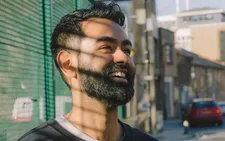 |
| Rahemur Rahman |
I note that there's a moment towards the end that I think will be shocking for people who are not familiar with those traditions, in which Neshi is talking about the risk of being tortured by her guru if she leaves to pursue a different way of life.
“When we stopped filming, we actually left her in a situation where it actually was quite volatile,” says Rahemur. “She actually fell ill and we had to help her through that a little bit as well. But she just was somewhere that wasn't safe. She started to also identify as transgender and she's actually moved to a city now. What is really lovely is that she actually found stability, and isn't anywhere where she has to perform a certain type of hijra or a certain type of trans person. We follow and speak to her on social media, so we see her evolve all the time. She's so much happier now and we're so glad for that.
“In the film she shows up what it's like if you stay within the rigid constraints of being a hijra, whereas both Jannat and Momo personify what a lot more women are doing as both were leaving these old traditions to self define themselves. And I think in today's age, from when we first started filming to now, trans lives and trans experiences around the world, but specifically in South Asia, are getting worse. I think we're quite lucky to have captured it where people were living so freely because obviously right now the Indian government is thinking about retracting trans rights completely, so I feel really lucky to have seen them live completely openly and freely before these rigid restraints are about to get tighter and tighter on trans communities.”
They’re also very pleased to have their film screening at Flare.
“I think it's a lovely safe community to start off with,” says Lily. “I just hope that [the film] goes into the mainstream as well because I think it's very lovely to have that conversation with the LGBT community, but actually, the education comes within the straight community, particularly straight white men. So I'm excited and I hope that this film travels to some of those more mainstream festivals and that voice comes into those spaces as well.”
“I love that we started off in London-based,” says Rahemur. “We are both Londoners, and a lot of the community who have helped us build the crowdfunder are from London. This feels like a home win. Obviously we haven't had institutional backing for production to make this film, so it was by the community around us and people from every walk of life. But like Lily said, we hope that this travels far and wide. We have applied to loads of different film festivals and the aim is to have as many people as we can watch this film, but mainly in order to have discussions around queer and trans identities and how they navigate life as a broader thing, which we would love.”