 |
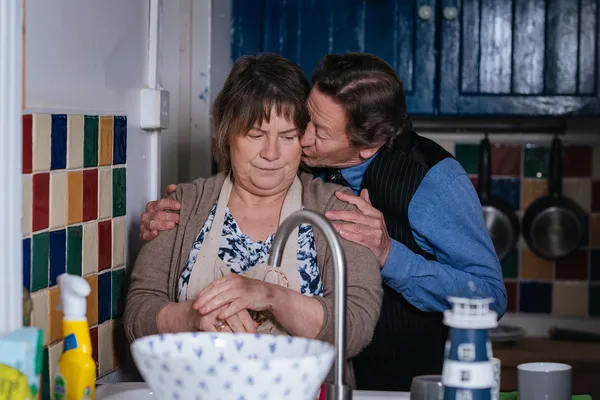
| Mary McEvoy and Brendan Conroy in Abode |
An anthology film comprised of five stories on the theme of home, Liam O Mochain’s Abode opens in cinemas across the UK tomorrow, Friday 20 March. It’s a film that reminds us of the different things that term means to different people, of what it’s like to be without a home, and of the dreams that keep people going in difficult circumstances. Liam is a busy man, a founding member of Irish Film and Television Academy and heavily involved in supporting industry workers, but he found the time for a chat. This particular film is of particular personal importance to him.
“Home is obviously very important and relevant to everybody,” he says. “I was homeless for a while as a kid and ended up being fostered in different families, so home has many different meanings to me. It was very important for me to find a home, so that was probably always at the back of my mind, to do something about that.
“I was thinking of doing a documentary about the different types of places that people live all over the world, from houses built into mountains to under bridges – you know, there's a community in Las Vegas that lives under a bridge. And then you have all these TV programs at the most amazing houses in the world, and then you have the miniature houses and you have the van people living in vans. You have all this kind of stuff. So I thought I was going to do something on that; and then I just thought there's just so much of that already out there.
“It inspired me to think about it in live action instead of documentary. I took some of the ideas that I had, stuff that I'd heard about and stuff that happened either to me, to other people, or that was out there in the public domain, and put it together in my way that I do stuff. It's very similar in style to a film I did that I finished in 2017, called Lost And Found, which was seven stories connected by a lost and found office. I wanted to revisit that sort of anthology film.
“This idea of home just came to me and I had so many different stories that I wanted to tell. I ended up with about ten of them and then I whittled them down to five that I really wanted to tell. Then it's up to the audience to just take what they want from those stories and own them, if you know what I mean.”
It’s often difficult to get funding for anthology films, I note.
“Yeah,” he nods. “It is difficult to get funding for something that you're not quite sure how it's going to come together. Like the last film, I didn't go looking for funding, so I did it myself and paid for it myself over a long period. On this particular one, I did two stories in one year, and by the time I finished the year and I had them, I had just about paid for them. And I started on the roller coaster again the following year, another two, and then by the end of that year I just about paid them. And then the third year I did the final piece and then the following year I worked on the post production.
“At the end of the whole thing early last year, I had just finished paying off the whole film. So at least I don't owe any money to anybody on it, just to myself, and hopefully I'll see it back. But that sort of element, you know, it is difficult. I will be applying for funding for the next project, which is not an anthology film. It’s supposedly a straightforward, one story narrative. It's never easy to get money, but at least I'll be able to pitch it and say I know what the story is and where it goes, from A to B, as opposed to ‘I'm not quite sure which story I'm going to fit into this part of the film.’”
I compliment him on how polished it looks for something made in those circumstances.
“I had a certain amount of time,” he says. “I mean, when you're shooting, you don't have time, but you have time in prep. Time to write, time to reproduce, time to get the crew and cast together. I had time to look at locations, and I was able to schedule two stories in a four day shoot. If you're doing that over a long weekend, it's easier to get people to commit to four days than 20 days or 25 days, you know. So I made the best use of the resources that I had, and we hired the best equipment and we got really good deals because again, we only had it for a few days.
“I made sure that I got what I wanted within that time and then I had time to think about the next one. But one of the biggest difficulties when you're editing something like this is figuring out which story goes where. I wanted to started on a certain type of story and then I wanted to end on a particular sort of type of story as well. I hummed and hawed about which story would better for it to finish on. I just thought that the beginning and the end should have similar ideas and story. Then you need to figure out what goes in between and where you can put the light-heartedness.
I tell him that I really liked the middle story because it gives us the impression that it’s talking about one kind of home, in the future, when really it’s talking about another, in the past.
“I wanted to tell that story from a human side,” he says, careful to avoid spoilers. “You can do these things without having to say that, you know, this person's responsible, that organisation is responsible. You just show the human element of it. I don't think I've ever seen a story that's just about those few hours before this incident happens, and that's what I wanted. And also, you don't know what the family are preparing themselves for. You're slowly finding out, and then when you find out, you're going ‘Oh, okay, that possibly makes sense.’
“Homes are rooted in all of the stories, and you don't always know what's going on. You might see something on the surface, but something else might be going on in the background. You can take any home at any particular time in any place in the world, and you get a certain glimpse, but that's not necessarily the full story. You could come back an hour later and it's completely different, what's going on, you know, so it's that sort of idea. On some of these stories, if you didn't have the twists and turns that happen in them, they'd just be normal stories, and that's kind of what makes you look at them in a different way once you understand what's going on.
“They are all their own story, first and foremost. The stories have to work within themselves. If they work within themselves, then they should work within a collection. You get one feeling from the story if you just watch it in isolation. You then get a different feeling from the overall film by watching them as a collection.
“You’re left with a certain tone, a certain feeling. It's all about feeling. But they need to stand on their own, and you don't know quite know what you're going to get in the next one. That's what's nice about anthology type film, that you just don't know what you're going to get. If you knew what you're going to get, sure what's the point then?”
It’s all held together by an impressive cast.
“Quite a few of them had worked on Lost And Found previously with me and then others I'd worked on other films with, and then a few I hadn't worked with before. I just kind of felt they were right, or I'd seen them in something and I just thought ‘Yeah, I can hear my dialogue in their mouth, I can hear them speaking it in my head. I think that would work.’ They're all just amazing actors.
“You make films for two reasons. Sometimes they're in the same film, sometimes they're not. You make films to entertain or to educate, and sometimes you'll get both. I wanted to entertain people, but also that you take something from it, whether you realise it now or you realise it later on. Every film starts a conversation, no matter how good or how bad it is, no matter what style or genre it is, if you go to the actual cinema and watch it, if you are with somebody or if you're with a crowd and you talk to people It generates conversation.
“This type of film, it's harder to get an audience to go and see it because it's smaller. There's no A-list stars in it and it doesn't have a big studio or whatever behind it. You're kind of twice trying to edge your way in there, in between other films. But it has something to say. I would hope that people would take something from it and learn a certain amount about the different characters and about the stories and maybe a little bit about themselves.
“A lot of these characters are around you all the time, you know? You just don't always see it because we've got busy lives.”
He’s busy, at the moment, with developing future projects.
“I'm writing lots of stuff. In the past, whenever I've talked about what the next project is, it usually then doesn't become the next project. So I have three different scripts that I'm working on right now, and they're all at different levels. One of them is at a level that I can go out and make it myself in the next two years. Another one has a slightly bigger budget that I couldn't afford to do. And then there's a very big budget one. So I'll work on the scripts and look for funding and in the meantime, and bring this film out hopefully to other countries as well and to film festivals. It's been invited to screen in Arizona at the end of April, to have its US or international première there at the Arizona International Film Festival. So hopefully I get to go there, depending on how things are going on in the world.”