 |
| Resurrection |
Chinese director Bi Gan has singled himself out as one of contemporary cinema's unique voices. His films are not guided by an adherence to a strict narrative tradition. Instead, he embraces cinema or a story as a prism for ideas, while exploring the audiovisual language.
Bi's début feature, Kaili Blues adopted the premise of a rural doctor searching for his nephew. His sophomore feature continued this theme of a person searching, but this time saw a man who returns to his hometown looking for a woman he once loved. Now, Gan adds a new layer to this thematic thread with the ambitious Resurrection. Setting it over the span of one hundred years, he uses a century of cinema history to explore Chinese culture and history.
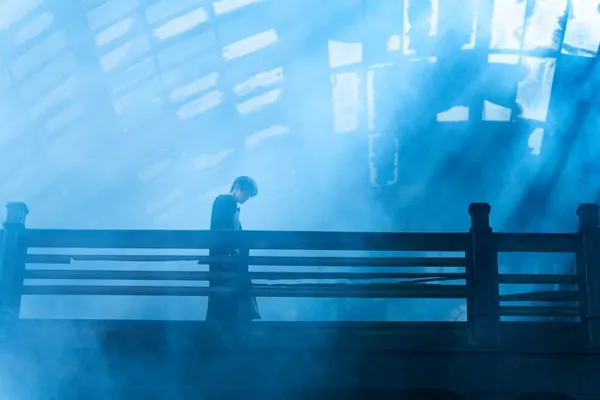
In Ressurection's alternative reality, dreaming has become outlawed, but there are those that disobey. These subversive individuals are known as 'deliriants', and they are hunted by 'Other Ones', who enter their dreams to eliminate them.
Bi's creative ambition can be traced back to Kaili Blues, which took a seemingly simple, albeit emotionally complex premise, and orchestrated a collision between past and present. The doctor not only encountered people from his past, but also his future. In Resurrection, Bi creates a captivating mix of sci-fi, monster movie and film noir, among other genres, to craft what is almost certainly a love letter to cinema.
In conversation with Eye For Film, the Chinese filmmaker discussed looking at reality through an abstract lens, the desire to make his audience feel uncomfortable, and how meaning comes with time.
Paul Risker : What insight does Resurrection offer into your creative identity?
Bi Gan: Unlike Kaili Blues, which was very much about my obsession with time, this particular film, which spans one hundred years, is larger in scope. I really wanted to find a way to use the lens of film history and film itself to explore Chinese culture and history of the past one hundred years. I created this particular film as a vehicle to traverse all these different elements, eras, genres, styles, and historical moments and cultural significance. So, that's one way of looking at what I was trying to do with it, but all those things have one main goal, which is to examine ourselves as human beings and to ask, what does it mean to be human? And to also try to address the existential crises that we are all experiencing around the world right now.
PR; Is one of the main objectives of cinema to reflect on the human condition or the human experience?
BG: Film can be very realistic and sit very close to our reality to discuss, explore and analyse the ultimate questions and subjects that we all face. I really see films as representing the ends of or the terminal ends of all of humanity's dreams from past to present.
PR; Resurrection allows the audience to reminisce about other films and specific genres. Were there any particular films that were either an inspiration, or you found yourself thinking about during production?
BG; I really see this on a very superficial level. The simplest way of entering this film is through the delirium, the film monsters. This is not only as a way to situate it within the film's context, but to use it as a way to connect with Chinese culture and history along the way. Therefore, I needed to find a way for people to have a kind of consensus like the one they have already formed about different genres, styles and differences in film language. Only by doing this would I then be able to use the delirium, this film monster, as a vehicle to traverse different chapters of the film and its different sensory channels, starting with silent film and moving on to the noir genre.
I needed to find something that is immediately recognisable, because we all have a certain consensus about what a genre looks and feels like. But at the same time, I also wanted to give each genre that I touch on a little personal twist. And for the noir genre, for example, the delirium at this point is at the beginning of trying to define itself and trying to find an autonomous individual identity. Therefore, I situate this particular monster in a house of mirrors, so to speak. And because of that, I immediately thought of The Lady from Shanghai. That's one of the reasons why the audience, including yourself, can see some sort of semblance to other films you have watched.
PR: I'd use the word challenging and confrontational to describe Resurrection, but in a complementary way. The film is rich in detail, so much so that you want to study it like you would a painting or a photograph. However, the perpetual motion of the film makes this impossible, and so, there's part of you that wishes you could pause the film as you're watching it to explore it up closer.
BG: This is the signature of my filmmaking. You can see that throughout all my films so far, all three of them. It is almost as if I am encoding and embedding very rich information to a point of overloading. This is to create something that is so rich in textures, and information that will hopefully make people feel as if they are immersing themselves within what I have created for them.
So, it's not so much that I want the audience to somehow pause and then to examine. In fact, I want them to just go with the flow, almost as if you have immersed yourself in this river of rich information and to really experience that. Then, hopefully with time and with repeat viewings, you will be able to find a different experience and gain different insights each time.
This type of filmmaking runs against the prevalent and the popular viewing experience right now. Everyone seems to want to have very linear narratives, that are clear in terms of plot lines and plot points. That's not my signature. That is not the way that I create my films. I want people to feel uncomfortable and confused maybe, or, in your words, you feel a conflict as you are watching my film. But I see that as being something great about the film that I'm making.
For some people, this will be very enjoyable and for other people, they might find it very difficult, but hopefully they will be able to come back to it. And with time, they will find that it is meaningful, and it is worthy of their efforts to have repeat viewings of films like mine.
PR: Is there a political dimension to Resurrection? And might we also recognise a reflection on fear of creative and intellectual expression, free will and individualism?
BG: This is something universal. There are inherent ideologies that writers and people in the literary world carry with them that are expressed in their work. I do see this as something that is inevitable and comes with the territory of writing or creating something. And so, for me, it is one of the hidden keys that has been encoded and embedded in the film. But in order for the audience to unlock and to utilise these hidden keys and to navigate those parts that might not be so visible, they need a certain context and knowledge about Chinese culture and history.
When decoding or navigating all the rich information that is related to ideology, history, and culture, it's not only in a purely Chinese context, but a global one. There are certain pinpoints that we all experience, which we can all understand and relate to. One of these ideologies is the culture and history of the human spirit's resiliency and also the limits of how we live our lives and the certain boundaries that have been imposed or simply exist.
One way to get closer to reality is not to deal with it in such a realistic way or to root it in pure reality. Sometimes, to deal with the limitations, issues and problems in your daily life, you might have to remove yourself. So, rather than going through the realistic realm, it is through this type of abstract perspective that you will actually get closer to reality and closer to the truth. The best way to deal with all of these different issues of our human reality, the pain and trauma we experience, and the limitations and boundaries, is through abstract depictions of our daily lives.
Resurrection was released theatrically in the US on 12 December, and will be released theatrically in the UK on 13 March 2026.