 |
| Mercenaire |
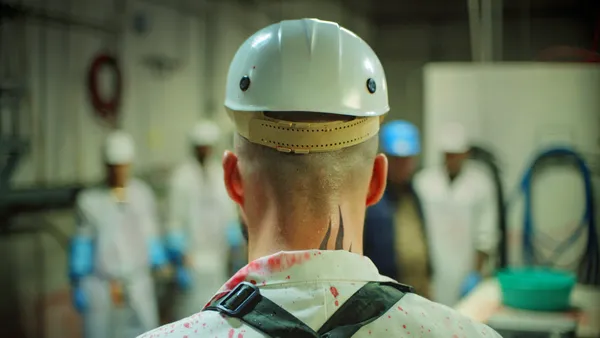
One of the most difficult of this year’s Oscar-qualifying short films to watch, but one of the most powerful, Mercenaire follows an ex-convict who goes to work in a slaughterhouse and has experiences there which are deeply traumatic. Trapped by a system which will send him back to prison if he doesn’t have a job, and by the unwillingness of other employers to take on people in his position, he feels pressure building up to an intolerable level. I met up with director Pier-Philippe Chevigny to discuss it.
“The original idea for the film is by the lead actor, Marc-André Grondin,” he explains. “He had shot scenes for another film that took place in a slaughterhouse and he realised that all of the employees working there were actually ex convicts. When he told me about that, I asked him ‘Hey, do you mind if I steal that idea?’ Because I'd been meaning to do a film about ex-convicts for a while because it just so happens that I have a lot of my childhood friends actually who spiraled into crime and violence and eventually prison. I come from a community outside of Montreal that in the Nineties was the drug selling capital of Quebec. And so I wanted to do something about that, but never quite found the right angle.
“When he told me about the whole situation with slaughterhouses, which as it turns out do hire a lot of ex-convicts everywhere in Quebec, I began making research on bad aspects which I was not familiar with. And that whole process was super eye-opening as to what goes on in slaughterhouses. The one spark that made me realise I had potentially something to write a film about was finding out that sometimes animals will wake up when they're supposed to be out. It's not like it happens like every day, but you know, with some slaughterhouse they kill hundreds, if not thousands, of animals per day. And so eventually, when you go at that pace, errors happen. And that's when you get stuff like that. “We shot in an actual slaughterhouse, but for the research I didn't go inside the slaughterhouses because, especially in Quebec, there's the food regulation that makes it very hard to enter. I tend to make films that are very political and people are wary of what perspective I'm going to have. Obviously I'm not going to lie and pretend I'm going to show the nice side of slaughterhouses, so I'd rather just not go.”
They were lucky, he explains, when it came to finding a location.
“The real slaughterhouse had been decommissioned for six years from a lack of workforce. They couldn't find anyone to hire. So so basically we just rented the place for a weekend and the owner was very happy to be able to make some money off that. That place that had been not in function for so long. So we basically just rented the stuff and everything was as is. All the tools that we used were the actual tools of the slaughterhouse. We had someone from the slaughterhouse to just show us around and make sure that everything was like, realistic.”
We talk about casting.
“Actually, I did a feature film right before that with Marc-André Grondin, the lead actor, and a lot of people were actually in both films. The young guy that's really angry was in my previous films as well, and he's kind of starting to be typecast as this kind of very edgy, over the top character. He plays those a lot.
“Carlos Guerra was in my previous film as well. He's the Latino worker inside the plant who's like, he's got the look and he actually did prison before. That was one of the reasons why I reached out to him, because he has a history also of going through prison. They were all people I knew basically, or had worked with before.
“Carlos is someone who has a past of being an ex convict, but he has started pretty much a career as an actor now. We see him more and more in Quebec because he's very naturalistic, he's very good. But he also has that in him for real because of his past experience.”
I ask if the bravado and laughter that we see from the supporting characters comes from prison culture, or is a way of coping with the slaughterhouse specifically.
“I did research, not inside Slaughterhouses but with rehabilitation agencies,” he says. “What they told me about the whole thing with ex convicts being hired in slaughterhouses is that some do not like it and want to leave. But there are also those who actually get a kick out of it, who enjoy it and find a way to express their violence and their anger. And so that's what the other characters are meant to express: that yes, some actual do find enjoyment in working in that. And, you know, it's kind of sick and perverse, but that was also a realisation I had when doing the research: that as hard as it is, some people do enjoy it.”
Does it help to keep them from reoffending?
He nods. “Oftentimes, as part of their liberation process, they have to find a job. They have to prove that they can maintain a job. It just so happens that oftentimes it's hard for ex convicts to find jobs anywhere else. This is one industry where if you have a history of violence, it doesn't matter. It almost seems like it could be a special skill that you have. So that's mostly it. They have to show that they can re-enter society, they can keep a job. So that's part of the liberation process.”
I suggest that there's a parallel between the way that the pigs are being herded through the gate and the way that David is being herded through a system.
“Yes,” he says. “You know, in all of my film, there's this idea that capitalism is a chain of exploitation where everyone is both a victim and complicit with the system, except the one that's at the very bottom and at the very top. And so the opening scene is kind of a literal expression of that. It's definitely meant to have you see the lead character - even though, obviously, he's the one that slaughters the animals – as also a victim of that system. He's also trapped within the system. So, yeah, that was definitely the idea.”
David has some distinctive tattoos. Are they something that sends a particular message to people who recognise them?
“Actually, yes. They're meant to allude to gang violence and the drug trade, but we don't know exactly what he did. We know he killed someone. If you pay attention, that’s said at some point, but we never know exactly, and I didn't want to go into that, because to me, it's not important to know exactly what went down. You can tell from the way he reacts that he's obviously not fundamentally violent or evil. He doesn't revel in the violence, he doesn't enjoy the suffering. He doesn't belong in there.
“That was the idea of the film, you know? That he committed a crime but he is not defined by his past actions. Which is something I witnessed from watching my friends when we were kids. They were all good kids, we would play and it's just that for economic reasons, you know, you end up making bad decisions, hanging around bad influences. And that's how you get into crime. But crime doesn't define you.”
We see David constantly telling people when he's in the slaughterhouse that he's not coping. And nobody seems to realise that could mean that he'll be violent again. That's something that parallels with the wider world that a lot of people do that before they've committed a crime, I suggest. They're trying to tell people that they're not coping.
“Yeah, exactly. And obviously, for the whole thing, he's restraining himself and trying to contain the violence that he has inside him, and at some point he has to explode.”
The other big challenge that came with the film was directing the pigs.
“They're super smart.,” he says. “Actually they were trained a little bit for the film. So, yeah, obviously none of the animals were harmed for real. We used a breed of domestic pigs, so in a way it's not super realistic, because those are not pigs that you would see in a slaughterhouse. They're not like the big pink swine. They were domesticated, but in turn, ethically, it made a lot more sense because we weren't going to put animals through a trauma that they would experience for real.
“They had been also on other films before, so they were used to having cameras around and everything. And so one of the pigs, for the opening shot, he was trained to fight back, to struggle, because we wanted it to be realistic. But what we found out is that after one or two takes, the pig would go straight into the den at the end. Because whenever we did a take and it worked, he was rewarded with a banana. And so by take three or four, he just went straight to the banana. We ended up using the second or third take, because at that point, he was still figuring out what was going on, and he was kicking a lot. By the end, he was just like, ‘I'm going to get my reward.’ And the pig at the very end, that has to stay completely still, he was rewarded for staying still as well.
“I worked with an animal wrangler who is used to training animals. And they did a little prep before, but we had so little money that they couldn't prep as much as they needed to. So we had to do a lot of takes to get it right. On average, I think it was about 10 or 12 takes whenever we were shooting with pigs.
“The budget was around $300,000 Canadian, so that's probably like £150,000, which, I think, is more than what you get in the UK for short films. We have good funding for short films in Quebec, and we shot over four days, which is the usual for short films as well.”
The film has now qualified for Oscar consideration.
“I was not expecting it for this film in particular, because I did a feature before, and so when I got back to making a short, I had no pressure of ‘this needs to be the next big thing because I need to fund my feature’, he says. ‘I was just going back to shorts because I had this story that fit the format, and I wanted to just explore and be bold and take risks. And so I didn't expect it – the amount of festivals we did, but also the quality of selections that we had and the awards and everything. I was not expecting that. And so, yeah, it's really cool. I mean, it's funny because these kinds of successes, they always seem to happen when you don't really crave for them. They just happen naturally, and that's what I'm experiencing right now.”