





 |
| Kiara Arancibia as Carmela in The Good Daughter. 'It was important that all the crew understood the emotional evolution of Carmela and the evolution of the narrative and the language of the film' Photo: Courtesy of POFF |
The pressures faced by a teenager following her mother’s divorce from her violent father are navigated in Júlia de Paz Solvas’ The Good Daughter, which became the first film to snag both the Audience Award and Grand Prix at Tallinn Black Nights Film Festival. When Carmela (Kiara Arancibia, who also took home an acting prize) begins having visits with her father (Julián Villagrán) she’s excited but soon he begins to exert pressure on her to continue his violence vicariously against her mother (Janet Novás). The film considers Carmela’s life in the round, so we can see how crucial her relationships with her mother and grandmother (Petra Martinez) are as well as her close circle of friends.
We caught up with Solvas and her regular co-writer Núria Dunjó after the festival to talk about their collaboration and tackling the theme of abuse. Their responses below have been amalgamated into a single answer as Dunjó was translating as well as co-answering the questions.
You’ve now made two features – The Good Daughter and Ama – which were developed from your earlier short films. Do you always have the features in mind when making the shorts?
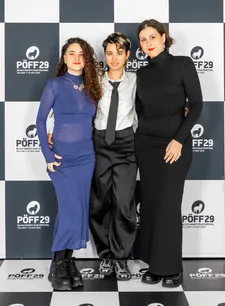 |
| Júlia de Paz Solvas, Kiara Arancibia and Núria Dunjó on the Black Nights Black Carpet Photo: Courtesy of POFF/Liis Reiman |
We started with the structure. We wanted to do it with respect and we wanted to do a lot of research before doing the film. So we felt we needed the short film to try to figure out what we were going to talk about because it's a very delicate conflict and we wanted to make sure that we were doing this with honesty and with respect, and we needed all that time to do the investigation. The short film helped us figure out which character had to be in the centre and which not. What was the role of the mother? Maybe in the short film it wasn’t very clear and here it is more clear. We did the short film to work out how we were going to do this and it was really helpful actually.
Is it tricky to select which part of the later feature to make with a short as this proof of concept?
We always thought that if we were going to do this film it would consider all of the life of the character and not just with the father. And we knew that the structure had to be more concrete and about this particular thing and, from there, to expand. But we always had in mind that if we do the feature film some day, if it’s possible we’re going to explore all the other layers of Carmela’s relationship with her friends, with her mother, with her grandmother.
You make a powerful choice in the feature not to let the father take the spotlight at the centre of the film, including not giving him a first name, although, of course his impact is continually felt. Tell me a bit about your process and intention with that?
It was very important for us not to judge the character but to understand it on every level. We did a lot of research and we even went to jail to have interviews with men, along with the actor, Julian and it was really interesting. But, for us, it has always been about Carmela and, of course, the father has a very important part in this story, but we always wanted it to be a film about Carmela's relationships she can rely on, with her friends and with her mother. So that was always the centre.We wanted to talk about this resilience. She is more than just this relationship with her father. She's a lot more things and she's not just a victim, she has a lot more to offer and a lot more to say to the world.
Tell us a bit about casting Kiara because she’s so crucial to the film because it is reliant on her body language as much as the script.
We saw more than 500 girls in two months. It was important that Carmela didn’t represent a standard of femininity. It was important that she was kind of androgynous and kind of in between both genders to explore how Carmela pursued her identity with her father and her mother. I saw that all the girls represented this femininity but, in the case of Kiara she didn’t. The principal element in Kiara was the emotion, she could present anger – and this emotion was important for Carmela. We saw Kiara had the tools to improvise. We saw Kiara late in the casting but when we saw her we saw she had this thing that we wanted for Carmela. It was very clear.
And how did you work with her?
It was important not to create a violent space and we found that it was very easy to work with music. Kiara connected that very quickly with emotions and it helped her a lot. To enter into an emotion and to leave it afterwards.
So did you have a playlist for her?
Yes, and Kiara had a coach who was with her at all the time, to care for and to help her go on the journey because it was her first film so everything was new for her. We felt Kiara needed this person beside her all the time because she carries the weight of the whole film.
Although the film is called The Good Daughter, it’s also about good mothers and about good friends.The friendship circle is very important to her, can you tell me about casting that because the dynamic between the youngsters is important?
It was a lot of fun to find them. They became friends. When they went out of the casting room, they made a WhatsApp group to talk to each other. It was funny because one friend represents the best friend of Núria and another represents my best friend and we saw in these girls the essence of our friends and people we can rely on. The friendship was important and the thing that Carmela relies on for her resilience.
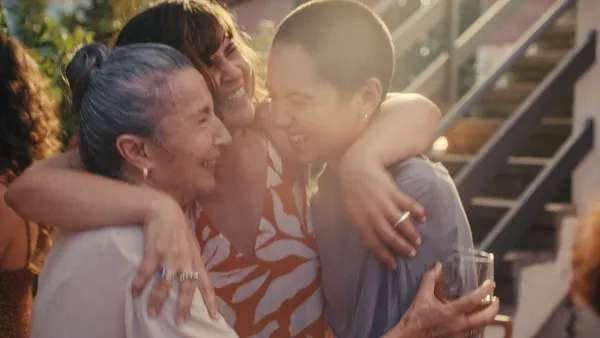 |
| Carmela (Kiara Arancibia) with her mother (Janet Novás) and gran (Petra Martinez). 'We always wanted it to be a film about Carmela's relationships she can rely on, with her friends and with her mother' Photo: Courtesy of POFF |
We can really see the changes Carmela is experiencing in two scenes using the swimming pool at her father’s house. In the first, she’s full of joy at being with him but in the second the mood shifts as she realises he is playing a different ‘game’ to her. Can you tell me about your directorial approach?
It was important that all the crew understood the emotional evolution of Carmela and the evolution of the narrative and the language of the film. Carmela travels in the light and in the darkness and it’s not all dark. We wanted the grey zones because in a relationship where violence is present, it still has light moments and dark moments and it was important that the narrative represented these two worlds. We worked with Sandra Roca, the DOP, and Víctor Santacana, the art director, on these grey areas and we worked a lot with all of the crew on the cycle of violence, which has light and goes to darkness. These kinds of people attach to you from the light. We had a speech from an expert in violent behaviour for all the crew before we started shooting and so we were all on the same page.
You said you spoke to some men with a history of violence but I assume you also spoke to women and children who had gone through this as well?
Yes, we did that a lot and that was the thing we did the most in our research. It was very emotional to do these interviews and I think we owe the film to the stories that they told us. The mothers participate in an association of women who suffered violence, and the women you see in the group talking to Carmela’s mother in the film are from that association.
What do you hope audiences will take away from the film?
If you are living in a violent situation you shouldn’t be defined by that violence because you’re so much more in life than that. Also hope and understanding. Carmela, in that moment, feels nobody understands her. We hope any child who is going through something similar can see the film and see themselves represented – it makes me emotional, actually. And see how they can go to their friends and can get over this somehow.
And what’s next for you both. I assume you’re going to continue to work together, because you’re very successful.
We’ve worked together since University because we studied together. So we will do that, for sure, forever. What’s next? We’re figuring it out.
And do you think you’ll make a short first or just go for the feature?
We’ll go for the feature. We’ve done it twice, now let’s go for it.