|
| Depeche Mode: M. Fernando Frias: 'The idea of translating the experience of a concert, which is something live in three dimensions, to the screen is a task in itself' Photo: Evolution Mallorca |
Depeche Mode: M, directed by Mexican filmmaker Fernando Frias, is chiefly a concert film, but it also draws on the cultural significance of Mexico’s Day of the Dead, which though it has been presented to the world in reductive terms by the likes of Disney’s Coco, retains a deep significance nationally and, like the music on this album, also has a more optimistic note. Cleverly, Frias also draws on the idea of things changing state or coming to life, with artist Joshua Ellingson, talking about the Pepper’s ghost illusion, in which an object in one place is projected so that it appears right in front of an audience, as though it is with them. This idea resonates both with the idea of the dead ‘beyond the veil’ and the more everyday trickiness of resurrecting a live performance which is now essentially ‘dead’ for a cinema audience.
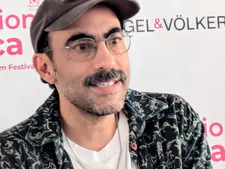 |
| Fernando Frias: 'It was an opportunity to connect with the Mexican vision of death from a much more poetic perspective' Photo: Amber Wilkinson |
He added: “I'm a fan of music in general and music films. They're always a challenge, especially when it comes to bands like this – almost sacred to the public because of the legacy they have built with the public after so many years. The fact it was in Mexico also attracted me a lot. Astonishing amounts of fans over three, almost consecutive, days with 80,000 people at each one.”
The film gave him an opportunity to “elaborate on the relationship between the new album and the band”.
“Naturally, you have to ask yourself, what's next, after so many years have passed, the idea of confronting mortality” says Frias, adding: “I was asked to talk about Mexico and death but there are a lot of stereotypes and clichés in common parlance. So for me, it was an opportunity, on the one hand, to connect with the Mexican vision of death from a much more poetic perspective. And on the other hand, to create pieces that work harmoniously with the concert without competing – without it being a documentary interrupting the concert or a concert interrupting a documentary. So, it was a very special challenge.
“The mission or objective was to demystify certain preconceptions and to open the conversation a bit from different perspectives, no. So, for example, there's an anthropologist who explains to us that the Day of the Dead isn't Mexican, it's not a Catholic celebration, and this anthropologist says, ‘Well, just like Mexico was given the trademark of death, Brazil was given the trademark of carnival sex.’ So, these are things that are sort of assigned. But I was also interested in explaining in some way that it's something that we're not going to fully understand, this isn't our way of thinking, the Western way of thinking. Let’s name it but let’s leave it there in an enigmatic, mysterious place, not very accessible but very interesting. Like death itself, when we're alive, it's not very accessible. We don’t know until we're there. So that's interesting.”
There is a playful element to the film, which via a segment with Ellingson, shows objects being able to escape the confines of the screens we initially see them inside.
Frias explains: “The idea of translating the experience of a concert, which is something live in three dimensions, to the screen is already a task in itself, and the way to integrate these two has to do with a game that we establish based on narrative and technological mechanisms. For example, playing with obsolete technology, which in itself is an analogy for Memento Mori. This camera, well, maybe it works well today, but in 20 years it'll be obsolete. So, talking about representational technology, which is something that's also good when you’re talking about a band that has been filming for so many years.”
Frias adds: “It was part of my initial treatment. Playing with old formats and playing with these ideas of pretending to bring things out of the screen into our world. There’s a writer in the film who says, ‘It’s crazy that we have access to the best technology in human history and yet something feels more real if it’s filtered with the texture of an older technology’. It’s very interesting. Bringing Josh to work with the TV screens was also part of the initial idea. It was to say, ‘We’re filming the concert but the music is so electric we want to show how it bullets out of your screen’. We found it was particularly interesting because it was all done with the use of old TVs and very analogue things.”
Looking to the future, Frias says he has other projects that revolve around music, adding, “Music is always, in some way, at the centre of my work”.
Depeche Mode: M is released in UK cinemas on October 28. The physical release of M is due on December 5.