




 |
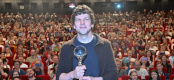
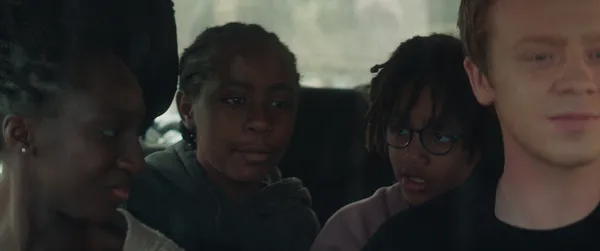
| Eye Haïdara, Jules Waringo and Leonis and Teodor Pinero Müller. Joachim Lafosse: 'Even if life becomes tough and difficult, you have to take advantage of the sea and the sun' Photo: Courtesy of San Sebastian Film Festival/Jorge Fuembuena |
Belgian director Joachim Lafosse has never shied away from difficult subjects in his films, taking on everything from historical child abuse in A Silence (2023) to the trafficking controversy surrounding NGO workers in The White Knights (2015) and the collateral damage of the end of a relationship in After Love (2016). One regular consideration of his work is the impact that adult decisions have on children and, on that score, his latest Six Days In Spring – which had its premiere in competition at San Sebastian Film Festival – is in the same wheelhouse, since it focuses on single mum Sana’s (Eye Haïdara) decision to take her twin sons Raphael and Thomas (real-life siblings Leonis and Teodor Pinero Müller) to her ex-parents-in-laws beachside second home. She also takes her younger lover Jules (Jules Waringo)... although her children, at least initially, see him as a friend and their football coach. As the days pass, there's the joy of spending time together but also the tension of secrets.
Inspired by an episode in his own childhood, his latest drama is a much sunnier affair than most of his films, warming like the weather it depicts and with a gently uplifting consideration of taking back control of your life. The jury warmed to it too, awarding it both the Best Screenplay Jury Prize and Best Directors Silver Shell. We caught up with him in San Sebastian to talk about it.
This film is based on your own memory. A Silence was a heavy movie, quite a tragic one. This one is much lighter but still complex. Is it more difficult to take a story from your own life than from somewhere else’s?
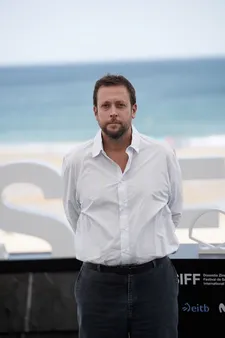 |
| Joachim Lafosse: 'I like tragedy but today it’s complicated for me to continue with it' Photo: San Sebastian Film Festival/Inaki Luis |
Joachim Lafosse: I think, even when you're talking about an event or anything, you always have a personal reason there, whatever you choose. If you want to make a film, there has to be something intimate, some link between the filmmaker and whatever you're talking about. That is why, for me, there is not any difference between films inspired on a personal level or films when I am going to talk about anything else. For the last 30 years, I had that story in my mind. I wanted to speak about it. This event was a fundamental moment in my childhood. That week when we were hiding in my grandparents house with my mother, who had just separated from my father.
In fact, I have realised that I was so disturbed for so many years about that event. Now, as an adult, the most important thing in my mind was to know why. Why in family life suddenly you have to hide like that. For us, as children, that holiday week was so very weird because a few months before we were on holiday with my grandparents there. But now we were with my mother and suddenly it was not the same thing. My mother didn’t even dare to ask if we could go there. I think that beyond my personal history, there is something universal. You may have separated as a couple but you are still the parents of your children.
One thing I like about your films is that they’re very grown-up, dealing with adult themes and emotions and embracing the complexity of them.
JF: It’s true that I have made many hard and difficult films, so I wanted to do something more light and sweet. My mum gave us that strength. Even if life becomes tough and difficult, you have to take advantage of the sea and the sun.
It’s almost the opposite of A Silence. That film is all about shame and hiding emotions and this film is about not being ashamed of being a part of something and of wanting to do something for your children. Sana refuses that shame in a way.
JF: Absolutely, you understand perfectly. In fact, I wrote A Silence 10 years ago, so it is another period, another moment in time. Today, it’s as if I want to go towards the possibility of having a solution. Even if there is trauma or we have made mistakes, there is still a possibility to evolve. I think that in this film, compared to A Silence, I see that possibility.
You capture the difficulty that children feel in these situations where they're trying to understand this new reality. Can you tell me about casting the children and working with them to bring out that complexity.
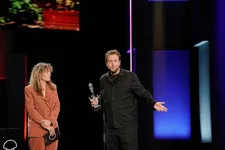 |
| Joachim Lafosse on stage with Chloé Duponchelle with their Jury Prize. Lafosse: 'If you want to make a film, there has to be something intimate, some link between the filmmaker and whatever you're talking about' Photo: San Sebastian Film Festival/Inaki Luis |
You bring home that sense of threat that can happen because of the uncertainty.
When we were in the house, the sensation was that it was exciting and very scary at the same time. We had those candles, it was funny, but at the same time we were so scared. Maybe, Sana is not really in love with Jules but he’s a guy who takes care of her. He is helping her and I think that he is really in love with her. She needs him because she is changing her life. He is maybe too young for her but they are good for each other.
When the police had to come to our house to verify that my mother had cheated, she was with somebody who was 13 years younger. So that was also something that I had in my mind since then. And I think she was right to persevere and to go for desire. That was the biggest lesson she gave us. There is something even worse than lying, and that is not to go for your desire.
Do you think that this is a permanent change from you, that we’re going to see a more positive and upbeat Lafosse?
JF: I would like to continue to write about the complexity of life but I would like to show more. I like tragedy but today it’s complicated for me to continue with it. In The Restless you see the beginning of something that’s lighter and this one is a continuity.
Six Days In Spring will be released in France in November
Read our interview with Eye Haïdara on working with children and building character