 |
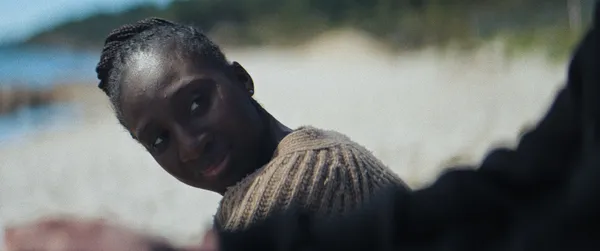
| Eye Haïdara on her character Sana: 'It’s a strong act to go to your ex-in-laws’ house' Photo: Courtesy of San Sebastian Film Festival |
Speaking to me about the film shortly after its world premiere in competition at San Sebastian Film Festival, Haïdara told me: “It's kind of a simple plot, actually, but it means so many things. It's so heavy what we say in the movie, but in a simple way. I really wanted to follow Joachim on that adventure.”
Much of the drama hinges on Sana’s relationship with her sons Raphael and Thomas (real-life siblings Leonis and Teodor Pinero Müller) and the star says it wasn’t her first time acting with children, which helped a lot and they also spent a week in the house where much of the film is shot.
“We had a week there acting inside the house in St Tropez and it was a good way to get to know them. I have something that I really care about – when you play with children it’s really important that we build a real family. I wanted people to look at us and feel like, yes they are my children. It’s really lucky to have that chance before the shoot.”
She adds: “Every day before the shoot it was important for me to talk to them because you don’t shoot the movie in chronological order. So it’s important for me to talk about the story and where we are, what happened before, what’s going to happen next, this is what we have inside us – it was important for me to do that every day. A kind of repetition about where we are now in the script and what we are supposed to be charged with.
“I need to do it, so why not do it with them.”
There’s a forthrightness to Sana that might not be expected. She isn’t ashamed to be taking her children to the house, even though it isn’t sanctioned.”
“She wasn’t ashamed,” says Haïdara. “I feel like she’s strong for them. It’s a strong act to go to your ex-in-laws’ house. By that you’re saying a lot about what she has lost and how she has fallen socially. At the same time, this house represents a kind of security for her children. I always said to myself, that when she realised that they can't stay with her partner Jules in Lyon, she also thought about going there, but she didn’t say it. She just tried to find something else for her children. But I think she had that on her mind because it's a place of safety for them. It's just like to protect them and to make them also realise that divorce means a lot of things but it doesn’t mean that you’re not a part of your father’s family. You’re still a part of their family, a part of my family, no matter what.”
 |
| Eye Haïdara with Leonis and Teoudor Pinero Müller, who play her sons Raphael and Thomas and Jules Waringo, who plays Jules, Haïdara says they became 'a little crew' |
Haïdara says “When you get a divorce, there’s a lot of things that you lose. You want to feel independent but it's not the same. This woman used to have a stable life with a husband, who had money. But I never saw her as someone who's not educated. She's educated. She's not poor but she doesn't have the same capacity as her husband. To socially change like this means a lot and at the same time you want to be independent. You want to convince yourself that you can do it. It’s not a fight about material things, it’s a fight about position and how you rebuild yourself after a separation.”
It’s also notable that Sana’s new partner is younger than her.
“This new partner – I don’t know if they’re going to spend a lot of time together but it’s kind of a way to escape for her, to say, ‘I feel like I can still seduce someone. I can rebuild my life’.”
Haïdara says that she and Waringo worked together with the children to become “a little crew”.
She adds: “I love to talk about characters and what maybe they’re going to do later on and this is something we would discuss together, like how they met each other, fell in love. Everything about the character is important – even the shoes are important.”
The star was nominated for a Best Newcomer César for C’est La Vie and has continued to find strong comedy roles, including in Lucas Bernard’s À Toute Allure. She’s also played a recurrent character in TV underworld action drama Furies and plays a woman at the end of her tether in telly comedy Frotter Frotter.
She’ll soon be seen in French/Belgian production Mata, directed by Rachel Lang and Mélisa Godet’s La Maison Des Femmes, which focuses on a centre helping victims of domestic abuse, which Haïdara says is “a beautiful project, which is coming out at the beginning of 2026”.
The star adds: “I have another one with Agnès Jaoui [L’Objet Du Delit], it’s the second time we’ve worked together and it’s going to be a social comedy – spicy!”
As for what else the future might hold she says: “What I love in my acting is doing different things. I don’t want to do just one type. I like to switch, that’s the way that I learn.”
Six Days In Spring will be released in France in November
Read our interview with Joachim Lafosse about drawing on an episode from his childhood and turning away from tragedy