 |
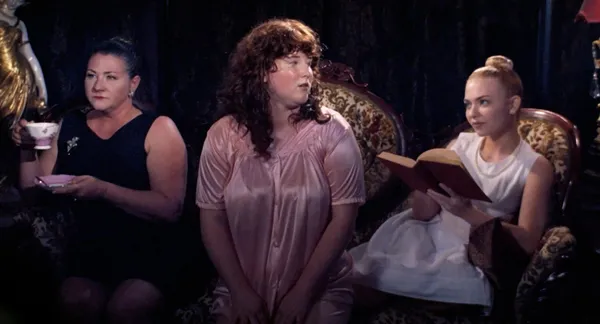
| Brooklyn Woods, Lauren Kitchen and Harley Madison in The Cramps: A Period Piece Photo: Warped Witch Cinema |
The story of Agnes (Lauren kitchen), a young woman trying to find her place in the world whilst dealing with a domineering mother and horrific pain every time she menstruates, Brooke H Cellars’ The Cramps: A Period Piece is about to get its première at Fantastic Fest. When I met the director to discuss it, we talked about the way that the heroine, on getting a job in a hair salon, enters a magical world where she is able to transform, and I suggested that it gives the film something of the structure of a fairy tale. She wasn’t specifically thinking about fairy tales, she said, but she likes the idea.
“I definitely wanted it to be surreal and dreamlike, like a 1960s kind of aesthetic. Like a Technicolor Twilight Zone in the Sixties.”
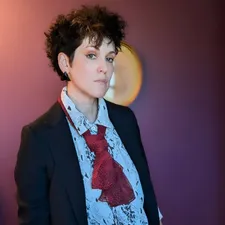 |
| Brooke H Cellars Photo: Warped Witch Cinema |
She’s been open about having had a difficult time with endometriosis herself, which was part of the inspiration for this. I ask tentatively if she feels that there's a positive side to the pain, in that when Agnes starts to acknowledge it, it makes her angry enough that she can break out of her difficult situation at home.
She nods. “That’s right on the nose. I had endometriosis from when I was a teenager until just a few years ago, when I was 40. It was undiagnosed for a long time. The pain kept me from living my life. I grew up in a family who didn't even take me to the doctor or anything to get diagnosed, and kind of ignored it. They were very religious. Even going to doctors, it was like nobody was seeing this creature that was obviously eating me from the inside and just stopping me from living my life.
“I was very embarrassed and ashamed of this because I couldn't talk to anyone about it. I felt like I couldn't talk about it because in my own family – I had a mother and a sister and brothers too – it felt like I should have been able to and I didn't, so that stayed with me my whole life. And trying to get the diagnosis and just say, ‘I need to figure out what's going on with me. I can't just live my life like this.’ Which kind of transformed me into figuring it out, getting whatever I needed to do done, and then getting to live my life finally.
“I’m kind of thankful for the pain because it not only made me angry enough to push forward, even though I was in pain, but when I got into filmmaking, I had had this story I could tell. Putting it on screen felt very cathartic and wonderful, to finally be outspoken about everything that I just kept suppressed for a long time. So it was kind of a beautiful thing. I got through the pain and then I got to transform in the person I always knew I was and always wanted to be, even later in life. I'm very thankful for that.”
Although this is her first feature, she’s made a lot of shorts before. Did she always have this film in mind? Was she always working towards it?
“I always knew I wanted to say something in a movie and I always wanted it to be horror, but I wanted it to be a different kind of horror than what I've seen before, because I love all horror movies but I also love other genres too. I wanted to put all that in there and just make this new horror movie – feeling old and nostalgic, but something new to the modern day. Looking at my short films, it felt like even though it wasn't said on paper, you could see there was like something I was trying to lead up to or trying to figure out. So maybe, unknowingly, my filmmaking journey was leading me to where I knew I was going but didn't say outright right away. I guess it was a process. It was a long process, a wonderful process.”
I suggest that it works more effectively because she sets up a poppy, cheerful, bright coloured world and then the gore appears in it – it’s more shocking like that. Similarly, for people who have issues with heavy menstruation, it's something that often feels out of place with the rest of life. Perhaps that's sometimes why people who don't go through that are so disgusted by it.
“Exactly. I think that's how they view it. It's gross, it's disgusting. It should be kept in the bathroom. You shouldn't say anything about it, especially around those who don't have uteruses. And at the same time, I'm trying to make those people feel a little how those with uteruses feel in actually going through this, and make them a little uncomfortable, especially with the gynecology scene. I wanted that to be uneasy. I know people that have gone through it probably found it more uneasy, but I wanted to bring that experience into other people's perspective. It's like, this is normal, but it sucks. You have to go through it as a woman and you just bite down. You just have to take it because that's what we all have to go through. And, you know, it's unfortunate and scary and horrifying, but it is normal, so...” She shrugs.
At the same time, alongside that horror, there’s a really cute little menstrual monster. How did she invent that creature?
“I wanted it to,” she says happily. “I was inspired by the 1950s The Blob, the original. The effects were so practical and raw, and I wanted to take that into account in making our monster, which we called Susie – that’s what we named the little monster because she was so cute and glittery. Even though she's a monster, she's still fabulous. You know, she still looks nice. I mean, she's - she's angry and she's trying to – well, she's a monster.” She shrugs. “But you have to, I guess, embrace the fact that you have periods and kind of live with it.
“I feel like you could figure out a way to live with it and be able to live your own life. Agnes controls it with the potion. I guess she's finally realising this is normal. But the extreme pain wasn't. She had to figure out how to diagnose that, deal with that, and then be able to live her life, which her mother didn't.”
Her home life is obviously a mess, but she finds a lot of support in the distinctly queer environment of the hairdressing salon. For a lot of people, that support does come from that kind of community, but we don't see that in films.
“I thought that was very important to put in there because that was my perspective too,” she says. “When I grew up, my family was against homosexuality and everything. They were definitely Southern Catholic bigots, and I am completely the opposite. I remember when I was young and I would hear my parents speak about homosexuality and see it on TV, it would make me uneasy because of what my parents said. But then with growing up, I realised it's not uncomfortable for me. And I met all kinds of people in the queer community, and they have been so supportive.
“I've had experiences where people in the queer community have got me out of my shell and told me I was beautiful, which I didn't get from my family at all. They weren't supportive. And I’ve gotten it from the queer community for the most part of my life. They are always quick to say ‘You're amazing.’ Like, just so many compliments and so encouraging. And I see them encouraging each other all the time, and I think that should be acknowledged.
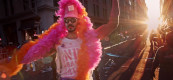
“Drag is one of my favourite things in the world, and I find the drag community so amazing and talented. I think more drag queens should be in movies because they're already characters. Martini Bear is a character. You just put him on screen and let him do his thing. He makes my job so much easier.”
Still more exciting, though, is the screening coming up this Friday.
“Oh my gosh, I couldn't be more grateful to be in Fantastic Fest. I can't believe we're having our world world première there. Me and my team are so excited,” she says. “We're all going to be there. It's for sure a fairy tale.”