Damned If You Do, Damned If You Don’t (Come Ti Muovi, Sbagli) is a warm-hearted charmer from Mid-August Lunch (Pranzo Di Ferragusto) director and actor Gianni Di Gregorio. The latest from the Italian filmmaker, sees him star as a retired professor who finds his quiet life disrupted when his daughter Sofia (Greta Scarano) and her two children (Anna Losano and Pietro Serpi) arrive on his doorstep after her husband Helmut (Tom Wlaschiha) has an affair with a student. Wlaschiha – best known international for playing Jaqen H'Ghar in Game Of Thrones and Enzo in the fourth season of Stranger Things – gets to have fun in a subplot that sees Helmut attempt to walk from Germany to Italy on foot as a demonstration of his love for Sofia.
Along the way, he befriends a dog that looks awfully like a wolf, who he names Sven. So how was it to basically spend a movie with a four-legged co-star?
“It's obviously very dangerous if you work with animals and kids,” he says, laughing, “But it was great. He was very sweet – actually, I think it was a she, if I remember correctly. And the part of the story where he tells the dog a little bit about his life, I really loved that.”
Catching up over Zoom with Wlaschiha as Damned If You Do, Damned If You Don’t had its premiere as the closing film of Venice Film Festival’s parallel section Venice Days/Giornate Degli Autori, the star says he was familiar with some of Gregorio’s work when he got the script, having already seen Mid-August Lunch and was then prompted to watch Citizens Of The World (Lontano Lontano).
He says: “They're all small films, but they are really lovely. You're immediately drawn to them. It's simple stories, but he has such a positive outlook on life and such an optimistic and fond look towards his characters. That's what I really love. And he has a great eye for the little absurdities of life. His characters are never your normal movie heroes, they're all people with flaws. And they know they have flaws and they're struggling to make life work but it’s great. I really like this optimistic look at life, that’s something very Italian.”
The star adds that he could sympathise with his character’s walking quest as he has “done some crazy things for love”.
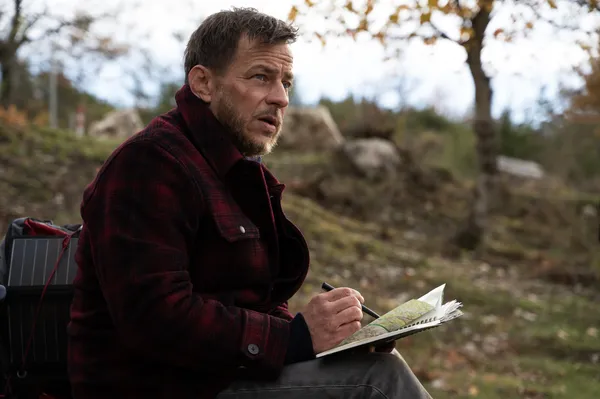 |
| Tom Wlaschiha in Damned If You Do, Damned If You Don't. He says of filmmaker Gianni Di Gregorio: He has such a positive outlook on life and such an optimistic and fond look towards his characters. That's what I really love' |
He explains: “I didn't walk for a thousand kilometres but I flew halfway around the world just on a whim. At one point, and I can only tell this because it was a long long time ago, I threw a show at the theatre because I thought I needed to be somewhere else very urgently and I never told anyone – but that’s more than 20 years ago.”
The 52-year-old star was born in East Germany, although the wall fell when he was a teenager. He says that experience has been an influence on his outlook on life.
He says: “I grew up in East Germany and we couldn't travel so, for me, learning languages in a way was like the window to the world.
“I always dreamt of travelling and seeing the world but at the same time, I knew it would never be possible. Then when the Berlin War fell, my life pretty much changed overnight. The good thing was I was 16 at the time so I really hadn’t missed anything, unlike the generation of my parents. So, I couldn't wait to get out and travel. We have a German word “fernweh” that doesn't really translate into English. It's like, longing to be somewhere else or longing to be in other places. So I love trying out different languages.”
That love is in evidence in a career that has stretched far beyond the shores of Germany and which has also included Sky series Das Boot and Tom Clancy’s Jack Ryan. He’s also a regular on the stage and today he begins a National Theatre run in London of The Land Of The Living, by David Lan and directed by Stephen Daldry, starring alongside Juliet Stevenson.
He says language is “a bit like learning an instrument”. He adds: “If you have a good command of another language, it gives you access to different ways of thinking and feeling, almost. At the moment, I'm doing a project at the National Theatre here in London and I always thought English was kind of easy but this is my first time speaking English on stage. So that's quite different.It's always a challenge and I like the challenge.”
Speaking about the play, he adds: “It's about a serious topic – stolen children during the Second World War and it's about trauma and memory and how people remember the same events in a very different way.”
This will be his first time on stage for 15 years, although that was where he began his career, although he says the repertory system in Germany makes it difficult to mix it with additional work since you have to sign on with a company for two or three years.
“At a certain point I wanted to focus on film but now this opportunity [to work onstage] came up andI really didn't have to think twice.”
On the difference between stage and screen, Wlaschiha adds: “It’s obviously a different technique in front of the camera. You almost do nothing. It’s all about thinking and onstage you have to state that in a bigger way. But having the audience there and the live experience is something that I think every actor loves.”
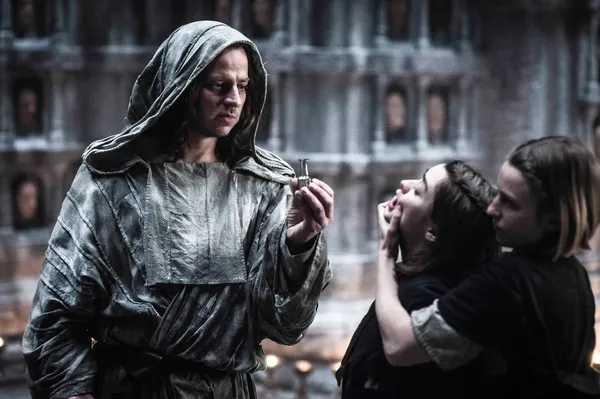 |
| Tom Wlaschiha in Game Of Thrones: 'If you have a good command of another language, it gives you access to different ways of thinking and feeling' Photo: Helen Sloan/HBO |
He admits he finds regular hero characters “quite boring” although he wouldn’t be averse to playing James Bond.
“I kind of like characters with edges and with flaws,” he adds, “multi-layered characters and characters who are struggling to achieve something or trying to make things work”.
One thing that draws him to Italian productions is the mixture of light and serious tones.
“That’s what initially drew me to the project because you don't get a script like that in Germany. In Germany, it's always like, if there's problems, it's immediately very heavy. I like the lightness of this but, to me, that’s something typically Italian, to have this positive and light outlook on life even though the characters are struggling. They’re going to fail again and again but they keep standing up, it’s something very human. I think Gianni has managed to put that in all of his scripts perfectly.”
Although noting that German cinema has changed a lot, he adds: “You hardly ever find this genre mix in in German cinemas, it’s either a comedy or it's a drama. If it is a drama it really is a drama. Life never is only drama or only comedy, so that’s what I love about this script, it kind of manages to mix all of that. The lightness of Italian cinema, I think it’s the whole Italian way of life, not only in cinema but also in art and culture and architecture and design. There’s always lightness and beauty in it.”
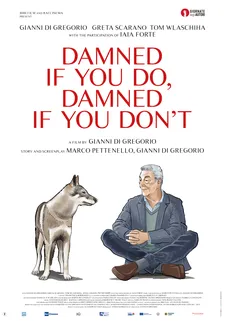 |
| Damned If You Do, Damned If You Don't poster |
While Wlaschiha says he wouldn’t mind trying his hand at theatre directing at some point, he’s not so sure he’d fancy the director’s chair on a film set.
“From what I’ve seen – and I’ve worked with some friends in Germany, who've written a script and then directed it and starred it themselves – the actual creative directing work is 10% of the director's work. The other 90% is finding the financing with the producer and endless talks and years of development and I don't think I'm cut out for that.”
In addition to The Land Of The Living, Wlaschiha has also just finished filming a German series called Black Gold. “It’s a story about a short period of an oil rush in Northern Germany at the beginning of the 20th century, when they found oil and then all hell broke loose and everybody tried to get the best claims and, but that was only for a brief period of 10 years and then they realised, there wasn't enough oil, and it wasn't worth it. That was an interesting project.”