|
| Michel Riondino and Giulio Feltri as Sergio and Matteo in The Holy Boy. Paolo Strippoli: 'It’s a film about people who are trapped in this community because they’re trapped in themselves' Photo: Jarno Iotti |
One thing we need to get out of the way at the start of my interview with Paolo Strippoli about his latest horror film The Holy Boy (La Valle Dei Sorrisi) is the question of whether he’s a hugger. I ask because hugging comes with a high price for 15-year-old Matteo (impressive newcomer Giulio Feltri). He is viewed as an angel by the townsfolk of the tragedy-hit town of Remis as his hug removes their sadness. The arrival of a new teacher Sergio (Michele Riondino), who is grappling with his own grief acts as a lightning rod in his well-crafted chiller.
“I am a hugger. I love hugging and, of course, it gives me a sense of comfort. But also I’ve always felt it can be abusive. It depends on the timing. The act is something that can be a cage. It was really important for me to build an ambiguous image around this beautiful symbol of community.”
The young protagonist of Strippoli’s film – which had its premiere out-of-competition at Venice Film Festival – has powers that put him in vaunted coming-of-age territory alongside the likes of Carrie and Thelma. At heart, however, the filmmaker says he drew on his own life.
“He looks a lot like me when I was younger,” he says. “I was really a lot like Mateo. I looked happier than him but I was struggling to find my identity, also from a sexual point of view. I was a gay kid in a southern Italian town so it wasn't always easy. When you leave your childhood behind and start feeling the instincts of an adult, you feel a little like a monster.
“When you grow into adolescence, it can be scary because you’re something, then you’re something else and the way that you’re changing – if it’s not what society expects – can make you feel like a monster. I felt that, I felt the guilt of growing up.
“In this film, the homosexuality of Matteo is not the real issue, the real issue is he has the instincts of an adolescent boy. He is finding his sexuality, he is finding what he wants to do in life. He wants to be free and he cannot be because it’s not what his society expects of him. I think this is compelling. It's compelling to see a teenage boy in a cage because when you put a teenage boy in a cage he can only explode and when a teenage boy explodes, he explodes in a terrifying way.”
Strippoli is no newcomer to the horror genre. He made the Netflix Original A Classic Horror Story, with Robert De Feo, about a road trip that takes a chilling left turn and Flowing, which sees an infected steam lead people to give into their darkest impulses.
 |
| Paolo Strippoli on the set of The Holy Boy. Paolo Strippoli on his young protagonist: 'I was really a lot like Mateo. I looked happier than him but I was struggling to find my identity, also from a sexual point of view' Photo: Jarno Iotti |
“It’s a film about people who are trapped in this community because they’re trapped in themselves,” says Strippoli. “It’s a film about a trap. What is the trap? The trap is that we have to deal every day with our grief, with our sorrow, with our personal pains, and as human beings, we're not designed to have the strength to go through his pain and to overcome it. We always find a shortcut. I would find a shortcut. I was in a difficult moment right now.. It's okay, I smoke. I have a lot of little vices that are my own personal emotional compensation devices. It's okay to have shortcuts but if you want to overcome pain, you have to use your user strength and I don't feel like I have strength. We are not Heroes. This is not a film about Heroes. This is a film about a flawed person just like I am. I feel like a Remis character. We’re exploring these characters who only use shortcuts without trying to go through and accept their pain as a fundamental part of their existence. I wanted to show that shortcuts can be a trap.”
Given that the film draws on iconography – although a faith is never specified – does the director also view religion as a trap?
“I think it’s a compensation device as well. It’s a thing in which people try to find a way to overcome things so, of course, it can be a trap. What is really interesting about religion is that it's used a lot to justify things and to find a reason in things we don’t understand. The religion in my film, it’s not Christianity, it’s not Catholic although it has a lot of Catholic imagery. What I found interesting is that everyone in the film is trying to understand what or who Matteo is. Everyone says he’s a saint, he’s an angel or probably they think he is a Christ-like figure or the Antichrist, in the case of one character. But what’s really important to me is the moment when Matteo’s father says: ‘They want to believe God sent him. I made him believe it because they needed it but I tried to find Matteo in the Bible and I didn’t find him. I don’t know who he is’. We cannot accept the unknown. We are not designed to accept it”
Much of the success of the film hinges on the central performance of Feltri in his debut film, with the director confirming in his press notes that “I wanted to avoid casting the usual Roman kids from films and TV series”. It’s a large role for a first-timer, not only in terms of screen-time but the emotional journey that the reserved Matteo finds himself on, something that the director was acutely aware of.
“He's a smart kid,” says Strippoli. “I tested him a lot before casting him and I tried to understand if he was also mature enough to handle the complexity but also the most difficult and dangerous parts of the role about his sexuality. He’s really mature about that.
 |
| Michele Riondino as Sergio in The Holy Boy. Paolo Strippoli on working as a trio on the script: 'The confrontation is what makes a story and character come alive' Photo: Jarno Iotti |
"I try to go very gently. I was really worried because doing a film like this can hurt someone and I didn't want to hurt anyone. My main worry was not to hurt him but to get what I needed from him. So I tried to talk a lot. I tried to make him understand some things and to hide other things. We became friends. Now he’s older, at 16 he’s a big friend of mine but at the start, we had to speak a lot and try to make him understand little parts of the film, not the whole film, because that’s not the way it works.I really tried not to train him too much because I wanted him not to be precise. This was really important for me.
“Mateo Corbin couldn't be precise. He doesn’t have to move well, he doesn't have to speak too well. To be naive. And Giulio is a really active kid, he’s not like Matteo, he’s not explosive. So we had to work at showing as more naive than he is in real life. And what a beautiful experience. I really loved working with him, he’s a special guy and he will do great things in the future. I hope he will want to continue in cinema but he’s a really smart guy.”
The rest of the large ensemble cast also got a big work-out in challenging crowd scenes towards the end of the film that Strippoli describes as “a really physical moment”, especially as they were using non-professionals rather than performers in the role and the director wanted people “from 12 years old to 80”. As for DVD extras, he says he can’t wait to show what was filmed during the rehearsals because “it’s so funny and so tragic”.
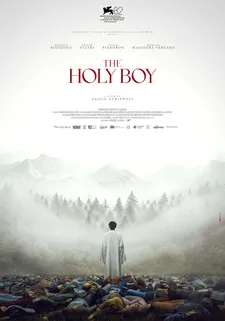 |
| The Holy Boy Poster |
He adds: “But during the scene everything went well and they had a lot of fun.”
He says working as part of a trio on the script was a great combination. “The confrontation is what makes a story and character come alive and I love the people I wrote this film with.”
He adds: “It was a beautiful passion project for us. And writing can be scary because you're alone in front of a page and having a friend writing with you is really beautiful andI think it makes the project better.”
The Holy Boy will also screen at Austin's Fantastic Fest later this month and will be released in cinemas in 2025