




 |
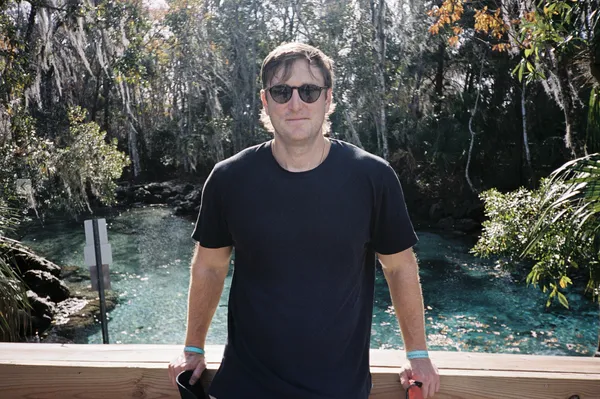
| Todd Wiseman Jr. Photo: Fantasia International Film Festival |
“I developed it out of being very angry at, you know, the state of things in my country as it pertains to kids being murdered,” says Todd Wiseman Jr.
He’s talking about The School Duel, the heartbreaking dark satire that screened at Fantasia a few weeks ago and has been sparking conversation ever since. Set in Florida, the film follows bullied outsider Sammy (Kue Lawrence) as he is recruited to participate in the titular event, a ritual designed as an alternative to school shootings.
“I was just thinking about how I could frame it in a different way and have people look at it through a different lens,” says the director. “And so I leaned into a really absurd take. Basically, every time some tragedy would happen in the United States, rather than try to look backwards and fix a problem, they would just double down. ‘Well, actually, maybe we should just arm the teachers and maybe we should just...’ you know. It just kept going in an absurd direction. So I was like, ‘Well, what happens when it goes further?’ And that is how this came about. And I wrote the character of Coach Williams to be more of the voice of reason in the film.”
Aside from the boy’s mother, Coach Williams is the only person we see show Sammy any real kindness, and Jamad Mays, who plays him, has joined us for the interview.
“I think for me, as a coach, it's to train these kids up from preteens to adults,” says Jamad. “Just in the course of it, I was conflicted between my loyalty and my support for the duel and where the state of Florida and conservatism is headed towards, as well as just seeing how these kids, especially Sammy, with what he's going through, are affected. And after a while, noticing ‘No, this is actually wrong.’ I’m really just trying to figure out, ‘Okay, this is right, this is wrong. How do I make this work? Where am I?”
I tell him that I think the coach is the heart of the film, because he shows an empathy for the kinds that the other teachers and official just don’t have. Is that something he was conscious of when making the film?
“Yeah,” he says. “I was very conscious of that. But also, I think just putting myself more and more in those situations, understanding where I am as an actor as well as a coach. And I think over time, I started to get more and more like the reactions and how I was reacting to everything just became more and more natural and more motivated for Coach. It was just understanding me with my moral compass, like, ‘This isn't right.’ I think over time, again, my reactions and where I stood, and the line or the fence I was on, became natural.”
He was the only adult in some of the scenes with the kids, and that helped a bond to develop.
“I was telling Kue – Kue Lawrence, who plays Sammy – that over time, there's a few scenes where I became very protective of him. And I feel like, ‘Okay, this is me, Jamad, me feeling a certain way.’ But it's also like, no, it's what Coach Williams is feeling right now. Nobody can express it, but this is what he's feeling internally. It's hard to show that internal struggle, but I think over time I was like, wow. This young man, he's trying to figure it out. He's being bullied, and everyone's just picking on him. He needs someone behind him, someone supporting him.”
“But with Jamad as a person also, I think just there's a natural goodness,” says Todd. “There's a good aura, and it was very apparent on set. The kids definitely did gravitate towards him and had a level of respect, but also just liked him. It definitely helped.”
Kue is an extraordinary talent. How did they find him?
“The story of me finding Kue is a bit sad,” says Todd. “I lost my youngest sister to cancer right before we filmed this film. Her name was Tessa, and she was the one who inspired me to leave my advertising business and finally go make my first movie. We were watching audition tapes in the hospital, me and her friend Ally, together. You know, we stayed positive through the whole thing. We saw Kue's tape together, and she was like, ‘Definitively, that's your kid.’ So my sister picked Kue, and I said, ‘Okay, let's go talk to him.’ And she also said the same about the mom, Christina Brucato.”
This isn’t the only sad story attached to the film, which is dedicated to the memory of one of its 16-year-old stars, Hudson Meek, who died in a car accident.
“I keep thinking of seeing Hudson with Jamad and Kue,” says Todd. “It was a nice little unit. Hudson was a wonderful kid. He came to Deauville for the première, you know, and that's the last time I saw him. He walked down red carpet with us. He was beaming and he was proud, and he should be so proud, you know? His family, I think, should be so proud of his role. And him. He was just a wonderful kid, and it was a terrible tragedy.
“There's no words. Nothing. It's just having lost my sister, and Hudson's family having lost him, all kind of around this film. It's hard to bottle up, you know? It’s a lot. But at the same time, any time when I see him in the film, it feels like it's a living portrait of him. That's how I remember him.”
A week or so before this interview, I spoke with Oscar Nuñez about the film, and he said that for him, it's something that he relates very much to the situation America is in today. And I thought, particularly with Florida, because Florida often seems to lurch off in its own special direction more than other parts of the States.
“To me, what happens in Florida is a microcosm for the United States,” says Todd. “It's absolutely meant to feel like that, to be commentary on the national predicament. Not just gun control, but how I feel like in certain ways we're going backwards in terms of social progress. Florida unfortunately leads sometimes with some of those efforts. Like the ‘Don't say gay’ thing and banning books in schools. That's insane.”
There's a lot of interesting stuff in the film that speaks to traditions of American filmmaking as well, like the scenes of Sammy in front of the mirror where he's practicing with guns like a young Travis Bickle...
“...in Taxi Driver,” says Todd. “There are lots of homages in this film. 400 Blows was in there. Obviously you have the precedent set by movies like Battle Royale, which was absolutely on my mind. There's a little bit of Occurrence At Owl Creek Bridge, La Haine. A lot of French cinema, a lot of American. And we actually looked at war photography as we were getting ready to make it. We looked specifically at black and white war photography.”
Is that one of the reasons why they chose black and white?
“Black and white was chosen for a few reasons. I mean, I always saw black and white, but I definitely wanted to dampen the violence. And talking to a major child psychologist who tried to course correct Netflix after 13 Reasons Why led to a rise in teen suicides. We locked it up in black and white so that it's actually irreversible. It's shot in black and white on the Alexa monochrome, and there were only two of those cameras in the world, and it can never be made into colour.”
Safety was a big concern throughout the filmmaking process. Jamad explains how they managed having guns and kids on the same set.
“Any time a prop gun was introduced, we always introduced it for everyone to see. To touch as well, obviously, when handling and things like that. Honestly, for me, that's where I really found the legs of who Coach Williams was. Day one was American Man, and that's where I found that dynamic and that energy with those guys. Because honestly, I don't want to say they corralled on me so much, but we all have a synergy to us in a way.
“Sometimes Todd would go off in the distance and talk and talk about shots and whatnot. And when he would come back and try to line it back up, I went ‘Okay, guys, let's go.’ I found it naturally. ‘Okay, guys, to settle down. Let's get back into it.’ My voice became stronger and as far as the kids were concerned, more commanding, during takes and outside of takes. So, yeah, I think it was pretty easy. We were all buying in and all knew our roles and were just living it.”
“Yeah,” says Todd. “And in terms of the kind of trying to separate them from the reality, the violent aspects of it, we were very, very conscious of what we were doing. A lot of the kids whose characters were killed in the duel, we recruited a team of airsoft players who were in Florida who do this recreationally almost every weekend.
“I think it was scary for them to reframe it as a high stakes, life or death scenario through the premise of this film. Seeing some of those kids come to the Florida première, I think they were shook when they left, and their families too. It definitely had them look at this through a different lens. We tried to protect them as much as we could off set, and gun safety was the absolute. We used blank firing weapons for almost everything, and that was the number one priority. We worked with Ron Licari, who's the armorer from Tropic Thunder and Sicario, and gun safety was priority number one.”
We talk about the musical choices in the film.
“I wanted it to have this Americana, like pomp and circumstance for some elements,” says Todd. “And then I worked with the composer Trevor Gureckis, who is incredible. He composes many of the M Night Shyamalan films and stuff like that. He's really great and he helped tie it all together. But yeah, Yankee Doodle is in there. And you know, I tried that escape scene, when they're running over the hill. It goes from that traditional Americana music and then Trevor blended it in with a beautiful solo piano piece. So I try to just make it all connect, but I wanted it to feel almost like propaganda in terms of the music.”
Jamad is excited about the whole thing because, when we talk, it’s only a day after he saw the finished film for the first time.
“I absolutely love the film,” he says. “I’m very proud of the work that I myself did, and that we did on the film and just seeing how it all came together. Obviously reading the script many times and living with it in that capacity, seeing it on the big screen, seeing how it's all tied together, the performances – I thoroughly loved it. I laughed. I almost cried a couple times. I felt like the film left the viewer challenged, left their point of view and perspective challenged, as far as this world and if things continue to go along this way, what it could be.”
He’d love to return to Fantasia, preferably with enough time to see some of the other films screening there, he says, and it’s clear that Todd shares his enthusiasm.
“Fantasia had me at the first miaow and I am all about it. I was not super familiar with the world of genre film and film festivals, and my producer, Christa Boarini was like, ‘We have to play a genre festival.’ And so when we got accepted into Fantasia, I honestly didn't know what to expect, and it's been one of the most rewarding festival experiences for this movie. And I'm so happy to be in the family and I hope to come back, for sure.”