 |
| Sane Inside Insanity: The Phenomenon Of Rocky Horror |
“I've never been a fan of Rocky Horror,” Andreas Zerr admits.
He’s speaking from Frightfest, where he has travelled to present his documentary Sane Inside Insanity: The Phenomenon Of Rocky Horror, so you can see how this might come as a bit of a surprise. I’m taking time out from a conference on literary ghosts and the work of MR James for a conversation which has inevitable personal relevance because, as Andreas already knows, I spent several years as a member of a Rocky Horror Picture Show shadow cast, the Glasgow-based Dr. Scott’s Extra Forks.
He doesn’t hate the film, he says – it just never really spoke to him. He saw it on VHS when he was a teenager and he liked the music.
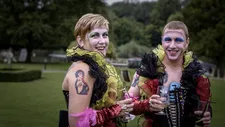 |
| Rocky Horror fans Paul and Sarah |
“Fast forward 30 years. I hadn't really thought about Rocky Horror when I heard one of the songs on the random playlist and I was wondering whatever happened to the guys playing in Rocky Horror? I mean, obviously everybody knew about the amazing careers of Susan Sarandon and Tim Curry. But you know, people like Richard O'Brien, Pat and Nell and so on – they kind of disappeared from the international stage. And I thought, ‘Okay, let's investigate what they are doing now and make a kind of late making-of feature.’
“45 minutes or something was the initial plan, but when we started to research, the deeper we dug, the more interesting it got. It developed in two directions from the film. It developed into the conception of Rocky Horror in the early Seventies, into the stage play. How many famous artists were influenced by Rocky Horror and all the connections with Mick Jagger, David Bowie and that sort of people; and how it developed into that amazing cult and it's still relevant and it still speaks to people 50 years later. I think that story is amazing and that's the reason why we made the film.
“The first thing you do as a serious filmmaker is you start to investigate and you start to make connections. Rocky Horror, I think it's a generational thing, it's very strong on Facebook, so we made a lot of connections there. And of course, we've been active in the community with posting our own stuff, being interested in what people do, and once you have one connection, it kind of grows itself. You know, you get phone numbers and ‘Hey, if you're here, then speak to them.’ People start contacting us because via our activities on Facebook they realised ‘Hey, there's a documentary.’ We got inquiries from fans and ‘Hey, come to our show if you are in Los Angeles, we are this and this shadow cast, we have a show there, you're welcome to come to us.’ That's basically how it developed.
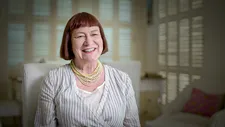 |
| Little Nell/Nell Campbell reflects on the glory days |
“Once you are accepted as a serious filmmaker in the community, it's pretty easy to get connections because if you send an inquiry like ‘Hey, we are in New York, we would like to film you. Is it okay?’ they start researching themselves and they see, okay, we have done some serious making-of clips, or we did some interviews with the stars, and we are serious in that way.
“Of course, most of the things I learned about by listening to the people, to what they made or why they become part of the shadow cast, what their concerns were, what their struggles were. From a filmmaker's point of view, it's not really complicated to relate to these people because they all have more or less the same struggle physically, psychologically – searching for friends, trying to find a peer group, not being accepted in regular social communities, especially in the United States, where the community factor is very, very strict. So once you listen and you ask the right questions, it’s quite easy to relate to them and to get really emotional and impressive answers.
“What actually surprised me was the dedication of the people. I mean, from my view, being a fan, it's a strange thing. I've never been a fan of anything. I like a football club and I like a music band, but not really a hardcore fan. And these dedicated fans are doing Rocky for 40 years. That's real dedication. And people traveling with the show in the United Kingdom to 40 different venues for the 40th anniversary, I mean, that’s borderline crazy, you know? I mean, in a positive sense.
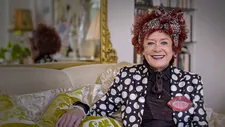 |
| Patricia Quinn shares her memories |
“How much of a fan do you have to be to see the same show 40 times with the same actors? How much of a fan you have to be to watch the same movie 3,000 times? I mean, it's lot of dedication. And all the time they are spending practicing for the shadow cast performances or the time spent in DIYing their costumes, their make-up, it's really astonishing. Not one of them gets paid for what they're doing. It's all their time, their money and their dedication that drives Rocky Horror. And that's one thing that surprised me because I've never met such a dedication for one thing in my life – except, let's say, hardcore soccer fans.
“They're very dedicated as well. But their football club is different every game, and every season is different, you know, But Rocky Horror is always the same movie they're watching, for 50 years. And we've asked that question to lots of them. We had the same answer: because of the audience, because of what they are doing on stage, every show is different. So yeah, they have found their passion and their found their dedication. They found their peer group. It's totally a good thing.”
We talk about the interviewees he found for his film, and I remark that I think it’s more interesting because it isn’t just full of the obvious people whose stories we’ve heard many times before.
“Yeah, actually, that's also how I feel,” he says. Of course, pretty early in the production, we asked Richard O' Brien if he want to be part of it and he respectfully declined. Several times. We asked him half a dozen times by different channels, but it never worked out. And also, if you're an independent filmmaker, let alone from Germany, without a big name, it's pretty hard to get people like Susan Sarandon and Tim Curry for an interview. If you don't have big money and a big name and a big studio like Netflix or whatever behind you, it's pretty hard to get A-list celebrities.
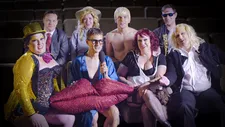 |
| Rocky Horror shadow cast Cards For Sorrow |
“On the other hand, as you were saying earlier, the film like it is now is pretty packed with information, lots of interviews and so on. We really exceeded what we could do in terms of timing. If we had Richard o' Brien and let's say Susan Sarandon, they would have taken up at least 15 minutes of screen time together, so we would have to cut out 15 other minutes. There would be less of like less known people or people who have never done an interview before, like Harriet Cruickshank, the manager, or Paddy O' Hagan, the first Eddie. They never spoke about Rocky Horror.
“Honestly, I don't think there's much said about Rocky Horror now which hasn't been said in the past. I mean, Richard O' Brien is doing the thing for 50 years and there are hundreds of interviews with him, and the same with Tim Curry and the same with Susan Sarandon. So I think our documentary is much more diverse in things we are saying. It adds to the value of the documentary. Getting more people to talk about it with different cues I think makes it more interesting.”
When he began this project, he says, he didn’t know that Rocky Horror had started out as a stage show, but he ended up developing some really good connections with people who worked on it.
“We had the first interview in 2014 with the costume designer, Sue Blaine. She's utterly charming and it was a wonderful interview. One of my favorite interviews of the whole production. She opened our eyes and she said ‘Okay, listen, they have that film. Of course we worked on it. But the stage show was so much more interesting. We developed the costumes, we developed the visuals, you know, we developed it all in the three week period by rehearsing for that show. You should really focus on that before you go into the movie because the movie is an extension of the original stage play.’
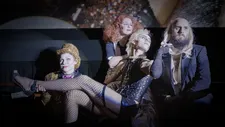 |
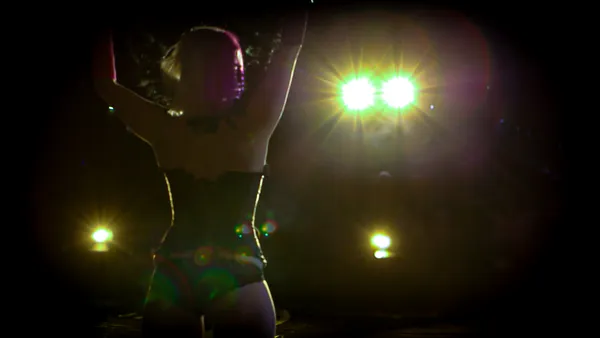
| The New York City Rocky Horror shadow cast performs Sweet Transvestite |
“She was so kind to provide us with the phone number of Pat Quinn, who was the original Magenta. Pat gave us three more phone numbers with Transylvanians and other people playing in the original show. And they gave us like three more numbers. It's like that rice grain on checkerboard,” he says, referring to the myth famously recorded by Ibn Khallikan. “We ended up with 80 phone numbers.”
Still, some people were harder to track down.
“Paddy O' Hagan, the very first Eddie and Dr. Scott, completely disappeared from the theatrical scene. So we got the chance to talk to people like Harriet Cruickshank, who was the stage manager of the upstairs, about how her experience was with Rocky Horror. Also Robert Fox, the assistant of Michael White, and we got a chance to talk to Michael White shortly before he passed away.”
With so many different elements going into the film, it was a challenge to piece it all together.
“I love editing,” he tells me. “But the story became quite complicated. So the only way of telling it was chronologically, and that's the way it worked out. I think that's the best way because otherwise would it been much more complicated.
“It's an honour to be at Frightfest. I'm not a big fan of horror myself, so I didn't know about Frightfest before we were selected to be shown there, but I’ve seen that there’s a whole community around it, it's a very well received and very well renowned in the genre. So we are very honoured to be shown there and have our UK première there.”
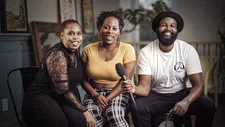 |
| The Chocolate Covered Rocky Horror shadow cast |
When I ask if he has anything else in the works, he says, very firmly, “No. Retirement. I think I'm going to retire.
“We've been working for that thing for ten years. I mean, we didn't work on it continuously, because everything we completely privately financed, so there was no studio or anybody backing us up. We called it the pet project. That's like a side project you love. We worked on it in our spare time. That's the reason why it took ten years, but actually it was worth it. It gave us more time to reflect within what we were doing. And we have 80 interviews and five big binders of transcripts and hundreds and hundreds and hundreds of pages of transcripts and stuff. So taking the time and not rushing anything actually added to the value of the documentary I think, a lot. So yeah. But I don't think that I will ever do something like this again! Please remind me, and shoot me if I try.”