 |
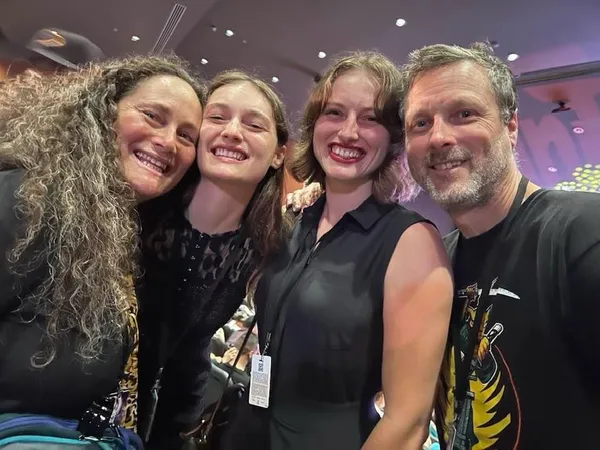
| The Adams Family: Toby Poser, Zelda Adams, Lulu Adams and John Adams. |
The family of filmmakers, Toby Poser, John Adams, Lulu Adams and Zelda Adams, have established themselves as a mainstay of genre cinema over the past years. They've captivated audiences with their unique creative lens and the family-centred ethos behind their films, which include The Deeper You Dig, Hellbender and Where The Devil Roams.
To the family's mind, they've found their niche and are able to tell a type of challenging cinema, the latest of which, Mother Of Flies, draws inspiration from the family's personal experience with cancer.
Shot in the Catskill Mountains, the story revolves around a young woman (Zelda Adams) who persuades her father (John Adams) to take her deep into the forest in search of a witch (Toby Poser), whose black magic might cure her cancer.
This genuinely striking film has the presence of a meditative narrative that morphs into the form of a poem. Thematically, Mother Of Flies is an exploration of the way our psychological, philosophical and spiritual natures connect with our physical wellbeing.
Ahead of Mother Of Flies playing the main screen at Frightfest, Lulu Adams and I sat down in a quiet corner of the West End to discuss her family's latest film. Coming to the interview after arriving in London from Edinburgh, there's no sign of fatigue. Full of energy, she's enthusiastic about discussing the film as well as life in general. This shouldn't be surprising given the films she and her parents have made are always driven by an interest in human nature.
During our conversation, Lulu discussed the layered psychology of their filmmaking world, the nuanced way music resonates with us emotionally, narratively and physically, and the importance of expressing themselves honestly through their art.
PR: How do you reflect on the experience of Mother Of Flies?
Lulu Adams: The first thing that comes to mind is that it was so personal. It was so tied in with each of us and it felt like it was such a deeply painful and personal subject to go into.
It was a really great time as well, because it does make people ask questions, and people will, of course, have different reactions, which is great. So, it's going to get people thinking and they might find themselves questioning their own thoughts based on how they feel towards the characters and how they build those connections. And from what comes up they will question what's good; what's bad?
PR: We understand the scepticism and pragmatism of John's character, but we also understand Toby's belief in the spiritual. This interaction is a thematic exploration of opposing points of view and the difficulty in finding some middle ground.
LA: Well, I just love the extremes because I love talking about black and white thinking and how I despise it. And I'm sure I do it myself at times. It's a human thing to do and we do it because of comfort. We think in terms of black and white, we categorise and we follow stigmas. We have all these kinds of stereotypes because we're trying to confine them into a box that is comprehensible, so that we can have expectations: I know where this is going to go. I know what narrative is going to happen. and it's something that's therefore comfortable and gives us control.
But humans are just not like that. They're complicated, they fluctuate and change, moving forward and then going backward. This is the most human experience and it's seen as a struggle. And maybe I'm thinking about it very psychologically, but there's the emotional and the rational side of your brain. You've got your left and your right side and they serve different functions. And trying to integrate that, and trying to essentially find balance is something you see in all mindfulness practices, including therapy and life coaching.
Living a balanced life is something you try to achieve, and I think of life as us constantly trying to do that, and often failing. But we're always in pursuit of trying to find balance or fighting with our lack of it. And so I think you have both these characters that you can relate to. Everyone can understand those times of being very rational, and trying to follow reason. And everyone can also relate to being extremely emotional — you don't even realise why you're emotional sometimes. There's the spiritual and pragmatic side, like you said.
They're such broad themes that we can all relate to. Then it's this example of the visceral and vulnerability you're seeing through Zelda's character that creates a struggle: 'I don't know how to feel about this. I don't know which side to pick.' There's no perfect or right way to do it. Both characters are right in their own way, and that is so human.
PR: You are all deeply aware and interested in human nature, but does your educational and professional background in psychological therapy, bleed into the films in any specific ways?
LA: I would love the idea that I did bring something in around that. I feel we each bring our own different elements, and we all commonly have our own interest in humanity.
Being an artist and being in rock bands, John was in such a social environment that involved working with people, and playing on people's attention by playing music for them or making art for and with them. And people seeing your art is relational work in so many ways. Then, Toby being an actress and playing all these different roles and getting inside these different minds, that is also about human beings and humanity, and what that means. And Zelda studies so much history, art and film, and that's watching people study history over time. It's understanding what has happened or is happening, and seeing it in a very emotional and artistic way — it's all so integrated.
As well as being a therapist, I bring my own interest in humanity. We each bring our different interests and fixations on the subject, and I'm lucky to have my own little niche. It's hard to think that I contribute too much to it. In a way, I'm sure that I do, but I'm usually described as the "cheese monitor." I'm always like, "Would a person really feel this way? Does this seem realistic?" Or, "How about this reaction that isn't normal, but is genuinely still very realistic? It's not something that's a common trope that you'll see in a movie, but it's still humanly possible. How much more complex and wonky would that make a character?"
That is the kind of stuff I personally love. And the scene that I was in for a bit was so fun to think about how I would like to introduce Lulu. What do I want to be? Do I want to be an entertainer? Do I want to be intimidating? Do I want to be quite obvious about what I'm doing? There are a lot of small things to the character which I enjoy.
PR: How do you observe the contrasting dynamics in the way you direct one another?
LA: Each of us talks to each other a bit differently. We all have this commonality that we've built over the years. We know how each of us receives, and how we naturally work, so that the other one can fill that space.
We take turns directing, and then you see in the editing room what actually works the best when you're removed from the situation. That dynamic leaves space for us to direct one another in our different ways. We will even act or film at the same time. I really like it, and I'm proud of that system — it works well for us. And it is really interesting to see how differently we talk to each other. It's not even, I guess, dyadic or tragic. It's multi because there are so many different dynamics going on.
I'm often living far away in a different country, and so, I'm more on the outside in many ways. And then there's individually, how we all cross over. And it is so interesting because that's maybe what you were talking about [pre-interview] how some of us can be quite similar to each other and then different.
That's when you'll maybe see how Zelda thinks like John. She understands his mind-set, and how he would maybe want to be directed to try to help him understand what she's trying to say. She knows how to explain and get him into her mind frame. And then, Toby and John have their more direct communication - their own partnership comes into that as well. Sometimes there's so much going on there of understanding each other's brains, as well as soft spots and not such soft spots, so you can be direct. It is really cool to see this.
PR: A friend once asked me if filmmakers are typically curious about human nature? I'd argue they likely are, and so, I wonder how much filmmaking influenced you to study and work in psychology?
LA: I've never thought about that because I always felt like my human interest was kind of natural, and it just made sense to go into psychology. I guess both became two different routes that are parallel to each other, which I've been able to do at the same time. And as we've gotten into horror, especially in film, the way they've maybe kept complimenting and influencing each other, tells me to remember how complex people are. And also how complex, undefined and indescribable 'bad' and 'evil' are. We think that we know bad guy kills; good guy saves, but it is so much more than that.
Making films that follow such simple lines or tropes has been a good practice to remind me of how complex people are, including myself. People can do and say they want to do horrible things, but there are still also all those "good qualities" as well. Horror is a great example of extremes, and it makes you confront them.
PR: Mother Of Flies leans heavily into poetry, and an interesting comparison might be to the narrative and poetic nature of certain music.
LA: Music is especially a big one for us because we have the band, Hellbender. And even before that, John had his band, and then John and I had our own little band. It was just me and him, The Hot Roses. I wanted to call us the Sex Addicted or The Horny Nuns — that one might not have landed when I was seven years old. And then he had his band with Zelda and that became Hellbender, which then became the family band.
Music is so tied with emotion. You can hear a song that doesn't have lyrics, but just listening to that beat and rhythm gives you a feeling in your body, and it creates your own story - you find the way it resonates with you. People feel different things when they listen to songs, but often there is a common or shared feeling as well. You might, for example, understand what you're supposed to be feeling, like there's a story you can understand without it being explained to you. It's something you can feel because there's a body/physical knowledge. It's existing on an instinctive visual or physical level rather than just a narrative that you're told. And that is very much a part of our music because there's so much complexity to it. In our movies, there are these very bouncy songs. There are also very quirky and fucking wicked songs or metal songs or really alien janky kind of songs — really solemn, sad or romantic.
PR: John was talking to me about how horror audiences have given you permission to make challenging films. It speaks about the empowering relationship filmmakers share with the audience.
LA: We're talking about the relational. We don't ever feel like we're doing things just for an audience, because that might not be authentic to ourselves.
I think we've found an audience in horror that feels warm and inviting. It's about knowing what our circle is, and then being honest with people in our circle by being ourselves. And there's something natural about having those people in mind, because you just know that they are within your world. It's a bit like they're gonna understand you. We all have things people love and are easy to love. And then we've also got some weird things as well about us, and people accept those just as much as the other things in this community — so much so that we can play freely and be as honest about how complex we are.
PR: Does a film start off being about the characters and become more about the audience? Are characters a type of prism for audience members to analyse themselves?
LA: You want your audience to be living in it — you don't want to be lecturing them. If they're just watching it then it's a lecture. The idea that they're living inside the content they're seeing, and they're finding things, is because we're talking about human things that mean something to us. Naturally, people are going to also relate to these complex and real, horrible and painful, happy and amazing things as they get to know the characters and go on that journey with them.
The goal is to invite people in, to create their own interpretation because ours isn't correct. This is what our quirky minds and our hearts came up with, and you guys take it where you want it to go. But we have control over that process because we're inviting you to explore that.
Mother Of Flies screened at the 2025 edition of FrightFest London.