




 |
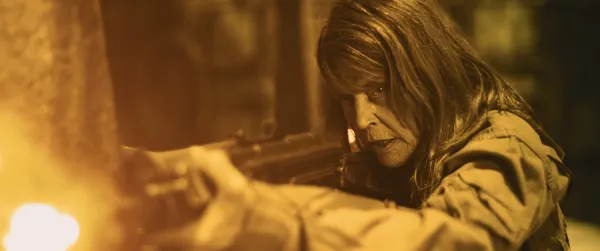
| Linda Hamilton in Osiris Photo: courtesy of Signature Entertainment |
Linda Hamilton does not like to be called a legend. She may have had, for a while, one of the most famous faces in the world, as the human centre of the Terminator films, but she’s also a human being and an actor who has continued to work in lots of different roles. Her professional ambitions are not limited to action – even if she has now found herself playing a hard-bitten survivor who leads a squad of soldiers against a powerful alien enemy in William Kaufman’s Osiris.
She came on board with the film at the last minute after another actor had to step aside for medical reasons, so had only a short time to prepare, but that’s the kind of challenge she enjoys, as she explained to me.
“They called me and I started no more than ten days later. I just thought ‘How much fun?’ And they were shooting the story in my neighbourhood, and it was three days of work. How are you going to say no? So I then spent the next ten days panicking and trying to get the Russian accent down, you know, working with the dialect coach for hours a day trying to memorise it like a theatre script, because for three days of work you really have to know it backwards and forwards.”
It might seem like a familiar role, but that kind of thing comes with its own problems for an actor, I suggest, as they then have to work harder to make it distinctive.
“Yeah,” she says. “Well, I do, anyway. I don't want to play the same darn person every time. Since The Terminator, more often than not, it's a fierce woman. And I don't want to only play fierce women. I mean, I love fierce women. I just don't want to only play fierce women.
“So yes, it was the Russian accent and just the fun situation. Monsters on a spaceship. Come on! I love sci fi. I love sci fi and effects, I genuinely do love that.”
This is a character who has lived on the ship for 20 years or something, and survived, so there's a whole lot of backstory to think about there.
“Maybe 30,” she observes. “She's lost track of time. So she's a wild woman and I really enjoyed that, and the scars and the dirt. I love playing a professional woman, too. I can't say that I don't want to play professional women, but I just love the wildness and it was wild working with Will. He was great. They didn't have a lot of money and he just was so selective. He knew what he needed. He didn't bother shooting all of it when he knew he could do it in a wide and he knew where he was going to cut it. So he could make those wonderful shortcuts that you have to make when you don't have a budget. Right? There's no extra time. So it was fun. I mean, I loved the guys. All of the actors were just totally characters already by the time I showed up. It was three days of great fun.”
She’s worked on projects with very different scales of production and very different budgets. Does she enjoy doing the smaller scale ones more?
“I do,” she says, “because you just don't have time. You have to think on your feet. And so you're just going, going, going in character and it's very satisfying, with no breaking and waiting. But I've actually hardly ever had the career where I've been sitting around waiting. I don't know, the other people might have had that career. But you know, it's just great to just do it and be creative. And that forces you to know it so well, you know what I mean? When you show up. Anyway, it's just a great exercise.”
She’s full of praise for Will, but says that whilst he gave her confidence throughout, it’s impossible to tell, when doing that kind of work, what it’s going to look like when it’s finished.
“He knew so much about what he wanted and how it was going to look, and he's very special effects oriented and he loved his team. I mean, they were just a fantastic team – this whole company, the producers, you know, they were just tight as a team. But then when I saw it, there were a lot of effects that I hadn't anticipated. You just don't know the look of a film until you see it. I admire Will for giving it something very specific through his artistry. I mean, no matter how you read the script or how it appears on set, you don't know until the finished product is there in front of you.
“That's the nature of a lot of movies, or movies that I do, where things have advanced so much. It's like doing the last Terminator and going ‘What is previs? What is that?’ You know, I started with blue screen, then went to pre-green screen, and now, with this, back to blue screen for previs. What's this? You have to literally refer to a little animated thing that they show you, to know how you are in relationship to a big space. I mean, there's no ship for you. There's no special effects shots and things like that. So it's really interesting to have to put it all together in your head.
“After a while I was doing The Terminator, it was like ‘Wait, I'm sorry, we're in a what? Falling from a what?’ You really have to work so hard to understand the spatial arrangement of the set. And that's fun, too. I love it all. I just love the fact that I've seen so many changes, too, in the way that things are done.”
I put it to her that she’s been responsible for a few, too. Her work helped to create the first opportunities for women in modern action films at the end of the Eighties, and now she’s at the forefront of creating space for older women in roles like that. is it important to her?
“No, because I don't think in large,” she says. “I don't think like that myself, in terms of the legacy or what I'm doing for women. Actually, if I'm a good example, it's all accident. It's just my nature to work really hard. And listen, I never was fit. Never. I mean, never.” She laughs. “I rode horses a bit and read a lot of books growing up. So, you know, I only did that because of the demands of the job. And then I wanted to be very careful to not just be that, so that everyone is always trying to see my arms. You know what I mean? Or the look of disappointment when I was pregnant and chubby after Terminator. I did not promise you a model of fitness. Now give me some cake. So it's interesting when that is given to you or that, you know, is assigned to you in a way. I am very grateful that women have been empowered, you know, but – never mind. It happens.
“People mistake it. They start to say ‘Oh my God, Sarah Connor!’ Me, like Sarah Connor? I'm like, ‘Are you kidding me? She's a miserable person who had a future thrust her way. She's a woman in Hell. She's disappointed in mankind. Why would you want to be like Sarah Connor? That’s such a bitter journey. You know what I mean?”
How does that affect working with other actors? When she comes onto a project like this, especially at the last minute, there must be some excitement in the team there that they're getting to work with her.
“Yeah, well, I have to say, that's also something that I’m really uncomfortable with. You know, people will be like, ‘Oh my God! Oh my God. You're an icon, you're a legend!’ You know? And I am so uncomfortable with those words. ‘Whatever. You'll get over it.’ I really try to deflect, you know? I just don't want to wear the mantle of ‘greatest’, ‘fittest’, whatever. I really think that could get in one's way. Like Jane Fonda, who was fantastic, but all of her aerobics and the – what was her program called? I just think that then when we see On Golden Pond, her beautiful body is distracting to the actual movie. You know what I mean? And I don't want to be responsible for generations of women.”
So maybe you can talk a little bit about the kinds of roles that you are looking for and what you would really still like to do as an actor. That maybe you haven't had the chance.
“Comedy,” she says, without hesitation. “Straight out comedy. I just haven't mastered it yet. I am funny in life, but haven't gotten to be funny on film enough. So I'm not very good at it. Plus now I have this fierce face and I have to work twice as hard to be funny. So I'm not sure if that's going to work out for me or not. And I love it. I don't think there's any greater thing at this point in time, in my life, that would mean more than just making people laugh, lightening the mood.
“I was the straight guy on Resident Alien, the show that I did. I told everybody that I just felt like I failed on that every single time, for four seasons, because they were all so funny. And I would try to work something into a moment where you get to see a little something else than the stern general. I would work it and work it at home, and come onto set and everyone, to a man, every director, whatever, for four years was like ‘You know that little thing you're doing? Don't do that.’ Oh well. ‘You're not funny. It's not the character. You're the straight man. Say the line.’”
Osiris may have been a return to type, but she clearly enjoyed making it. Her last words on the subject?
“It's fun. Have a good time.”