




 |
| Fucktoys Photo: Fantasia International Film Festival |
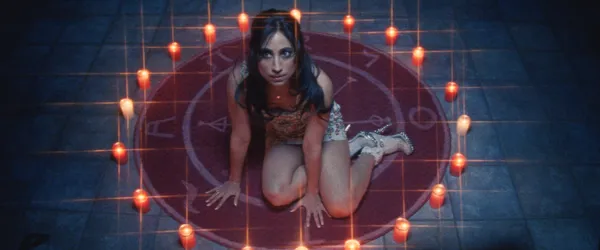
“I felt like you might like this movie,” says Annapurna Sriram when we meet. She’s referring, of course, to Fucktoys, the festival sensation which has recently screened at Fantasia after wowing audiences at the likes of South By Southwest, Fantaspoa and Karlovy Vary. It’s a film that she wrote and directed and also stars in, playing a sex worker called AP whose meeting with a fortune teller inspires her to set off on a quest to raise $1,000 – a quest that will show us the sights in a world that rarely makes it onto the big screen.
It’s a world that people describe as wild, unusual and daring, I say, but to me it just felt like the kind of people I’ve spent most of my life around getting their chance to be in the spotlight for a change. There aren't many people who make those kinds of films.
“Yeah. I think Mike Leigh does a little bit,” she says. “I hear what you're saying. I feel the same way. I mean, I feel like the movie is – it's not naturalism, but it is kind of naturalism and it's not fantastical in the genre sense. It's actually just a straight ahead story that has, like, production design.
“I too feel like the people are all very familiar, especially if you live in New York or London. I'm from Nashville and in Nashville, you meet these characters and you're like, ‘Wow, if someone put that in a movie, it would seem fake.’ But these people are actually so real; they're eccentric and nuanced and idiosyncratic and sort of dramatic as people, and you don't really get to see that type of eccentricity in movies.”
It’s a complex world to bring to the screen so vividly whilst telling a story at the same time.
“I've spent some time in the UK, I don't know exactly what it's like to live there, but I feel like Trashtown is just America. I'm just calling it Trashtown to trick people into thinking it's this fantastical other place, but actually this is the reality of our country right now.
“I grew up in the South, which has, I think, extreme...” She hesitates before concluding “Just extremism in general. There's the extreme right. There's leftist politics. There's extreme poverty, there's extreme wealth, there's a lot of disparity. There's extreme segregation still, you know – communities, everything is very segregated in a lot of ways. And I think that there's something about the South that I have both this affection for and this frustration with and, now even more so than ever, this disgust with.
“There was this element, though, of my childhood in the South that felt very stuck in a time capsule, because you would go to your friends houses and they would still be decorated from the Seventies or there would still be a soda shop from the Fifties. There felt like all of these remnants of other decades, and it was pre-millennium, so it was the Nineties. So it also was this pre-computer world that felt like this quilt or this tapestry of all these different eras coming together. It made this sort of childlike or innocent place in some ways. I think that when I was that young, that's how I was still perceiving the world is, through this very hopeful lens. And so that is where I think the world really started to percolate inside of me.
“Living in New York, I think there's another layer of grime, but it's like lovable grime. That's the thing – when you're like a starving artist or a starving anybody, you end up living on the fringes of society. But what you actually find in those fringes is there's so much beauty and there's so much character and there's so much love. And even in these complicated places like the south, you still meet people that you like. Even if your politics are fucked up or you're kind of backwards. There can be these shared connections. And so I think that Trashtown is this place of affection. It's this place of love. But it is also critique.
“I drew like a city map, you know, like in the opening of Lord Of The Rings they had the map of the world. I drew the map of Trashtown. And it's just like a shrunken version of America as a city where you have, like, the desert and New England and the swamps and the plains and the industry. It’s all just condensed.” She pauses to reach for a mug of black coffee. “I think that we call it a heightened world because the timing, the decade isn't really clear. I wanted it to be this amalgamation of decades. But it is just our reality.
“I think initially there were two things that made me start writing it. One was I was seeing all these psychics and I was seeing a lot of them because I was sick with this low grade fever and I couldn't get over it. I was reading this one psychic who is a medium who does a diet that you should eat. My mom had this healer that she was having me see who's sort of like the neon psychic who puts her hands on me [in the film]. But then she also told me this story of my past life. So a lot of the stuff that the psychics say are real things that psychics have said to me. And then this one psychic told me that my boyfriend was the cause of my illness. And then I needed to dump him. And if I didn't dump him, I wouldn't have the career that I was supposed to have.
“So I dumped my boyfriend. Immediately after I got off the phone with the psychic, I just called him and I was like, ‘I have to talk to your about something.’ And so I was really heartbroken, and I also felt really stupid. I felt like the Fool in the tarot. Who just gives up the love of their life because a psychic tells them to? I felt so silly and absurd. So I started writing down these satirical scenes with these psychics. I just felt like I had to write those scenes down because they felt so funny and real and absurd, and I'd never seen a movie where that happened to a character, where she wrote something and then just immediately acted on it. But I did that in real life, so it is a real thing that a character would do.
“The other aspect was that I've always loved all these films from the Fifties and onwards. Movies like Alice Doesn't Live Here Anymore, Pee Wee's Big Adventure, or The Loveless, or Gregg Aracki films or John Waters films or Grease 2, these old movies that depict the Fifties. So as I was writing, I wanted to include these locations or these sets that felt like they were part of this nostalgia that I was having. I think, because I was heartbroken, I was probably just living in my nostalgia, and I'm very sentimental as a person. So it's like all of these memories from my childhood of places that all feel very big and important to me. I wanted to have these settings that felt like these remnants of my past.
“Another movie, Jubilee, is a really big reference for me, which is a movie by Derek Jarman in which the Queen of England goes into the future. It's in the Eighties, so it's this Eighties poetry, punk, anarchist dystopia. A lot of that first set where they're in that sort of Peter Pan house with all the kids fighting, that was very much a reference to Jubilee and squatters, poor kids in London, kids in New York, living in this sort of punk house where they make their own rules. And then the doughnut shop and those locations felt like they were almost dreams or memories of other movies or my childhood.
“So that's where the specific world building pieces came from, but I think structurally, it was that break-up, with the psychic. And then there was this boy that I was kind of in love with, and he wanted to be an actor. So I told him that I would write a script for us to be in together and we would be in love in the movie. And then of course that relationship had a very short life. We were very passionate and it burned really bright and then it fizzled out really fast. And then by the time I got to making the film, I didn't even want to cast a boy in the part. I felt like, you know, seeing a cis boy in this context in 2024, 2023 just doesn't hold the same weight that it did when it was Johnny Depp in Cry-baby or Matt Dillon in Drugstore Cowboy. You know, it just is a different feeling.
“So that's where then I opened up the casting to femme or non-binary actors, and I found Sadie [Scott], who plays Danni, the love interest. But the original boy who inspired that love story, he also felt like he was a relic from a different era. He had this like mullet and he felt like this Eighties character from The Loveless or a John Waters movie or a Jim Jarmusch film, or a Harmony Korine film. He felt like this real like rugged punk kid. And I think that was where, then, I wanted to draw on a lot of these older references for the world of the film.”
I ask her if she got over her fever and if she does now have the career of her dreams.
“Yeah,” she says, blushing. “She was right. I mean, that's the craziest thing, is she was right. This is still the question I grapple with, with psychics. if they set you on a good course, does it matter if it's right or wrong? You know, if they set you onto a course that is ultimately going to make you happier, give you the life that you want – because before when I was sick, when I was in what was kind of a dead end relationship, I was a struggling actor with no real prospects in front of me. I was broke. I didn't really have a career. And after that breakup, even though I didn't think I was ever going to be a director, I was able to take agency over my life and over my career in a way that I didn't before.
“Maybe needed some like drastic shift to happen to shake me up and make me take agency over my creativity, which I don't think you have as an actor in a lot of ways because you're not really in control of what the script is. You're just there to service the vision. So, yeah, I think she was 100% right. But I would be very terrified to ever call her again.”
In case she suggested giving up other things, I suggest.
“Yeah, exactly. Like, what if she's like, ‘No, you shouldn't have a dog’? Because when she said it, it felt like it really was the sacrifice. Your biggest fear in talking to a psychic is that she's going to say you're with the wrong husband or you're in the wrong career. You're going to be asked to question this thing that you deem as part of your identity. And I think that now I'm like, ‘No, I can't,’ and I can't afford it.”
The film has attracted huge festival interest, but back when it was just a script, it must have been very difficult to find support for it.
“We spent five years alone just to get the financing for the movie,” she says. “It started with just little tiny increments. And you're right. There were so many meetings that I would have or people I would send the script to... I worked as an actor, so I knew all these producers just from being on indie films. So my first attack was just talking. I would email every single person I basically had ever worked with, and I was very shameless. I think that that's key to making a movie. You have to be very shameless, and you have to be very open to being your own salesperson. If you're an introvert, it's going to be very tricky.
“A lot of my strategy was just being on a set or reaching out to people and being a big personality and being like, ‘Hey, I did this thing. I'd love to get your feedback. I'd love to get your advice.’ I worked on the script with one of my professors from my acting conservatory. We did table reads and he was a sounding board, and he was such a great resource for me as a dramaturg. So I had gotten a lot of confidence in the material on the page. I've heard actors read it out loud. I think it's funny. I think it works. So I had a lot of confidence just in, ‘I know this is a really unique script, and it's really different. It's actually not as risqué as movies used to be. For where we are right now in our cinema, it is going to be a little bit edgy, but I promise it's not as crazy as De Palma or films from the Eighties or Seventies that just had so much more nudity and random vulgarity and problematic things in them.’
“I had a lot of support from people that understood the script and other artists, like actors, like François [Arnaud], who's in the movie, who really loved the movie and got it. I think a lot of artists really like actors. And my cinematographer and a lot of the creative department heads came on board very quickly because they all saw the opportunity creatively for themselves. When it came to financing, I had to rely on a lot of my past work as an actor and the prestige of any of that, you know, working on the West End or doing this film that was critically acclaimed by the New York Times. I had to lean into ‘I'm a serious artist. You know, this isn't porn. This is serious art, and we're exploring these political themes through metaphor.’ And so that was a lot of how it went. But there were so many men who just straight up were like ‘You can't make this movie. It's too risqué.
“We have so many men making even more risqué films all the time, like Infinity Pool. You know, there's so many movies that you can name made by men that are just so much more out there sexually. And then also, I think people were just like, ‘You can't have this title. You can't make a movie about these themes. You need to tone it down. You need to censor it.’ The more that I was told to censor myself, the more I was determined to not censor myself. And then also people that would come on board that were like, ‘We have to keep the title.’ Like François, and my producers. So even if I was like, ‘Well, we can think of other titles,’ I started to have people around me who said no.
“That became this sort of anti establishment rallying cry for the movie – this movie that really stood for something outside of corporate industry or corporate studio. And I think that that's also what we're missing in American art right now, is people really taking a stand against industry or corporation and making outsider art.”
She apologises as we are interrupted by a friendly dog who demands her attention.
“This is Post. We actually found him on location in Louisiana when we were filming. He was a stray puppy,” she explains. “He's jealous. He's like, ‘Who are you talking to?’”
Post doesn’t agree to lie down, but does back off a bit, allowing the interview to continue.
“So yeah,” says Annapurna. “It took us a long time, and we had to finance the film in very small tranches of 50k or 100k. We raised about 250k, and then when we were going to film in Louisiana, there was a tax credit, and we were basically able to double that because we were like, ‘Oh, we can get up to 40% back with the tax credit.’ So that was how the financing went. But, yeah, it took a very long time.
“I think the thing that's crazy, though, about the marketing of the film, is that at festivals we sell out consistently, and we also sell out consistently with Gen Z audiences. And I think it's predominantly a lot of kids who don't typically go to film festivals, who don't typically go to theatres, are showing up for this film. I think that that is our superpower as a movie, because we're offering something that feels authentic. It's not being pushed to them by a marketing institution. It's not just being forced onto them by a big company that has a lot of money to advertise something, but it's this genuine thing that’s coming across their plate that is made by people. People like them, also poor artists, also outsider freaks, you know? People who are queer. And I think that that is our advantage in the game. But yeah, that title is a blessing and a curse.”
I suggest that whilst there is indeed more risqué stuff out there, it's female sexuality and queer sexuality that censors are afraid of.
“Yeah,” she says. “But it begs the question, is it risqué or are you just afraid of it? My producer did all this research on censorship in all these different countries, and he found that a lot of countries – I don't remember which ones exactly – would outlaw porn that was specifically around female pleasure. And so, for example, golden showers are outlawed in some countries, which is an interesting thing because it's either kink or BDSM-angled, or it's female pleasure in a situation where a woman is peeing on someone, is not herself being penetrated, but is potentially enjoying the act of degrading and humiliating a man. And that's such an interesting thing to consider.
“Women who are taking control and enjoying and having fun with their sexuality and their dominance, or their power and sexuality, like knowing that I can pee on this guy, knowing that I can call upon this sugar daddy to do whatever I need him to do. You know, when you have that power and you have fun with it and you play with it and you have characters, male characters who can't get an erection. And that's their problem. I think that it is really scary to men because it means that we're pulling back the curtain on intimacy. You know, like actually, after sex, a man's penis is shriveled up and ugly. It's not sexy. And that's beautiful, you know? That's where the vulnerability and the intimacy comes in, because then you're having this sweet, sensitive moment. The post coital isn't the cigarette in the bed. The post coital is the ‘Do you still like me? Do you still find me attractive? Was that good for you? Did you even come?’”
We talk about her decision to shoot on 16 millimeter, a bold step on a tight budget.
“That was such an important thing to me and Tim [Petryni], my producer, and François, my actor,” she says. “He brought us all together. He was like, ‘We have to shoot on film.’ I'm a film snob. I bought the camera during 2020, when a lot of people were selling their gear at discounted rates. So I owned the camera, so that helped with a lot of the costs – we weren't renting the camera body with our budget. So we have this ethos and this line that we would say to ourselves, which is, ‘The movie lives forever and the movie is going to live forever. The movie is going to live after I die.’ And so we wanted every choice that we made creatively to go towards ‘this is something that will live forever. We want it to be the best quality it can be, and we want it to stand apart from everything that's being made at this budget by our peers. And so we felt like one thing that we can do is shoot on film.
“We also shot on these anamorphic lenses, which also give it a different look because we were like, ‘This way the film will have a look that stands apart from everything else that's in the market and will have a classic, timeless look. It will hopefully be ageless or age well after I'm gone, as it lives on in the ether and has its own life.’ So one thing we did was I was like, ‘We'll only basically get three takes of everything when we're filming.’ There was a lot of rehearsal. My cinematographer and I test shot the entire movie in an Airbnb, with a camcorder and a cell phone. We did a lot of prep for the storyboard of the movie and for the shot list of the film.
“On set, you can hit a moment where you're like, ‘Oh no, everything's going wrong. We only have ten minutes to get the scene.’ You know, these horror stories of sets. So we would build this priority list of our shot list. So it was basically like, ‘If we have our dream day, let's try and get these ten shots. If we're pressed for time, we'll get eight. These are our five main shots. If we have to shoot the scene in one shot, this is the shot.’ So if we were in a bind or we were in a crunch on set, we always knew plan A, plan B, plan C. Like, how can I craft the scene and make sure I can still get what I need and not waste film, waste time making a decision. That, paired with extensive rehearsals with my actors and basically only three takes.
“When you shoot digitally, there might be this idea that you can just play around and shoot, but you're running out of time no matter what. So I felt like it gave us this healthy constraint. And I sort of feel like being an actor, you know, if you're on set, if you get to take four or five and you're not really getting the scene, you're probably not going to get the scene that day. That's just a lack of prep and a lack of rehearsal and a lack of whatever it is. So I lived by that rule. If I'm on set, if I'm not getting it by the first or the second take, I can do a fuck it take where I'll just be like, ‘Okay, just try whatever you can.’ And that's the best we're probably going to get. So rather than beating something to a pulp, we should just get what we can and then move on. So that is how we made shooting on 16mm work. And I think it's worth it because I think the look of the film adds so much character and adds so much uniqueness to it . It's like a nice little sparkly glaze over the whole thing.
“It makes the colours. And it feels like I wanted it to be, as if someone found a time capsule buried somewhere, and then they opened it and found this movie, and they were like, ‘Wow, when was this made? The Sixties?’ It had this feel of being this discovered piece of art that was lost in time.”
Her next script is already written, she says.
“I wrote it basically right after we finished production, before we started editing. I wrote the first draft of it, and I think I'm on drafts maybe four or five. My next movie, I want to shoot in Tennessee, and I want to make it black and white on film. It's set in the Fifties and it goes into the Sixties, and it's about an illiterate ex-con who ends up in the country music world. It's sort of a revisionist history of the birth of outlaw country. And so I think of it as my Coal Miner's Daughter meets Down By Law, with an O Brother, Where Art Thou? sort of tone to the film. It's my country music movie with the big hair and the big dresses and, you know – but about outlaw country and outlaws.”