




 |
| Hold The Fort Photo: Fantasia International Film Festival |
Failure to read the small print in a homeowners’ association contract leads to trouble in William Bagley’s Hold The Fort, which screened as part of Fantasia 2025, with new homeowners not realising until too late that they’re now under obligation to help hold off waves of monsters from a nearby hellmouth on an annual basis. It’s a film which begins with a party and the cast seems to have experienced the shoot in a similar way. In fact, they’re still overflowing with excitement about it, to the point where cast members Chris Mayers and Levi Burdick decide to crash the interview I had arranged with William, and it takes a little while to get the to sit still and restrain their banter enough for me to get a question in. When I do, I ask William if he’s always been a fan of monster movies.
“Oh heck yeah!” says William. “I love a good monster movie. I love anything fantastical with magic, fun stuff like that too. I like films with characters who are in crazy situations and adding monsters on top of that just makes it more fun. So I think trying to create some kind of fun character environment was basically what we were going for.” So it didn’t just stem from a bad experience of a homeowners’ association?
He laughs. “No, no, no. Weirdly enough, if you watch the movie, it's kind of pro HOA. I don't think I'm pro-HOA, but the movie itself might be.”
Chris concurs. “What's cool about monster movies in general and then hopefully about our film as well is with a lot of monster films, especially your classic ones, it's less about just a monster. There tends to be this sense of the underlying societal anxiety that is represented through this monster. Because, you know, when you look at your Frankensteins and your Draculas and your classic monsters, those tended to reflect what was happening in society at the time, the things that we were most afraid of. Right? And so for this, I think William did a great job of using these monsters to really represent the anxiety of what it feels like to become an adult and try to grow up, you know what I mean? And how difficult that can be.”
“Each character kind of had a very simple, almost caricature sort of thing,” says William. “Lucas is your basic leading man. Jenny is the female version of the basic leading man. Levi's supposed to be the crotchety old HOA guy. The president is very, you know, ‘Stay off my lawn!’ They all had simple identifiers but then the actors were able to bring in way more depth to that and then make these characters feel real. So we had a quick place to start with, so as an audience member you can go ‘I know exactly who this person is,’ and then we had the actors, and hopefully the script, which dives in more and embellishes all of it – makes it way, way bigger.”
They also developed backstories for each of the characters, he says.
“We all did talks, too, about what we thought.” He looks at Chris. “I remember talking to you the first time we met, and I was asking you a bunch of really random questions. Like, I was like, ‘Do you think Lucas drinks alcohol?’ We would go into this sort of stuff and dive in and just try to figure out who they were. I think you guys probably created your own versions, too.”
Levi nods.
“Yeah. Part of the actor process is building a backstory for your character, and that allows you a real, real solid foundation for once you begin the relationship, building with other characters and using the script as your framework, your guideline. It really works well.”
So did he have a sense of what had happened at the HOA 's equinox parties in previous years?
He grins. “Oh, yeah.”
“Yeah,” says Chris. “What's interesting is when we originally shot the film, principal photography wrapped, and then as William was editing the film, he realised that we maybe needed a little bit more setup than we had shot initially. And so there's this first scene of the film where we find out a little more about what's happening in this neighborhood, sort of the origin story of it. I think he did a really good job. You see this opening scene of this older couple who see this portal to hell open up and have to fight it off. And you see they are just tired of having to fight this stuff. This has been going on for a very long time. It was cool to see because I wasn't there for that shoot, and I didn't even know it existed until I saw it.”
“ I've got a whole backstory,” says William. “The Gruber family that owned this land for years, they've been fighting off monsters for years. These are the last two left over. They eventually sell the land. There's a whole thing that's not in the script.”
“Yeah,” says Levi. “And William does a really good job with the script of planting lines throughout that let the audience know some of the events that have happened in recent equinox parties. I kind of built that out: why I'm such a fan of McScruffy and some of the things he's done in the past that really impressed me. So I've got a reason why Ted feels the way he feels towards him.”
I point out that one of the challenges is making viewers understand why Ted has stayed there despite having to deal with monsters emerging from a hellmouth every year.
“It's a cheap-ass mortgage,” William responds.
“There's a certain Americanism to it,” says Chris. “I honestly don't know how popular HOAs are in certain other countries, but I know especially in America...”
“It's a real pain,” says Levi.
“It's a real pain in the ass,” Chris agrees. “But something like a property tax, if you get cheap or no property taxes, that honestly would be a huge plus. And yeah, there would be people who would literally risk life and limb for it.”
William nods. “It's only one night a year. Yeah. There's the scene towards the end of the movie where Lucas and Jenny are talking, and she's just talking about how everyone in the neighbourhood did all these things and there's this real sense of community. And I think for a lot of the characters, it probably actually is that they're there for the people and it's just like one of the things that you have to put up with. But no property tax, definitely.”
So how did they decide which monsters to use?
“A little bit of budgetary restriction,” says William. “And then also just coming up with things that I thought were funny and cool. Werewolves are always awesome. Witches are always awesome. The kung-fu spirits was actually because I needed something that we could film on a lower budget that would still look cool, but wouldn't be a full creature thing. But I didn't just want to do zombies. So then it became like, what if it's zombies who know kung-fu? And then it became kung-fu spirits, and I'm like, ‘That's just hilarious. Let's do that.’
“The kamikaze bats was actually because it was supposed to be ninjas with ray guns that shot little pink lasers, which was way sillier, and I decided it was too silly. So we ended up doing kamikaze bats, because I really liked the image of McScruffy and Lucas running with pink explosions going off behind them. And then the stick man. The stick man...” He takes a breath. “Actually, that was [co-writer] Scott Hawkins’ idea because he's a very tall guy, and he was originally going to play the stick man. He's like, ‘I just want a really tall, slender guy.’ And then Shane Morton came on and made the stick man significantly scarier than we thought it was going to be. And it's amazing. It's pretty terrifying.”
Obviously an awful lot of the budget went into special effects. Was that a big consideration with each monster type as well?
“Oh, for sure, for sure,” says William. “But, you know, Shane was willing to create some amazing stuff and really do some awesome favours for us, so we weren't too worried about the budget of the creatures. When I was thinking about the budget of the creatures was in the script when I was writing it. Because when I'm writing, I always try to at least be like, ‘Well, if no one will help me, I can at least somewhat pull this off.’ And then I find people who can help me and who are way better than me, and then it becomes this great.”
“I think it was important to all of us how just how rich and tactile real, practical effects are,” says Chris. “Like, obviously there's visual effect shots in this film, but I think they do a great job of supporting the practical effects. What I love about it is it's just so...” He trails off. “I don't know, there's just something so delicious and real when you're using practical effects. Like, could we have done a CG werewolf? I guess, maybe, but it would not have been nearly as cool.”
“The audience wouldn't get as much out of it when they get the chance to see Ted fist-fighting a real werewolf,” adds Levi.
“Which is just such a fun thing!” says William. “You fist-fighting the werewolf is amazing.”
Does it help with the acting when there’s something real there?
“Oh, yeah,” says Levi. “I've worked with CGI and stuff before, and there's nothing there, so it's definitely a different skill set. This was pure fun, pure enjoyment, and I think I speak for Chris and myself both when I say that we had a ball every single day of filming.”
I remark that, never mind the cost of the creatures themselves, all of the clean-up and continuity must have been a nightmare to manage. They agree.
“This clubhouse just got destroyed," William admits. “From the second the witches attacked, we had flower petals and blood and fake glass and all sorts of stuff all over the floor. And we were shooting in an actual HOA clubhouse, like an actual neighbourhood clubhouse. And it was a hot set, but it was also the only room in the building. So there were constantly people walking through it. And there was just a level of like, ‘Well, it's so messy, maybe the continuity will be okay. It's so dirty, hopefully they won't notice that that flower petal moved six feet because the gaffer kicked it as he was walking by.”
“But the art department, the wardrobe department, the makeup and the hair, they were flawless,” says Levi. “I mean, they really were on top of everything. Where stuff was, what the blood was on, what phase of the blood was on Lucas...”
“There were four different stages of blood for Chris, and all of them had photos,” William explains. “He'd be in stage three one day, then back to stage two, then go into stage four. So, yeah, the production team and their level of organization was really top notch.”
“It was funny because we were in an actual HOA clubhouse,” says Chris. “There was a downstairs that had a gym that members could go in and out of, and that had to remain open to the public. I was covered in blood for 19 says and sometimes I would need to go downstairs to use some facilities down there or whatever, and I would forget that there was blood on my face. Somebody would just be doing curls and would look at me like, ‘You okay, buddy?’ And I was like, ‘Oh, yeah, this probably looks bad.’”
Nevertheless, William says, the locals were very enthusiastic about the film shoot.
“Weirdly enough, some of the people who lived in that neighbourhood, it turned out I had worked with before, because we all work in the film industry. Some people who live in that neighbourhood were walking by, and they were like, ‘Oh my gosh, y' all are shooting a movie!’ So they were very supportive. The HoA itself was very supportive. The president’s son was trying to get into movies and was really interested in special effects. He came on to the set a couple times and was able to hang out behind the monitor and all that sort of fun stuff. He's 10-years-old. We hopefully didn't scare him too much with all the blood and stuff, but he had a great time. And everyone – they were really cool.”
“A lot of the neighbors decided to walk their dogs and come by and take a look,” says Levi. “We wanted to entertain them. You know, we were grateful that they let us be there.”
With all that going on, was there room for any improvisation during the shoot?
“The story was pretty much locked in,” says William. “As far as improvising every now and then, usually the way I like to do it is I like to get what's in the script and then if we have time, we do a wild one.”
“Because the script was so concise, we didn't feel the need for a whole lot of improvised improvisation,” says Levi.
“There are two things that are my favourite,” William continues. “Yours is when you kiss the shotgun before you're about to head out. That was the Levi special.” He turns to look at Chris. “Yours is all the one liners we did for the glasses. I don't remember what was actually in the script. You did a bunch of different ones and the glasses was the one that ended up staying. So every now and then we did some fun stuff, but for the most part, it was pretty much the script. We also didn't have a lot of time to play around.”
Nevertheless, they were prepared for any eventuality, with a chest full of additional weapons for dealing with different kinds of monster.
“There was a ton of stuff in there,” William reveals. “We had the guys who were doing the props work on a bunch of stuff in Atlanta. Over the course of years they had acquired a bunch of random mythical objects. So we put in a lot of those. We also, if you know who Julian Smith is – he plays Jerry [the HOA president] in the movie. He also had a very big YouTube channel back in 2010. So we have one of his props from his movies in there, which is just like a little Easter egg for Julian Smith fans. Yeah, there's wooden stakes in there. There's like feathers for warding off shaman people. There's all sorts of crazy stuff.”
“The handheld chainsaw,” Levi recalls fondly.
“Your handheld chainsaw,” William nods.
“It was funny because there's like A scene where Lucas is digging through this chest trying to find a sword,” Chris recalls. “It’s funny to not be able to find a big old sword in this chest. But as I'm digging around, I'm like, ‘There's some sharp stuff and some legitimately weird things in here.’ I was like, ‘What?’ It was not hard to act that. ‘What is all this?’”
“When they threw in a giant calculator, I shoved that to the bottom,” says William. ‘I was like, ‘I don't get that one.’”
We talk further about the fun they had on set and I ask about their favourite moments.
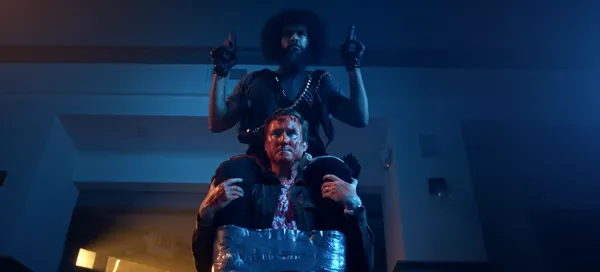
“Making an indie movie is extremely hard, limited to a strict budget,” says William. “So for me, honestly, the most fun is when we've accomplished something really good and we've done it within time and we finished our day. But one of my favorite things is the creative magic that just happens when you're up against the wall. There's a scene at the end where Lucas and McScruffy are running towards the portal, and we had shot this shot on green screen where there's actually a wire and Hamid is on Chris' shoulders, and they run. We were planning on using that, but Tim Rice, our producer extraordinaire, came up with an idea while we were on set.
“We had a golf cart. He was like, ‘What if Chris sits in the front seat and then we put Hamid in the back and we just drape his legs over? Then we just take the camera, we tilt up, and it'll look like they're running together.’ And it looks great. And I giggle so hard every time I see that shot. I have not stopped laughing, even though I've seen that movie a thousand times. I love that shot. So that was a huge standout. I think the second it worked, everyone just kind of freaked out. It was also, like 3am on a freezing cold November night, so it was just a good heartwarming moment.”
“For me, it was what I call the Lucas and Ted dance scene, where we finally figure out the solution to killing the kung-fu spirits,” says Levi. “You know, a little bit of baseball, a little bit of dancing, a little bit of fight choreography. It was a lot of fun doing that scene.”
“I would agree. That was one of my favourites,” says Chris. “All the stuff around those kung-fu spirits was really cool. I love watching really expert stunt people working. It’s fascinating to be a part of.”
“And we got a chance to do a little bit of our own stunts and work with a really Hollywood level stunt team,” says Levi.
“Yeah. The rigging team works on huge Marvel movies and stuff,” Chris adds.
They’ve also been having fun at Fantasia.
“Oh, man, I don't want to leave,” says William. I'm leaving tomorrow and I don't want to. It's been incredible. The reception of the movie was awesome. Seeing the reviews come in, talking to people, meeting all the people here, the audience itself, just seeing everybody kind of geek out about our movie has been super fun.”
“Yeah. Montreal has been an incredible host city,” says Levi. “Mitch Davis has been just flawless at hosting an event like this. And really the chance to network, meet other filmmakers, other actors – we just got to spend some time with some Koreans who made an incredible short called Floor. I’m blown away by the level of talent and the quality of productions here.”
“People from all over the world who just love the art of filmmaking,” adds Chris. “This has been an absolute blast. It's great to see, worldwide, people making this stuff because they love it. And getting to be here to see all these wonderful horror and fantasy and sci fi films, it's just been a real blast.”
Levi nods. “And you can see in person why Fantasia has become the biggest genre film festival in the world.”