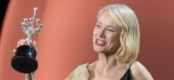






Luke and Harry Treadaway in Brothers Of The Head
It's 1977, the height of punk, and self-made freaks are everywhere. Sid Vicious is rubbing margarine into his face to give himself more spots. GG Allin is cutting himself up onstage and covering his audience in faeces. And according to Brian W Aldiss - science fiction's enfant terrible (despite already being over 50) - the Howe twins, Tom and Barry, are confronting the world with their own form of body shock - the strip of flesh which has bound their bodies together since birth.
It's 2006, and an adaptation of Aldiss' novel, Brothers of the Head, has now reached cinema screens. The world has become blasé about the likes of Vicious and Allin, yet, bizarrely, Tom and Barry retain the power to shock. Perhaps there is something about the differences people are born with which disturbs on a different level than those they might create. Conjoined twins, in particular, continue to attract both fascination and hostility. Curiously, despite a slew of documentaries and sensational newspaper stories, most people still understand very little about how they happen and how they experience life. Most, for instance, assume that all conjoined twins must be identical, and that they must all long for separate lives, neither of which is the case. Many still have difficulty treating more closely conjoined pairs of twins as two people rather than one.
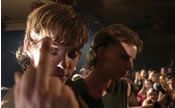 Cinema's most famous pair of conjoined twins remain Daisy and Violet Hilton, who rose to stardom in Tod Browning's 1932 classic Freaks. Telling a sinister tale of a beautiful, manipulative trapeze artist who marries a dwarf for his inheritance only to be discovered by his friends, who wreak a terrible revenge, this perhaps reaches the heart of the public horror about the freakish and unusual - a horror which centres on reproduction. In actuality, only a small percentage of the more obvious deforming conditions have a genetic element, but this didn't stop the eugenicists of the early 20th century - in science fiction as well as in fact - hoping to eradicate them.
Now, in the 21st century, the issue is once again at large in the public consciousness, as new medical technologies give rise to imagined futures in which everyone is, or strives to be, 'perfect'. Films such as Gattaca have championed the rights of the underdog in such scenarios, yet have done little to address the question of whether perfection is really a wise ideal. It's one thing to ease pain and cure deadly diseases, but there are any number of borderline cases. Conjoined twins who remain together often comment that they imagine it must be terribly lonely to be 'a singleton'. Yet despite a gradual shift in the balance of sympathy towards those with different bodies, their own perspectives have rarely been explored in art. Only Japanese manga has made a serious attempt at this, drawing parallels with wider identity issues, and the Japanese are gradually beginning to introduce such concepts on the big screen.
The big difference between Japan and the West is that western society is still affected by Victorian attitudes which said that what was malformed on the outside must be evil on the inside. These attitudes persisted even as late as the 1950s, when utopian science fiction films presented a world in which bodily 'perfection' was an essential part of the future we were all striving towards. Again, it was the pulp comics which rose to challenge this, giving us superheroes whose unusual abilities were often rooted in physical abnormalities, and who were frequently insulted and called freaks.
Horror gave us creatures who might be monstrous to look at but were more and more human by nature. By the 1980s they were crossing the boundaries, and Clive Barker's Nightbreed gave way to the Martian mutants eager for justice in Total Recall, making visceral what Philip K Dick had only hinted at. The X-Men films outwardly celebrated difference and sought to address real issues relating to the position of the physically different within society. They also provided a rare scenario in which such people mingled comfortably with others and were even allowed to be sexy. Sir Ian McKellen has stated that a large part of the reason for his devotion to the X-Men project has been its importance to outsiders of all kinds, including young disabled people.
Whilst real human freaks have continued to dwell on the borders of others' stories, like the conjoined sisters known as la Pieuvre ('the Octopus') in City Of Lost Children or Flora and Fauna in The Addams Family. 1999's Twin Falls Idaho stood out by letting its twins take the lead, but its story centered on their condition and on the issues surrounding their eventual separation.
In telling the story of conjoined twins with active lives and independent concerns, Brothers of the Head stands alone. Perhaps Aldiss, an acknowledged master of far future science fiction, is still far ahead of the game in imagining a world (or even a small part of one) where differences like theirs have not been eradicated, but where they simply don't matter.