




 |
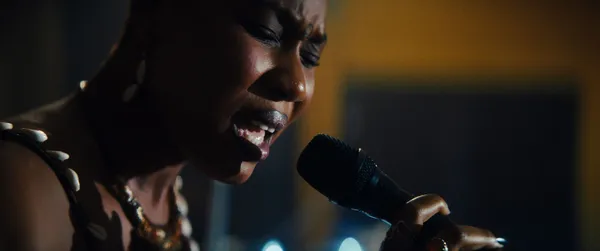
| Titi (Tosin Adeyimi) singing in Dear Ajayi. Damilola Orimogunje: 'She’s crying for help every time she sings' Photo: Courtesy of Venice Film Festival |
Your previous, film For Maria Ebun Pataki, focused on a woman's postpartum depression, and this one is also very female-centric, what draws you to the woman’s perspective?
Damilola Orimogunje: I would say it’s a mirror of my immediate society and the immediate people around me. I’ve had the privilege of seeing the experiences of some very strong women. That shaped how I've thought about women. I didn’t set out to tell a women’s story, but I found it strong and interesting.
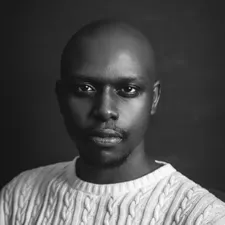 |
| Damilola Orimogunje: 'The goal for me as a filmmaker is to inspire or influence filmmakers to want to make films that are honest, have sensitivity and that exceed their territory' Photo: Courtesy of Venice Film Festival |
DO: I always imagined filmmaking to be an idea of everyday life. I wanted the film to feel real as much as possible. I think the best films are those that take you away from the idea that you're watching a film. In so doing, I imagined I’m presenting every aspect of time that we have in a day.
That’s why when we were making the film, from pre-production, we imagined what it looks like early in the morning and how do we portray the late afternoon? Also you hear the Nigeria of these times. In the early morning there’s a set of people that are in the soundscape, maybe selling stuff around the locality. There’s also a call to prayer at a particular time, which is in the film. I also wanted to use moments that feel nostalgic to me. Not necessarily so many years ago, but what I experienced and how I see life and I wanted to put it in the film.
You shot the film on a single lens. Tell me about that choice.
DO: It was always instrumental to make this film feel like the audience are the ones making the decisions with the camera movement and who the camera wants to see, and in doing that, myself and KC Obiajulu thought what could be the best way to imagine that. I can’t remember who said what but we said, what about we shoot with a 100mm. At first it was like, no, we’re restricting ourselves. But then the more we tried it onset, the more I found I fell in love with the idea of that. It made sense to me that I wanted to tell this from the viewpoint of the audience, and that was the majority of the reason why we shot on one lens.
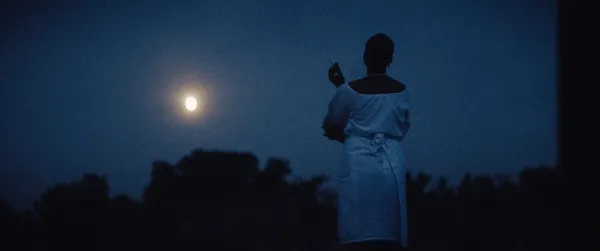 |
| Damilola Orimogunje: 'I imagined I’m presenting every aspect of time that we have in a day' Photo: Courtesy of Venice Film Festival |
DO: We wanted the film to shape the storytelling, also, because the film has a lot of patience, a lot of restraint regarding the characters, with their thinking and with their sensibilities. The camera stays on the character for a very long time and it makes us also want to know more. So the camera has as much restraint as the characters. I was interested in Vitalina Varela by Pedro Costa. It was the use of lighting. How they were able to shape the darkness, in terms of how we can connect to the agony of the main character. With this film it was important that we painted a texture that showcases sadness, melancholy, depression and even the ambiguity of the conflict of the love of their life. I think what the camera and the lighting and the framing was doing was to give us a perspective into how these people are. Every frame tells us thousands of words. So I was discussing with the DP, “If we see a frame, what does it say about this character and what she’s feeling in this film?” And that’s the mindset we had.
Did you have a lookbook?
DO: Absolutely. I’m a big fan of foreign cinema. I’ve also been shaped by Wong Kar-wai’s work. I’m also a big fan of Djibril Diop Mambéty who made Touki Bouki and Hyenas – you can see the texture of Africa. These films, like Vitalina Varela, that I mentioned earlier, and If Beale Street Could Talk and Moonlight by Barry Jenkins. It was so important to use films that have texture and represent black texture in that manner. Also Mother Of George, by Andrew Dosunmu and Sinners – that assisted us for the music part because I wanted the music to be immersive. So there was a combination of all these films in thinking about what the film was going to look like.
It’s interesting you mention the music because that’s also a key element. How did you choose the tracks you wanted?
DO: Firstly, I'm a big lover of music. Besides film, music is probably my best love. I would say these are some of the finest songs on my playlist. I wanted to give the audience a little bit of a taste of my music but, more importantly, it was also telling the story with music. We have a character Titi, who has fewer lines and will not expose herself to what people might think of her. But she says this through her music but people don’t hear it. She’s crying for help every time she sings. It brings us to the point of how we confront these characters and how we really understand the people beyond what they present to us and I think the music does that. I also wanted the film to be very African and quite nostalgic. Some of them were songs that my dad played to me. There’s also an appreciation of all this art in the film. It has music, it has art, it has performance. It’s like a version of all the arts but with an African or Nigerian sensibility in them.
Tell me about the casting because such a lot of this film is based on gesture as well as dialogue.
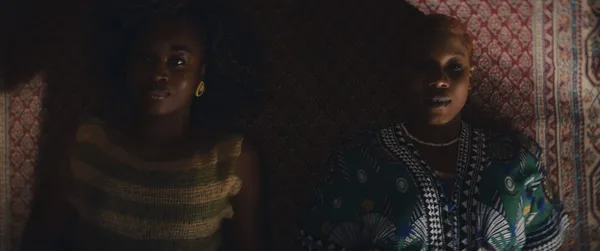 |
| Damilola Orimogunje: 'I didn’t set out to tell a women’s story, but I found it strong and interesting' Photo: Courtesy of Venice Film Festival |
Bimbo Akintola, who plays the lead, was the person I thought about as I was writing the script. Her character’s sister took a longer time to cast because we had spoken audiences and saw so many actors before we got to Tosin Adeyemi, who I think is phenomenal.
You’re the writer/director here, do you like both roles equally or do you find one appeals more than the other?
DO: In this case, I was juggling three roles, I was the writer, director and producer. It causes a lot of complexity but I love it because it gives me the ability to be able to shape the film exactly the way I want it, of course, with the help of every other artist. The ultimate vision of what I want is easy for me to be able to communicate and achieve because of the roles I'm doing.
How do you feel about the state of the Nigerian film industry right now?
DO: I think it’s blossoming right now. For the last three years we’ve had Nigerian films playing at the biggest level. This year alone we’ve had films at Sundance, Berlinale [Lady in both cases], Cannes [Clarissa], Tribeca [One Woman, One Bra, Crocodile] and now in Venice. This you didn’t see five or ten years ago. Nigerian filmmakers are coming to the market making honest films about our realities. I’m excited by how bold these filmmakers are getting. I can’t wait for what we see in the coming years because it can only encourage people to want to go and make films. The goal for me as a filmmaker is to inspire or influence filmmakers to want to make films that are honest, have sensitivity and that exceed their territory – films that go outside the country.
Dear Ajahi is premiering in Venice, which is a step up from your previous film so you have a trajectory going. Do you see yourself continuing to tell more of these family tales?
DO: Absolutely, These are the people I see every day. These are people that I know. And I think the best form of cinema is telling stories that are true and honest. I have two projects in my mind but they are in early development. I absolutely want to tell Nigerian stories – small, intimate stories – that I feel don’t get projected on the big screen, and to take them to a global audience every time.