





Eye For Film >> Movies >> Full Moon Rising (2026) Film Review


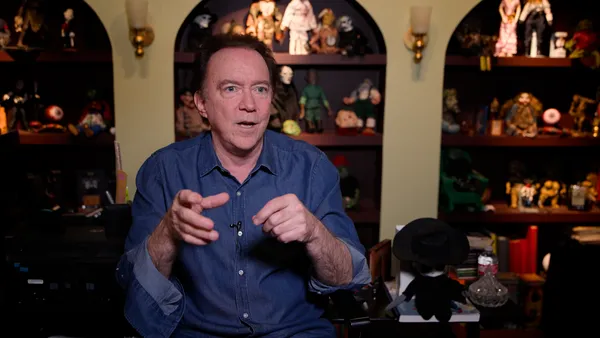

Have you ever watched a Charles Band film? Let me put it another way: did you, at any point in the last 50 years, ever rent a cheesy horror film based on the title alone? If so, the chances are that you have watched a Charles Band film, and that, even if you thought little of it at the time, parts of it stuck with you. No other film producer was quite so prolific over this period. Indeed, it has been said that Band invented the concept of straight-to-VHS. There are gems in his catalogue as well, from Terrorvision to From Beyond, Puppet Master, both versions of Castle Freak and of course 2023’s The Primevals, which latter he and I discussed at some length. Sarah Appleton’s new documentary, screened as part of Frightfest 2026, attempts to sum up this extraordinary career.
Where does one begin to talk about a man who released 22 feature films last year alone? Perhaps by tracking him down to his lair. The Band house is full of treasure, from notes and photographs to much-loved props – we are barely inside when we come face to face with Evil Bong. It also contains family memories, and the first part of the film focuses on Charles’ father, Albert Band, who has an incredible story of his own, fleeing Berlin in the late Thirties and building a new life in Hollywood – Charles was just too young to remember being babysat by Marilyn Monroe. He does remember being around the film industry very early and finding himself gravitating towards horror, knowing that those were the kind of films to which he wanted to devote his life. After a rather inauspicious start with Last Foxtrot In Burbank, that’s what he would do.
Going on to address the rise and fall of Empire Pictures and, subsequently, the emergence of Full Moon Features, the film mingles clips from their more notable offerings with talking heads. Band himself shares memories, subtly shaping the conversation as much as one can without controlling the edit. Several of his family members also participate; amongst the praise for his work there is a more personal tribute from rock star son Alex (of The Calling), who describes him as an exceptional dad – not an easy thing to achieve along successful entrepreneurship.
Naturally there’s a selection of Band’s collaborators, including legendary director John Carpenter, Re-Animator scribe Dennis Paoli and star Barbara Crampton, who enthuses about Tourist Trap. Ciarra Carter asks viewers to ditch their assumptions about Ooga Booga and explains what it meant to her to see people of colour positioned as a more advanced future humanity in Robot Jox. Libby Higgins remembers being recruited after her video Woman Rages Over McRib went viral, and how she loved getting to play a character who was fat but whose weight was never mentioned. There are fond tributes to visionaries Stuart Gordon and David Allen, whose influence on Band’s work extended far beyond their direct contributions.
There are some great anecdotes; one imagines that there could easily have been enough for a miniseries, but for a running time of 97 minutes, something had to be cut. It’s here that Appleton’s experience really shows. Documentaries like this are all about balance, and that requires a willingness to be ruthless that she has learned from working on The Found Footage Phenomenon and The J-Horror Virus. This film feels richer and more satisfying than either despite the challenges presented be a looser structure. The thesis behind it doesn’t really emerge until the end, when we get the suggestion that if Band’s work is less visible these days, that’s at least in part because of what has happened to everything else. The kind of ideas that drove exploitation cinema can now be found in the mainstream. Yet Charles doesn’t come across as a victim of his own success. He’s still having too much fun for that.
Reviewed on: 01 Sep 2026


