





Eye For Film >> Movies >> House Of The Wind (2026) Film Review


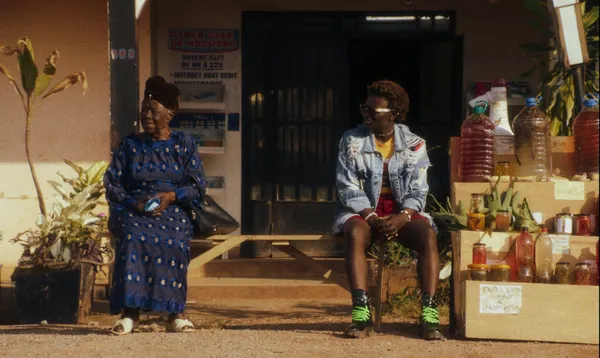

The personal odysseys young people undertake to new countries in search of a better life have proven fertile ground for contemporary arthouse cinema. But what about those who are left behind? Auguste Bernard Kouemo Yanghu’s very personal feature debut stays with an elderly Cameroonian mother of six whose adult children now live in the West. Inspired by the director’s own mother, Josette (Josette Kwanya) lives alone in a family home veiled in a particular kind of loneliness – the maternal one. She talks to her children through video calls that are often brief and punctuated by their distractions and divided attention.
From the outset, there is an almost one-sided delusion, mistaken for a pact, that they will return to their homeland. Josette oversees the construction of her son’s house, rushing the contractors to have it finished by the summer, when he is only noncommittally expected to arrive. Piercing her solitude are the television programmes brimming with analyses about the brain drain Cameroon is experiencing and the necessity for young people to stay.
But when she loses her ID card, necessary to withdraw money from the bank and pay the contractors, Josette crosses paths with a young woman, Sarah (Moudjeu Pouadeu). The two strike an agreement. Sarah will withdraw money for her, while Josette will pretend to be her mother in front of Sarah’s French fiancé and let Sarah live in her home. As the two warm to each other, their arrangement takes on an increasingly maternal dimension, with Josette finding in Sarah a substitute for the children whose absence has come to define her life.
House Of The Wind wafts in an underexplored perspective of the parent who stays behind as her children pursue their ambitions. Yet its perspective is complicated by the uneasy position of a director who himself left Cameroon and his mother behind. The film seems woven with notes of perhaps regret, perhaps reverence. Yanghu, now around 50, spent 20 years living in France and, because Cameroon does not allow dual citizenship, is no longer a Cameroonian citizen. The contradiction between genuine sympathy for Josette and Yanghu’s examination of hus own absence through her is noticeable.
But besides honoring his mother, the French-Cameroonian director also does justice to his motherland, offering a slice of Yaoundé, Cameroon’s capital. From the informal art of buying your way to the front of a queue to the women-led microfinance network that Josette belongs to, these details offset the more conventional narrative construction.
Ultimately, it is the universality of a diasporic child judging an older parent’s decisions through the distorting lens of distance, age and solitude that will resonate with many. When Josette tells her children that Sarah is living with her, their concern quickly turns to the possibility that their mother has been taken advantage of. One of them remarks that “it’s a pity there are no retirement homes in Cameroon” .'The line stings. Even from thousands of miles away, her children are trying to manage her life – for the sake of their peace of mind.
Despite its bittersweet ending and somewhat muddled last act, House Of The Wind is an ode to mothers who lose their children to a better life elsewhere. For those of us still privileged to have a living mother, it is the kind of film that nudges you to rush and hug her, or call if you are continents apart. I know I will.
Reviewed on: 04 Sep 2026


