





Eye For Film >> Movies >> Colony (2026) Film Review


At times of great social upheaval, it is often noted, politics tends to become more polarised, with people moving either to the left or the right. Although many people find this confusing, the obvious answer is that people realise they can’t figure out a course by themselves, so they try to work collectively – whether that’s with everybody or just with a select group. Of course, what all too often happens in reality is that rather than truly pooling their ideas and strength, many of them end up following individual leaders whose thoughts they mistake for their own. This is true even online, despite talk of the internet ‘hive mind’. it may be inevitable. The dream, though, is to create increasingly fluid, immediate forms of communication, because it is observably true that miscommunication and failures of empathy are leading factors in the instigation of conflicts and wars.
What if perfect communication could be achieved biologically?

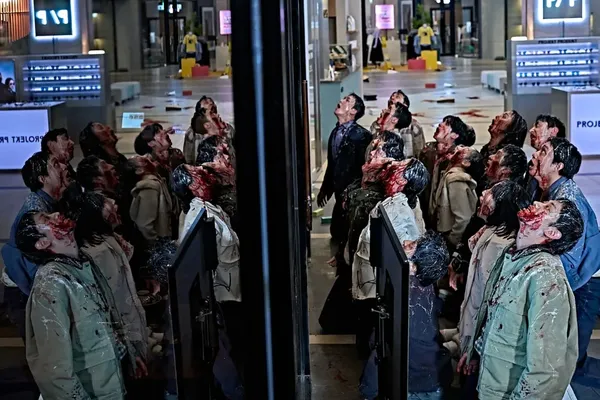
Coming from Yeon Sang-ho, who is best known in the West for the thrilling, kinetic Train To Busan, Colony may at first look like just another zombie move, albeit one that’s likely to be viscerally intense and entertaining. it won’t let you down in the action stakes, but there is a great deal more going on here. Following in the tradition of films like Day Of The Dead and Herd, this is not just another film about inevitable doom or a small group of heroes forced to use violence to fight back against overwhelming odds. It’s something far smarter. The notion of collective action on which it hinges can be understood in multiple ways. Though acutely focused on the present, it retains sight of the future. It values the intellectual as much as the physical, challenging characters and audience alike, and as such, it’s packed with surprises.
Kwon Se-jeong (Jun Ji-hyun) is a biologist attending a conference in the company of her ex-husband Han Kyu-sung (Go Soo), who is trying to help her pursue a new job opportunity. The two remain very close, and she jokes about what his new wife, fellow scientist Kong Seol-hui (Shin Hyeon-bin) must think; in fact, the two women like each other a lot. This is the first of many little tweaks to stock character relationships that Yeon and co-writer Choi Kyu-seok will make, sticking close enough to formula to make viewers feel secure, but shifting it enough to say something quite different.
Another biologist in need of new opportunities is Seo Yeong-cheol (Koo Kyo-hwan), who has been sacked from the company whose owner Se-jeong hopes to impress. Denied the opportunity to use its facilities for research which that owner considers dangerous and irresponsible, he has elected to pursue it secretly. Collective intelligence, he insists, will be the next great step forward for humanity. One way or another, he is going to make it happen – even if he has to begin by infecting everybody in the building.
Despite the film getting its première at Cannes, many critics seems to have written it off as more empty-headed zombie nonsense. One of the easier points to criticise is the characterisation of Young-cheol, whose pre-existing privilege and gift for strategising his way out of difficult situations blind him to the fact that it’s his own immaturity which gets him into them in the first place. The truth is, however, that he’s very much in keeping with the techbro personalities we see in the real world. Yeon is interested in population dynamics, and as such, failings of this sort are as much a part of the equation as brilliance.
It’s a much rarer thing, in today’s cinema, for us to encounter intellectual characters, let alone groups of them. When she’s barricaded inside a store in the multi-purpose Doongwoori building, Se-jeong immediately begins to engage with the situation as a puzzle to be solved. As others have been panicking, she’s been observing. It’s clear that when one of the infected has acquired an idea or skill, the others have it too – an extension on the idea of zombies copying one another, taken much further. Two things immediately suggest themselves to her: getting all of the survivors communicating through their phones so they’re at less of a disadvantage; and finding ways to introduce misinformation into the opposing system.
Although it’s a complicated process and not always immediate, the infected’s knowledge transfer capacity makes it much harder for the survivors – who include an angry rich man, three high school students, a security guard and his mobility-impaired sister – to make their way through the building. This aspect of the story is cleverly played out, and it’s more than a gimmick, instead being a core component of a story about information, belief and social interaction. A police officer caught up with the same group insists that they avoid killing anyone, reminding them that the infected are still human beings and should be thought of as patients. If there is to be any hope of curing them, and of preventing further infections should building quarantine measures fail, it’s essential that Yeong-cheol be found and delivered to the emergency science team outside (which soon comes to include Seol-hui). If they can find him, the policeman says, they will all be rescued. Since he can wander at will without being hurt by the infected, however, this is not going to be easy.
There is the occasional break with the bounds of scientific possibility here, usually for narrative reasons. The transformation upon infection is very fast, but this means that overplayed subplots about allies hiding their infection or slowly, tragically succumbing to it can be dispensed with altogether. Instead, the danger within the group comes from conflicting character motives and behaviours. The actions of the teenagers serve as a reminder of the uncertain potential of the infected – people must be considered not just for what they are but for what they might become. Kim Shin-rock brings a shrewd intelligence and strong sense of agency to the disabled character, making it clear that she enjoys her life and very much wants to keep it. As her brother, Ji Chang-wook gives us a character who is in many ways more dependent than she is, and who is clearly tempted to use murderous violence from an early stage, influenced by what he says, his brain being rewired in a different way by a particular kind of exposure.
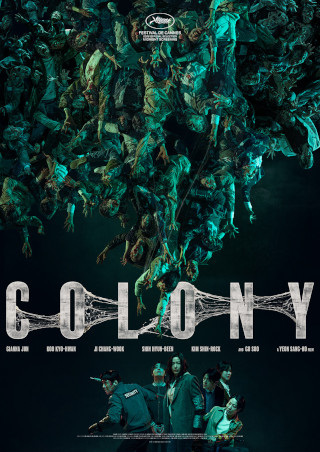
Throughout, Yeon’s directorial skill and Byun Bong-sun’s stylish cinematography grip viewers’ attention. Dance-trained, highly flexible extras , wonderfully choreographed, make the infected into something distinctively terrifying. A scientific mechanic drawn from slime molds, introduced in the conference at the start, contributes to a unique visual aesthetic, with strands of whitish slime gradually accruing over every surface and bonding themselves to characters’ clothes. Doongwoori is a term which suggests a nest or haven, and the building increasingly comes to resemble a wasp’s nest.
Although some plot elements are predictable, shaped by Yeon’s awareness of what satisfies a mainstream audience, the film shifts gears enough times to keep us guessing. Exactly what are Yeong-cheol’s real aims? Is he, too, caught up in something bigger? What do the various responses of politicians, the military and the general public tell us about collective behaviour? The title, in Korean, suggests not so much a socially colonised space as a population being studied, a microcosm of something larger. Conventional blockbusters have contributed much to the delusional macho environment of contemporary politics. In suggesting different ways of solving problems, Colony becomes a subject for study itself. Without ever compromising on thrills, it emerges not just as a story about social contagion, but as an antidote.
Reviewed on: 06 Jun 2026


Director: Yeon Sang-ho
Writer: Yeon Sang-ho, Choi Gyu-seok
Starring: Gianna Jun, Koo Kyo-hwan, Ji Chang-wook, Shin Hyun-bin, Kim Shin-rock, Go Soo, Kim Hyeong-mook
Year: 2026
Runtime: 123 minutes
Country: South Korea
Search database:
