 |
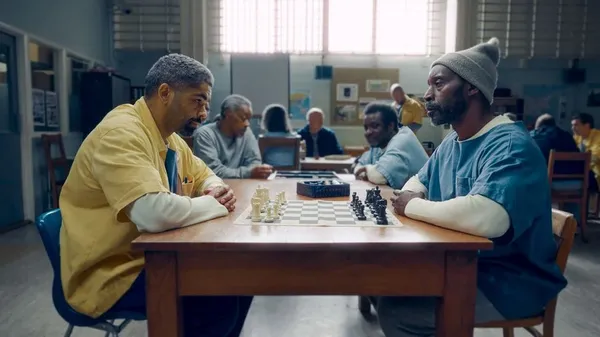
| Kingsley Ben-Adir and Rob Morgan in Frank & Louis. Morgan says: 'I showed up prepared and really wanting to be honest, to put a human being on, on screen, and not a caricature' Photo: Zodiac Pictures Ltd/Frank & Louis Laundry Services Ltd |
Volpe explains that the film predates her previous film Late Shift.
“I've been working on this project for over 10 years,” she says “The idea or the story was brought to me by Esther Bernstorff, who read about the Gold Coats programme in the California men's colony in San Luis Obispo. We were both really intrigued by the fact that their younger, incarcerated men are taking care of all their incarcerated men with Alzheimer's and dementia and we saw a lot of potential to tell a very humanistic, socially relevant touching story about men in a space where that's normally known for toxic masculinity. To tell the story of care that was very intriguing.”
She praises the actors for working “the thin line of being emotional and vulnerable and volatile and showing themselves naked, in a way, but still not making it tip over into something that’s sentimental”. Volpe tried to stay as truthful as possible to the things that she had learned through her encounters with the Gold Coats and their patients. She adds: “What they do is real and it's not sentimental and it's very deep because the way they care for the patients and what the patients mean, for them personally, were just resonating with us and we tried to capture them as best as possible.”
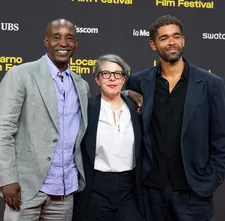 |
| Rob Morgan, Petra Volpe and Ben Adir on the Locarno red carpet Photo: Courtesy of Locarno Film Festiva/Ti-Press |
“It was really, really challenging in a way that I haven't kind of experienced before, challenging in a good way. Just the smallest micro differences in a look or a touch could make such a huge change in the frame, so I feel like lots of the conversations were about that.”
Morgan also undertook his own dementia research. He says: “I started reaching out to the Alzheimer’s Association of New Bern, North Carolina, and they allowed me to meet up with two different couples who were going through what my character was going through, early onset Alzheimer’s disease – 57 years old and 62 years old. And I got to see various stages of it because one was somewhat present where the other one was completely not present. It was such a wealth of information and I just took it in.”
Morgan says he got the script a couple of months before the shoot. “I just slept with it, ate breakfast with it, had lunch with it. I scribble in my scripts like crazy, it's colourful and everything. They were even laughing at me when they first saw my script with all of these notes and different colours.
“I really try to organise my character in my mind, and the story from start to finish even before I get to set. It’s the theatre background in me. I come from the American Theatre of Harlem in New York City and preparation is this key, knowing your character's journey to the T and then trusting my director. I showed up prepared and really wanting to be honest, to put a human being on, on screen, and not a caricature.”
In order to keep track of what stage his character was at in terms of the memory loss, they devised a number system, so that he knew where the character was. He adds: “It is a very challenging thing especially with a disease like that that's very volatile and very very thin line to to depict.”
Although the film deals with a serious subject, it wasn’t a gloomy set. Morgan says: “We had loads of fun. We were joking in between takes, because it's such sensitive, highly emotionally charged material. I'm the type of brother, I like to play, because when you go see a play, you go see a play. You don't go to see people cut their wrist and die on stage. What we do is literally about play so if we don't play and have fun how can you enjoy it? You got to see us playing. And the environment was so safe and accepting and embracing.”
He adds, jokingly, referring to Volpe’s Swiss accent and Ben-Adir’s London brogue: “I didn't understand one word these people were saying. But a smile goes a long way.”
He’s also keen to get Ben-Adir more work, suggesting he would be perfect to play tennis ace Arthur Ashe.
On the subject of incarceration in general, Petra notes that the US system is “particularly cruel” since it focuses on punishment not rehabilitation.
She adds: “That was a driving force for us. To show that if you end up in this prison system, you become discarded as a human being and you are very dehumanised. It starts with the fact that when you become an incarcerated person, they take away your name, you’re just a number. So for us to have these two names, Frank & Louis, to give them back the names that their mothers and fathers gave them was a very symbolic gesture.
“I think a society has to think deeply about these very complex questions the film raises, because there is, of course, crime – we also take the victim, very seriously and we don't show men that are innocent – but how do we treat them and how do we give them a chance to stay human beings and not to be discarded and treated like they're dropping out of society because I think the main point of the movie is that the person is much more than the worst thing they did.”