 |
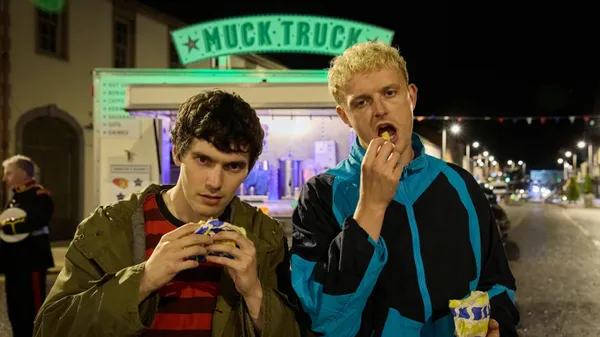
| Night out in Skintown: Jack Rowan, left, and Chris Walley. 'Passing in to adulthood is complicated enough without throwing conflict on top of it' Photo: Courtesy of EIFF |
As a portrait of youth culture in the 1990s Skintown (the nickname for Enniskillen) the film captured the imaginations of audiences with its banging soundtrack of 90s hits and the narrative of two friends who wheel, deal and plan their escape from the Troubles during a brief respite in the conflict.
Walsh recalls that his first 2000 feature film When Brendan Met Trudy, a dark comedy, was written by Roddy Doyle (of The Commitments fame) and produced by previous EIFF director Lynda Myles, and his first short film found inclusion in the festival selection back in the day. “I cannot think of a better Festival for the film than in Edinburgh because there are lots of common points between Ireland and Scotland – the sectarianism, the flute bands and the violence,” explained Walsh.
The film is based on a book by Enniskillen native Ciaran McMenamin who sent Walsh a draft copy ten years ago. “I remember getting a photocopy of the book before there was any interest by publishers. He just wanted to know what I thought of it. I read it when I was on holiday and by the time I was half way through it I had to ring and tell him it would make a great movie. He was like ‘What are you talking – I just wanted to know your opinion.’
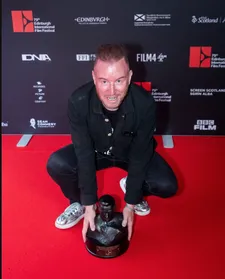 |
| Skintown director Kieron J Walsh at the prize ceremony of the 79th Edinburgh International Film Festival: 'It was funny growing up at that time in the 80s and 90s when music was a badge' Photo: Courtesy of EIFF |
It helped that Walsh and McMenamin were of a similar age. “Obviously I didn’t grow up in the North but I was fully award of the political situation. I used to travel up and I had interest in rave culture and rave music. As it happens I never went to the particular night club Kellys which is featured. It was one of the first places that Catholics and Protestants would go, mingle, and take ecstasy. And then danced together and nobody cared where they were from. It kind of brought them together like a little goldfish bowl which was nice. My original thought was to try to depict that idea,” said Walsh.
“It was funny growing up at that time in the 80s and 90s when music was a badge. Depending on what music you were into reflected what gang you were in. That has gone now because music is everywhere. You can like country and western and rave music at the same time. In those days we you were either one or other and you had to find you tribe. It was a kind of crossover period which gave an interesting backdrop to the film.” Prodigy, Elastica, Happy Mondays and Carl Cox all feature prominently on the soundtrack.
What Walsh and McMenamin were keen to explore was male friendship in your teens and twenties. “The guys lived out of each other’s pockets and even though you might have had a girlfriend your relationship with your mates was stronger. I also wanted go depict what it was like growing up in a conflict zone. Passing in to adulthood is complicated enough without throwing conflict on top of it. I’m hoping people will go ‘Wow – is that what you lived like back then.’ It is easy to forget but it was only 30 years ago.”
McMenamin has said elsewhere that while the story itself is a work of fiction, the world of Skintown was very much based on his own personal experiences of a teenager growing up during the Troubles in Northern Ireland and trying to escape that. "The world is mine, and that of my friends we grew up in," he has explained.
It took Walsh almost a decade to get the film to fruition. Originally one of the main roles was to be taken by Anthony Boyle and he remained attached until he was offered a role in the Netflix series House of Guinness. Walsh generously told him to take the part and instead English actor Jack Rowan came in the frame with an immaculate Enniskillen accent (his father came from Northern Ireland) to play Vinny opposite Chris Walley’s Jonty.
As a filmmaker recreating the not so distant past Walsh found it was tricky make sure the sense of period was spot-on. “There are obvious things like the clothing, the cars and no mobile phones as well as signage and even street furniture. The bus stops had to be different and so did the buses. You would be filming and all of sudden you found that if the camera moved slightly to the left you would see something that would not have existed in 1994. You always had to be on guard,” said Walsh.
He was impressed that his youthful cast played their part in the process. He added: “They were all pretty well read and did a lot of research. If you live here either north or south it is hard not be aware of the divide but we’re certainly edging towards being an all-Ireland situation.”
Although the humour has similarities to Lisa McGhee’s hit TV show Derry Girls (also with an Enniskillen background) and one of the cast from the series Jamie-Lee O’Donnell features in the film as well, there the comparisons end. Walsh had described the set-up thus: “The narrative revolves around these two teenagers who dream of moving abroad, and who also discover ecstasy. They’re presented with an opportunity to earn enough money to be able to leave, by selling ecstasy in a new rave club whose regular client base is composed of paramilitaries. It’s a crazy idea but they decide to go for it. It all takes place over the course of one night: they succeed in their enterprise, but they pay a high price for it… There are already films out there about the conflict in Northern Ireland, but none of them explore the coincidental arrival of ecstasy in the country or the advances made in the peace process.”
Walsh put the finishing touches to Skintown just two days before the start of the EIFF. He hasn’t had time to clear the decks for his next outing. “I just need the dust to settle on this one and clear my mind. I may even go on holiday,” he smiled.
The Edinburgh International Film Festival awards also included the Thelma Schoonmaker Prize for Short Filmmaking Excellence for Grief Room, directed by Sindha Agha.