





Eye For Film >> Movies >> I Plant My Hand In The Garden (2026) Film Review


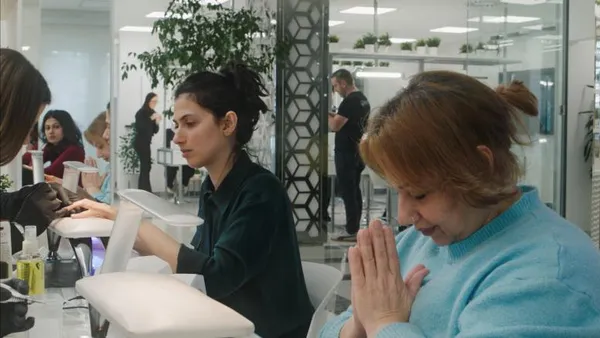

Boris Hadžija and Hoda Taheri refuse to be defined by the cinematic and narrative traditions of their respective cultures. Their feature debut treats reality as being just as fluid as gender or sexuality. Playing versions of themselves in this docudrama, with supporting roles filled by their real family members, the Serbian-Iranian duo are getting married while Hoda’s pregnancy looms over the proceedings like a phantom. But Boris is a gay man; Hoda, an Iranian refugee living in Berlin, is a woman who sleeps with other women, and this isn’t the only unconventional thing about them.
Set between Serbia and Germany, between the wedding and the diasporic newlywed life that follows, the film tunes itself exquisitely to the undertones of visas and passport privilege. Hoda’s mother is enamored with her daughter’s German passport, a stargate into the rest of the world, while learning that Europe is not as monolithic as she imagined, revealing a hierarchy of mobility between non-EU Serbia and EU Germany. The passport is hardly incidental here. Hadžija had already made Yugotransport, about ex-Yugoslav workers travelling to Germany in search of prosperity, where movement across the same European geography is itself the subject.
Absent, or dead fathers haunt throughout. Boris’ father is struggling with depression and doesn’t attend his son’s wedding. Hoda’s father died a while ago and she thinks he was secretly gay, an opinion she supports with her mother’s confession that they consumated marriage only ten times in 25 years.
Even the cinematography serves to render reality optional. The film is brimming with portals: reflections in mirrors, video calls, door frames between the camera and the characters. They evoke possibility, but also a world fragmented and refracted. A song performed towards the end, Two Windows, by Iranian singer Googoosh, contains the line, “Two windows are trapped in a stone wall; both tired, both lonely, one of them is you, the other one me.” Hadžija and Taheri seem to want to bend reality enough for the windows to move and mingle, with limited success.
Hoda’s pregnancy is at times concealed and at others imposing. At an OBGYN appointment, the shot begins from within the uterus, enclosed in pink, mucinous tissue, while the conversation between Hoda and Boris reaches us muffled through the squelching of flesh. It eventually exits through her vulva, almost like a baby. The image makes the body into both vessel and prison. Hoda’s history of abortion after arriving in Germany as a refugee is tragically encompassed in one line: “I finally came to a country where abortion is legal but I was illegal.”
The sequence is also where the film’s genealogy becomes clearest. Mother Is A Natural Sinner, the short Hadžija and Taheri made together, already revolved around Hoda, pregnancy, the female body and the social expectations attached to motherhood. Its production design was also by Michael Schindlmeier, who returns for the feature. The short and feature converge into same inquiry, with images and anxieties from the earlier film expanded, distorted and folded into the larger construction.
The fluid reality spills over and contradicts itself, a bold cinematic choice that risks diminished returns. The docufictional construction can become meditative to the point of meandering, a tug-of-war between autobiography and fiction that sometimes weighs down the story. Reality becomes Schrödingerian: both possibilities remain true until, and perhaps even after, the film gives us reason to believe otherwise.
This bold first feature won’t be everyone’s cup of tea, with its peculiar meditations on autofiction, abortion, marriage, sexuality and family. While the film itself refuses to be particularly Serbian or Iranian in nature, Hadžija and Taheri remain somewhat bogged down by their previous work. Still, there is food for thought here for those who turn to cinema for more than entertainment and like to keep thinking afterwards.
Reviewed on: 03 Sep 2026


