 |
| Lesbian Lines |
It’s the opening night of Docs Ireland 2026, and I’ve been speaking with Cara Holmes, who tells me she’s really been looking forward to the festival. We spoke a few years ago about her Notes From Sheepland and she told me then about a film she was half way through making. Lesbian Lines, which explores the hidden history of queer women in Ireland in the 1970s and 1980s, is now finally getting its day in the sun. It’s fresh from Doc/Fest with good word of mouth, and she’s looking forward to introducing two of the helpline volunteers, Claire Hackett and Heather Fleming, to their home audience.
Coming from a place close to the border, Cara loves the way that the festival brings together filmmakers from either side of it. She’s hoping to go and see some of the Irish films there, such as Forever Is Now, An Irish Atlantic Rainforest and Magilligan, but mostly she’s just thrilled to have her own film screening at one of her favourite festivals, especially when she still feels relatively new to this whole directing thing.
“I have been editing for years,” she explains. “So it's only since about 2018, 2019, that I started directing, and the reason why I started directing was because I wasn't seeing my life, or the lives of people that I knew, represented in Irish film. I was seeing all these different things happening around me but there weren't documentaries being made about it. And that could have been for lots of different reasons, you know, maybe a bit more conservative attitudes from the funders or whatever.
“When I kind of started embracing directing, I was interested in those stories that really hadn't made it into feature documentaries before, and it was 2019 when I heard that the Dublin Lesbian Line was having its 40th anniversary. I couldn't believe that a lesbian line, a voluntary health line, had lasted for 40 years. It was quite incredible. So, you know, it's 47 years now! It’s still running and so many other health lines are still running. But it was a whole night of ex-volunteers and original volunteers and current volunteers talking about their experiences of being in Dublin and answering phones in the late Seventies and Eighties.
“I just thought there was this huge history, this really rich and vibrant lesbian and dyke history that I found it very hard to find much information about. So really, it started there in 2019. And then a few months later I approached Keeper Pictures and Evan Horan, who's the producer on the film. And I just thought, you know, attached to a telephone helpline or something that spanned the 40 years was a really interesting way of getting into some parts of that history, because that history is huge, and, as I realised through the making of the film, you can only do so much. That added positives and negatives.
“The first phone call that I had about making the film was with Joni Crone, who is the woman who went on the Late Show, the chat show back in 1980. She was there on the night of the 40th anniversary. She was really enthusiastic. Obviously she wanted to know who I was and why I was wanted to make this film, and all of those questions were asked. But that was nearly seven years ago. That was the starting point.”
I ask if it was easy to get funding for it, or if that conservatism that she mentioned was still a problem. She’s happy to report that it was not.
“I think with people like Screen Ireland, they have broadened their funding – and necessarily so – especially either with women in film or with the subject matter. So I think very quickly actually, when I approached Keeper, we got development funding and that seemed quite easy at the time. You know, it wasn't so easy after that. But yeah, we really worked hard to get the funding. The treatment went through several rounds. it was just really about trying to find the right funders. The RTE, the broadcaster, came on board and that led to more funding and then another European based fund came in as well.
“I hope it remains as open because I think as the film is starting to go out into the world now. I just want that to be an encouragement for other queer filmmakers or younger filmmakers to know that there are funders out there who are funding these films. So that is becoming more and more important to me and I hope they continue to do so.”
I mention that I've had conversations recently with people around the world who are sort of gradually waking up to the fact that we need to record this era of queer history, that so much stuff is disappearing, partly because we didn't think of it as history when we were living through it.
“Yeah, definitely,” says Cara. “As I say, that first call with Joni, she knew it was important, and she's been an activist for many years, and she knows how important these things are. But I think as I started to talk to more and more volunteers, [there was] the realisation that we really didn't keep very much, and in some cases they couldn't keep very much in terms of an archive, out of fear or they didn't want people to know. Even down to photographs or the log books. And they're a bit too humble as well.
“While they're very proud of the film, they understand that this film isn't just for me. It's actually for all of us. I do hear the word ‘niche’ being bandied about the place at the moment, and I actually just really want to reject that because while it's so important for queer people to know their histories and there's confidence in that, I think this is much wider. I think we all need to know these different histories, you know? Why do we only know one part of history? What about all of these other parts?”
Some of what’s covered in the film is very much part of the wider history of women’s lives in Ireland, I observe.
“Yeah. I mean, a lot of them would say being a woman is one thing, but then being a lesbian was a whole other thing as well. People are using phrases like ‘second class citizen’. It was a terrible time back then. And while it was really oppressive and very limiting for a lot of people, there's a whole other side of the coin where it's like, you know, when communities did start building, that was the power in that society.
“There was nobody really skipping through the fields or shouting from the rooftops that they were lesbian.” She pauses for a moment, then laughs. “Some people were, which is great, but yeah. I was a teenager in the Nineties and even then people were whispering the word lesbian, you know, so. And I didn't know any other lesbians even then. I was too afraid to call the lesbian line. I knew what it was. It was just like it wasn't a thing to be doing. It was something secret.
“Even in the Nineties, and the late Nineties at that, I think you can relate to that kind of secrecy and the shame in many ways as well, so I suppose that's how I related to those women who I didn't have their experience. But they were very open to talk about that and what it was like. Also, on the flip side, they were very open to talk about the joy that they found in all of it. I remember a few of them saying to me ‘You’d better include the queer joy in this because it's not all about the hardships and it's uncomfortable to watch the hard stuff. You have to show the light in the dark because that's what life is, I suppose, in many ways.”
That does come across, I assure her. It’s heartening to hear about the fun some of the women had once they were able to meet others. But then there’s also the talk of silent phone calls, and that must have been quite a thing to deal with, just sitting on the phone and trying to think of something to say and not knowing who was calling.
“Yeah, I really found that fascinating. Obviously the history is hugely fascinating, but the other side of it, that listening part of it, just being there even if you're listening to somebody breathing and they just didn't have the words yet, but, you know, that might be a silent call that day, but the next week it might not be a silent call. They’d find the courage. But yeah, I just think of the volunteers going in, week after week, not knowing who was going to call, what awkward stuff they're going to have to deal with...what I found fascinating was the duration that these women sat on the lines for. One person was saying they volunteered for 16 years, you know?
“It was her building her own community, and that's what she could do to give back. But week after week of sitting, lifting up the phone, not knowing who was going to talk. I think just as human beings, when we know that somebody is listening to us or that we have a space to talk like that...” She trails off. “For me, in 2026 this is so important, as important as it was back in 1980, you know, 40 years ago. We just need to listen to each other.”
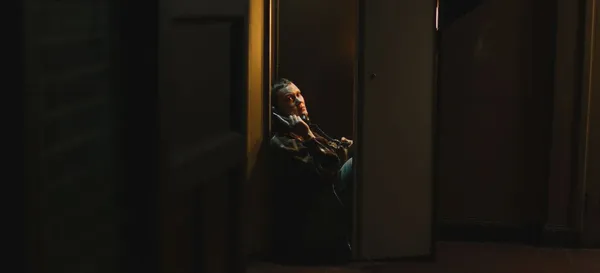
There's just a wee moment in the film where it's mentioned that back in those days the phone used to be attached to a wall in the hall. In context it sounds quite sinister. Today people have a lot more freedom just from being able to choose where they can call from.
“Yeah. Or text. Texting things seems to be a big thing now. I would say for younger people, but we're all texting. But I remember that, you know, that the phone is in one position in the house, or if you have two phones, within another position in the house. Even chatting to my friends, I’d be pulling the phone underneath the door and into my room. It was just trying to get those moments of privacy in a space where you probably didn't as a younger woman, back in those days, who didn't want anyone overhearing the conversation. And the telephone box as well, that was another private space, but if anyone came along, you wouldn't be on the phone very long because they would hear what you were saying. It seemed to be hard to get those spaces to have the conversation.
“I think that's why they [the lesbian line callers] were looking for the information, you know? ‘Where can we meet?’ Those people who were desperate to meet up and really wanted to meet up and weren't afraid to meet up, you know, probably the phone calls didn't last for very long. But, yeah, it's just the intimacy of that.”
The phone box gives her something visual to focus on. That must have been an issue at the start, I venture – pitching a film about a phone line. How does one illustrate that?
“What I had to go on was hours and hours of the volunteers’ interviews and how they described it. There weren't any photographs of the lesbian lines. There wasn't anything concrete to hold on to visually. I set up the lesbian line office, you know, the one desk, the one chair, the one phone, the one cabinet. I was constantly asking them ‘Is this right?’ And they were like, ‘It's kind of right.’ One of them said ‘How are you ever supposed to get this right if you weren't there?’
“Lack of archive kind of challenged me in several different ways. I found it an exciting challenge at the start of making the film. As the film progressed, it was just like, ‘Where is this archive? Why weren't we keeping it?’ Irish people love history, so where is all this history? Why has this history been forgotten about?
“I was going to people's houses and filming their photographs, but none of it was in an archive, so after every kind of time I went to film something in people's homes, I was just like ‘Please put that somewhere. Please make sure you have that. Whether it's a local university or it's the Irish Queer Archive, we're going to need this further down the line.’
“You know, when you start making a film, you're bringing in DOPs and you're bringing in other visual creatives, so it goes from my head out to them and then we work collectively to build it. So, yeah, I feel there's lots of different elements and lots of different components to try and tell the story, and a few people were saying the film itself is a kind of an archive as well.”
There are a number of scenes when we hear speakers but don’t see them, as the camera rests on a phone or a piece of old audio equipment. It made me wonder if some of the participants are still wary of being identified; if it was just audio for that reason.
She nods, with a small sigh. “It was audio for that reason. Yeah. And that's kind of what I found interesting as well. Because I suppose it was always going to be from the point of view, from the volunteer. We got into the dramatisation elements of it, or the voice elements, just to try and give a sense of the types of people who would have been calling, based on going through the logbooks and again, the interviews. But people were very reluctant to talk about their experience even in audio, for many different reasons. We really had to be very careful through the whole process, sharing the words that were going to put in the film with the person that was giving, making sure they were okay. It was very back and forth like that. And, you know, as filmmakers, you want to hold on to the process as much as possible, but I felt like this was the type of film that was kind of – a community was building it.
“Then you can see the women who you did interview and were not reluctant at all. They were very happy to be there and wanted to be there and could see the purpose of It. And even the women whose audio we just used, they could see the purpose of it as well, but they just didn't want to put themselves out there. That's fine, you know, but, it was hard especially to get the people who called the lines. The two sides of the phone call, you know, the caller and listener. It’s still difficult, unfortunately.”
A group of young people talk at the end of the film and it just seems like a different world for them. I ask Cara if she thinks things have improved much, or if she’s worried about society going backwards, as a lot of people are at the moment.
“I’m definitely worried about going backwards,” she says. “We had a few glory years of the marriage referendum, you know, and that was back in 2015. Everyone was just full of life, just totally emboldened by the whole thing. And the marriage referendum didn't just happen overnight. It happened over these 40 years. All of these women who were volunteers were part of this change.
“I'm in my forties. I'm really inspired by people in their twenties and young queer people who are really embracing who they are and what they're about. I look at them and I go ‘The future is really bright and we're in really in brilliant hands.’ And then you're looking at the laws we know back in the ‘States and the UK. We're not there in Ireland, and I feel like we’re still pushing forward for our rights, but to see everywhere else around us moving backwards, that is a very scary thing that we need to maybe be preparing ourselves for it. But I am very hopeful knowing that the younger people coming behind me are very solid in their thinking and strong.
“There's an awful lot still to do in terms of trans rights and in terms of mental health issues in the community, for older and younger people, so that is still a challenge. But, yeah, it's twofold, really. I really hope we don't move back because there's so much energy out there. It’s really bright energy.”
I meet young people, I tell her, particularly in America, who are saying that things are getting hard and they want to know what it was like in the old days. How do they learn from that? How do they fight if they have to? So it seems like this kind of film has educational potential for young people who want to know how to cope if things do go wrong.
“I think so,” she says. “It was important to bring in the idea of what community can do, what listening to each other can do. You might not agree with everything, but just listen, because we're so polemic in everything it seems at the moment. And while I hope we don't go back to a state that's like in the late Seventies and Eighties or even beyond, you know, there's the idea of moving forward, of taking that history, listening to it and knowing what can be done.
“I live in Cork and it's kind of like the lesbian capital of Ireland. It feels that way anyway. There's such a great community here and in West Cork and I can't see it being any other way – just people coming together constantly. But, yeah, I suppose it's that kind of bigger thing around communication, listening, you know. Ruth McCarthy, I think, in the film, talks about queer liberation and how we can do things differently, and how we should do things differently as queer people. You know, learning how to be in relationships, learning about care systems. The Dublin Dyke March started again last year, and you just go to these things and it is bursting with energy and people want to be together and they want to embrace identity of all sorts. So, yeah, I hope it's an educational tool as well. If we could get it into schools, great. We might have to cut a few things out to do that. But I think, you know, on a personal level, if I saw that in secondary school, I would have felt very validated and would have had a lot more confidence in myself much sooner.”