





 |
| Ponderosa Photo: Tribeca Festival |
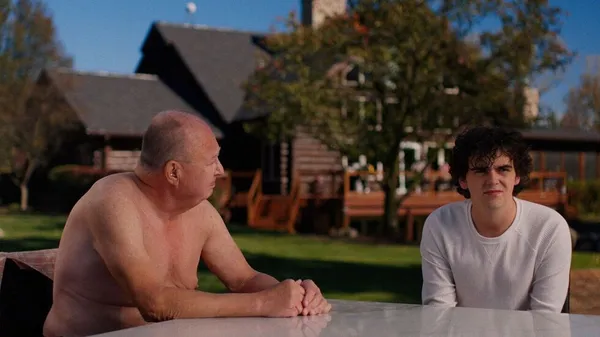
Director Rob Rice’s Ponderosa follows Gen Z-er Zeke (Jack Dylan Grazer), who is forced to entertain the advances of George (Bill Camp), a regular wealthy customer at his mother Sandra’s (Alexis Bledel) buffet before it closed. An elderly and childless corporate real estate developer, George has fallen in with ideological evangelists, who share his vision of the American 20th Century, which together, they believe future generations should recreate. However, Zeke isn’t inclined to agree, thwarting George’s attempts to create a tight father-son bond with the young man he wants to be his ideological heir.
Ponderosa is Rice’s sophomore feature. He made his feature debut with the hybrid fiction, nonfiction Way Out Ahead Of Us, about a father who hides a terminal diagnosis from his daughter. Prior to filmmaking, Rice worked in the sciences as a CRISPR engineer at the Massachusetts Institute of Technology (MIT) and Harvard, using 'genetic scissors' to cut, modify or replace DNA.
In conversation with Eye For Film, Rice discussed cultural inheritance, cathartic laughter, and the lucidity of Gen Z-ers. He also spoke about the film’s politics, why people are politically bowing out, and the naïveté and sanctimonious nature of some left-wing politicians.
Paul Risker: What are the differences between a first and a second film?
Rob Rice: My first two films are very different in their scale. The first film I made was with an eight-person crew that I financed by myself. It was a hybrid fiction, nonfiction film. So, the people who are in the film were producers and those collaborators that made it possible. It was a much looser network of roots under the forest style of production, whereas this [Ponderosa] was very formal – there was more money and more people.
On the first film, we would run around and if we had an idea we would go off and shoot it. On this, sometimes we’d finish early, and we might have an hour before the next thing, that we needed it to be dark to shoot. One time we said, "Oh, let's run over there and do it.” I turned around and there would be 30 people putting their reflective vests on, scurrying to follow us. And I realised I needed to tell people if I'm gonna just run over there. So, it was in those moments that I felt the difference between the two films the most.
PR: What was the seed of the idea for Ponderosa?
RR: In general, I'm interested in inheritance and reproduction — what people take from their families. I have a background as a scientist, so, there’s some essential tension between nature and nurture. What socialisation is has always interested me, and in a way, it's in both films.
The first film is about a real couple relating to a fictional daughter, and this film is about a boy being harangued and chased around by this wannabe father, who explicitly wants to reproduce without any of the emotional or biological components, only the ideological ones. He wants to take on a son. He wants him to take up the mantle of his ideas and his himness, and it’s also about George wanting to have some purchase on the future by having some representative there.
This film was a way to make that idea comedic, because there's something ridiculous about making it that literal, where somebody wants someone to be them, and chases them around asking them outright, “Do you want to be my son?” It's like, what are you picturing here? And so, I think the comedy helps.
There's a sense that it's commonsensical or obvious that, yeah, we passively take on the inheritance, culturally and specifically within our families. But rendering it this way maybe helps it to seem less inevitable, and you may have some choice, especially in the cultural inheritance world. You don't have to just take up the mantle of previous ideas, and your vision of the future doesn't have to look like the past.
So, it’s about the terror that George, who is in his sixties, and let's say a representative of the 'boomer' generation, feels about how the world he built will not be validated by the next generation.
PR: I was always told as a youngster, “Many a true word spoken in jest.” When you look back to great British satirical comedies like Heaven’s Above, and I’m Alright Jack, they are an example of how humour is incredibly effective at engaging in social commentary.
RR: The root of comedy is incongruity. There are those incongruities we notice, but when a comedian points them out for us, you cannot help but physiologically acknowledge that's true by laughing. And there's something ridiculous about the arbitrariness of how things work in our world. And when that's put well, it's very cathartic to recognise it by laughing.
PR: There’s a sense of hope in Ponderosa that these extreme forces that are suffocating us right now, if we choose to put our minds to it, can be defeated relatively easily. I always liked the analogy that the Republicans are playing chess, and the Democrats are playing chequers.
RR: Absolutely, and that’s the sense that I think of it in. There are three generations represented: the boomers, the in-between generation that Alexis plays, and which I maybe come from, and then Zeke’s. The failure of my in-between generation is that despair that she's dealing with in the movie. She's trying on death and wondering if she should just bow out of the race. But through her son, she sees that it's not inevitable and that you can refuse these inheritances.
I think the disappointment in the Democrats that a lot of us have is that they have been too conciliatory and made too many compromises with the right. And here we go, they trusted the right to play fair or to reciprocate that kindness with kindness, and that was ridiculous because that was never going to happen. And why you enabled those people to do that is not my fault, it's your fault. They’re then sanctimonious and say we should have voted for them harder, but it's like, maybe you should have been more serious. And Gen Z-ers are waking up to that, and I'm proud of them for that.
PR: Do you consider Ponderosa to be a political film?
RR: Yes. It's about all the political bases that reproduce in this country through family, money and business, from Dale Carnegie to whoever people are inspired by today on the internet. Those people should be made fools of in a loving way, and the most satisfying thing about the film is that George, who represents that world, is not a competent evangelist — it’s the people he’s around that are. So, you can feel for him, and you can understand how you could come to invite him to leave that world. What he wants is connection and community and that’s what we're offering. The world he’s in is rooting that out. Being around these people, he has accepted that there's an inevitability that they're in charge, and he should try on their ideas because they help to frame what he feels. But instead, he should be invited to leave.
PR: Everything breaks down to whether you are on the left or right, and if you occupy the centre, then that is thwarted with danger. Ponderosa attempts to ask us to consider these polarities and how to avoid becoming defined by them. In this sense, it’s a progressive film that’s trying to pull us back from the brink.
RR: Yes, and it's trying to also cast those polarities as a vision of the world from the previous generation of Democrats and Republicans. It's like, we don't respect any of you guys, and you've all now defaced the world.
The Democrats are scrambling to try to understand how young people can be motivated by what they're offering, and they're realising that the lesser of two evils kind of thinking is not sufficient. And when you hear what the philosophy of a young person is, it often no longer tracks in these simple ways where words can instantly put them in one camp or the other.
If you were to ask most people in this country, and maybe yours as well whether the system is rigged on behalf of the rich, they will say, yes. And I don't know that there's a more important thing to have in common politically than that.
PR: I myself, I’m unplugging. You speak up enough times and find your voice isn’t treated with dignity and respect, you become exhausted. And one consequence is voter apathy. What you’re talking about is this need for a reset, but as you say, society is scrambling for answers amid all these voices competing for dominance. This is troubling because history has taught us what happens in these moments.
RR: Absolutely, and like you're saying, a lot of people are bowing out, out of exhaustion. It becomes a kind of silent and eerie clamouring. We all know how much energy it takes to stay silent. We have tonnes of passion, rage and hope to funnel into a coherent outlet if we had one. But like you've said, the promise has been broken too many times, and our trust is hard to come by, and hard to reproduce.
Ponderosa premiered in the US Narrative Competition at the 2026 Tribeca Film Festival.