 |
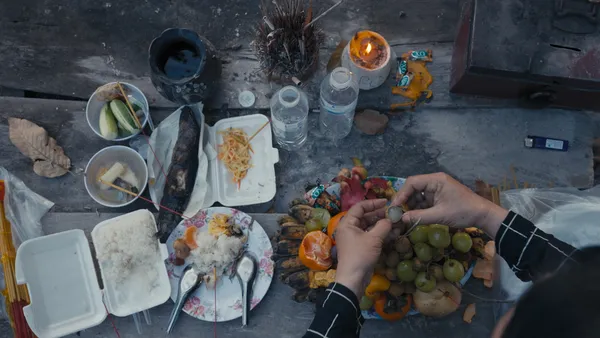
| How To Feed A Dictator Photo: Tribeca Festival |
Director Andrew Neel opens up the conversation about dictatorships, by giving voice to the private chefs of five of the most notorious dictators: Augusto Pinochet, Pol Pot, Saddam Hussein, Idi Amin, and Kim Jong-Il. Based on Witold Szabłowski’s 2022 non-fiction book, Neal’s documentary differs from the source material, by switching Enver Hoxha and Fidel Castro for Pinochet and Jong-il. Through interviews with each of the chefs, Neel explores their experience of being integral cogs in the day-to-day lives of these notorious figures, which for some, we learn, was a choice. For others, it was not. How To Feed A Dictator digs down into the moral rationalisation of the human being to open up the discourse on broader concerns about human nature, particularly relevant as western democracies flirt with far-right ideology.
After co-directing (with Luke Meyer) his first feature documentary Darkon, about a live-action role-playing game, Neel made his solo feature début, documenting the life of the American portrait painter Alice Neel. He reunited with director Luke Meyer for New World Order, a documentary about four individuals seeking to expose the Bilderberg Group, a secretive annual forum dating back to 1954 that brings together an elite group of individuals from America and Europe. Aside from documentaries, he has directed the narrative features King Kelly, about a young woman seeking celebrity status by way of her online striptease show, and the psychological drama Goat, in which the limits of a young man who is a victim of assault are tested when he joins a college fraternity. He has also directed episodes of the TV series StartUp and the miniseries, A Teacher.
In conversation with Eye For Film, Neel discussed the mechanics of authoritarianism, the human animal, why dictators are rather boring, and bringing the audience closer to the system to recognise a frightening familiarity.
Paul Risker: How did you first come across Witold Szabłowski’s book, and what was the driving force behind your decision to bring it to the screen?
Andrew Neel: My producer, Michael Merlob, and I were working on another project when he brought the book to me. He knew I made docs and when I read it, I thought it was enlightening.
Something missing from the conversation about dictatorships, which is obviously so pertinent right now, is the experience of the everyman — your average member of society and what they have to live through willingly or unwillingly under a dictatorship.
Dictators create a moral trap that is inescapable for everyone, whether they like the dictator or not. One of the most unseen tragedies of dictatorship is that the entire society enters into a Faustian bargain, and they didn't even get a meeting with the Devil. I felt that was something I could add to the conversation, and given what's happening here in America with Trump, I wanted to say something beyond the polarised finger pointing.
PR: I’ll be honest that it never crossed my mind who cooks for dictators. The film at once transports us inside a part of that world I would imagine many in the audience will also never have thought about.
AN: People don't often realise the fact that an entire society has to become part of a dictatorship, whether they like it or not. To take a quote from the film, “A country is a living thing,” with resources that can be devoured and everyone has to become part of feeding that machine, whether through choice or involuntarily. And these chefs offered a way into that.
Also, to go back to your question, food and cooking are something everyone can relate to. So, you kind of show up for the food, and then you get trapped by the corruption and genocide. That's what happens to us, right? We show up for basic things that we need because we all have to survive. We all want to make money and have a decent house and, under a dictatorship, being able to do so becomes a moral conundrum.
PR: The film asks its audience to hold off on judging these chefs and to listen, so we can understand their story. In the current political and cultural climate where everything is polarised, this frames How To Feed A Dictator as a challenging type of filmmaking.
AN: That's one of the reasons I made it. If we don't understand how we could all find ourselves in this situation, which is historically documented, then when we have to choose between thriving or surviving, not supporting a regime or looking the other way, most of us are going to look the other way. And that could be me. I'm not religious, but I often say, "But for the grace of God, there go I” when I think about this movie, because history proves that we can talk ourselves into turning a blind eye to things, for the sake of the superficial or in some cases, dire needs. Knowing that should strengthen our resolve to avoid dictatorship at all costs, because a lot of people, including those who support a dictator or an authoritarian regime, are not going to escape either, because no one does.
PR: There’s a perception that dictatorships, and figures like Donald Trump are at the extreme end of the spectrum. However, having worked for bureaucratic institutions, the culture of seeing people through the lens of process rather than as human beings is a significant problem. People are not hurt through malice necessarily, but rather a bureaucratic kind of indifference. These and many other patterns of behaviour reduce that safe distance we naively perceive.
AN: Yes, absolutely. I actually might say that it's not so much indifference as it is rationalisation. We need to create a story or a moral architecture that allows us to feel okay about ourselves on a daily basis. That applies to all of us, whether you own ExxonMobil or Tesla stock or whatever little, teeny part you have to play in all this, we all have to talk our way out of those moral rubs. And a lot of them are not substantial enough to worry about as a human being, but it's very much a necessary part of life. Let's make sure it’s not a matter of life or death, because most of us are going to rationalise our way out of that.
I rationalise eating meat all the time. I probably shouldn't. Am I gonna stop? Probably not. Now, I'm not going to equate eating meat with genocide, but I do think this is very human. I hope when people watch the film, they recognise that what it is to talk your way through having to live under dictators, to justify and to live with the corrupt system that you must function within, is very human. And that we all have that capacity to get through life, which is necessary.
So, dictatorship is about tempting that inclination in the human animal, under very dangerous circumstances. Again, avoid it, fight it, stay away from it, because it's just the most dangerous of environments to put the human animal in. It generally only ends in tragedy and violence and iniquity.
PR: What we’re discussing is the broader way things intersect, one way or another.
AN: If populations don't come together to some extent, be it what their common needs are, we're in trouble. And what these guys do is they prey on our insecurities, our greed and desire to blame other people. In so doing, they polarise us. They want us to be enemies; they want us to judge one another; they want us to create the “other” because that works to their advantage. I hope the film does the opposite of that. I wanted to bring people closer to the chefs and, in so doing, closer to the entire system of dictatorship. And I wanted people to understand it in human terms, not by societal monoliths or finger pointing where there are good guys and bad guys. Unfortunately, the world is not that simple.
PR: How To Feed A Dictator is a history lesson, and in the Pinochet chapter, you go quite in-depth about the historical context, which, of course, is important. Was the challenge not getting too bogged down in the history, and instead keeping it focused on the chefs and what their experiences bring to the conversation?
AN: This was the hardest edit of my life. Balancing the necessity of establishing some historical context without it getting dry and keeping it focused on the chef's stories, was difficult, and it took a long time to find that balance. What we tried to do was give people just enough to understand the context of the lives of the chefs and why they were making the decisions they were, and not much more.
The funny thing is you don't have to know that much about these guys to recognise their playbook — it’s so transparent. They all do exactly the same things and in a lot of ways, dictators are the least interesting part of how a dictatorship works. They're also the least complex part of it because they’re so obvious — what they're doing is right there in front of you; it's not even hiding in plain sight.
The hidden part is really why so many of us choose to or have to go along with it. Obviously, dictators like to hide all the murder and stuff, but that’s pretty hard to do in the end. And in most places, that's memorialised, so we remember. But every individual in that society had to enter into some kind of moral conversation with themselves or choose not to. And that's a mechanism of dictatorship that is critical for us to understand in order to avoid it.
PR: The fracturing of western democracies is a concern, which is compounded by an inability to learn the lessons from the past to counter the tactics of the far right.
AN: Watching western democracies flirt with this stuff is really disconcerting. History repeats itself, but let's try to do a better job. It's going to repeat itself; there are going to be more dictators, but hopefully this is a blip on a better trend — we shall see.
One of the first things dictators do is get rid of proper history teachers. Forgetting is the easiest way to solve that problem for them. I could go into a whole kind of jag about why western democracies are moving in that direction. I think that greed, iniquity, and wealth inequality rule the day. And you’ve then created a population that is ripe for these kinds of people. When your elected officials are not improving the mean average experience or equally sharing in prosperity, that creates a very fertile environment for dictators to use these idiotic and manipulative methods to get us to where we are.
How To Feed A Dictator premiered in the Spotlight Documentary section of the 2026 Tribeca Film Festival.