




 |
| Meadowlarks |
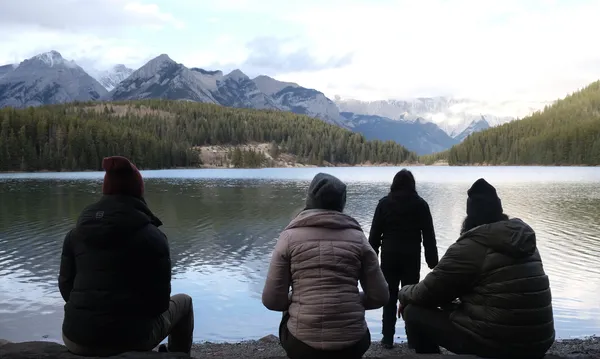
Four siblings in their fifties meet as strangers in Tasha Hubbard’s Meadowlarks, which screened as part of this year’s ImagineNative film festival. Although they began life in the same household, they all fell victim to the Sixties Scoop, in which some 20,000 indigenous children were removed from their families by Canadian authorities and adopted out in an effort to destroy their culture. This film, which follows their reunion and effort to put some of the pieces back together, takes in a number of painful but important topics, from addiction and suicidality to reform schools and experiences of social exclusion. It’s the first venture into fiction for Tasha, whom I last spoke with about her documentary Singing Back The Buffalo, so I ask her how that came about.
“I had another idea for a film that I thought was a documentary, and I actually developed it to a point where the producer and I were like, ‘I think this is a drama,’” she says. “I started to think about what that would mean, to make the leap, but, you know, got busy with other films and just kept that in the back of my mind. And then I met Julia Rosenberg, who's one of the producers of the film, when Birth Of A Family premiered at Hot Docs, and she asked ‘Are you interested in scripted? I really like how you shot the doc.’ And we started talking about what I might do.
“Then she said ‘Were there things you would want to further explore if you had space in the dramatic world with this story? Because I think it would make a great first feature for you.’ And I said ‘Yes, there are some things I would like to further explore.’ It just went from there. We started to think about what could we reveal by letting the characters share some of the experiences they'd had and how they grew up, and how that might deepen some of the stakes for them. And what are they needing to overcome?
“We all develop these coping mechanisms to survive, and I think we articulated this most clearly by Anthony, that maybe it isn't serving them anymore and maybe it’s getting in the way of fostering this real connection that's possible for them. It's just the courage to be vulnerable. How do they find that creative courage when they lived this fight or flight existence their whole lives?”
It's interesting, I observe, because whilst they have a very specific set of experiences, it's something that a lot of people will relate to. Many people reassess themselves at that age. I mention that I was talking to a Polish filmmaker a couple of years ago who said that really we should talk about coming of age as something that can happen at any point in life.
“I think there's something about being in your fifties,” Tasha reflects. “We felt that in the documentary. They were all coming to terms with that. I think what really resonated, and why I kept it similar, is you really starting to look at the time you have left, hopefully, and what do you really want in that time? What haven't you done yet? When you're in your thirties and even forties, there's this sense of ‘Oh, I've got lots of time. I can change direction. I can do this.’ But I do think there's something about 50 where you're like, ‘Okay, this is what's missing.’ And it's also a period of great change, right?
“Parents are starting to pass away. Children are leaving home. Even if you're not a person with children, you're in this place where, in a working life, retirement's now within sight. All of these things, I think, make that decade really rich and a place for storytelling.”
I ask if fiction gave her a useful means of exploring some difficult issues with risking harm to the people who were dealing with them.
“Exactly,” she says. “We negotiated with the real family for the documentary. What were their parameters? What did they not want to talk about? What did they want to focus on? And that's what we followed. I felt really strongly that I wanted them to retain agency in the telling of their story. It can still be real, it can still be truthful, it can still be documentary, and the audience doesn't have to know everything. But with the fictional characters, because we started over and made completely new characters, we were free to have the characters go in places that you wouldn't necessarily want to ask a real person to do.
“That was really freeing, that experience. Certain stories, I thought, might better as fictional than as doc because, yeah, I'm always worried about the people in my film. How are they in this experience? Characters are different.” She pauses for a moment. “I still kind of worry about them, too.”
As a writer myself, I understand that, I note, and we both laugh. I ask if it gave her room to explore the negative personality traits that people can pick up from that kind of experience, and the ways in which people are damaged, without having to expose a real person in that kind of way.
“Yeah. You know, I think sometimes the coping strategies we develop aren't in our best interest and sometimes we don't even know that. You're just going through life, you're trying to protect yourself or you're trying to minimise your vulnerability or minimise rejection, but in a way, it's not working. That's what I had in mind with these. This this was the time where they realised ‘Oh, wait a minute, this isn't getting me what I want.’ I always think about Connie, where she's so busy trying to curate the perfect experience of this that she's not realising that all of her curation efforts are actually alienating.
“One of my favourite moments is just seeing the character of Connie relax for the first time at the end of the film, where she just sits with her coffee and isn't trying to manage something or control something. I think that's known, that when someone's had a childhood of chaos, they try to control. That's where Connie comes from as a character. But yeah, it was fun to think, ‘What is she doing this last morning?’ And, you know, she's just having a breather for probably the first time in her life.”
What is the primary audience she hopes to reach with this?
“I always think about how for indigenous audiences, it’s just people feeling validated in the experience that they've had, how they've survived it, how the scars have healed or not healed. So definitely people who've been through this experience, wanting them to be seen and heard. I do think it's not understood by Canadians in general, this experience, but I'd also say it's not always well understood within indigenous communities either. You know, these people who were taken and came back. I don't think it's fully understood, what that experience was like. I want our own communities to reflect on that as well.
“What's needed in order for that reunification to happen is things like what the elders do, you know, welcoming and saying ‘We didn't forget you.’ I wrote that for survivors. They need to be told and to hear that. I can do that through the language of cinema, if they don’t have that in their own lives.”
We talk about the character of Connie, who went back to her community but didn’t feel that she belonged there. The way that she talks about it, I suggest, implies that this may be a failure to recognise that she does have that connection, but she also has other things about her that are separate parts of her identity and just don't fit with that.
“Yeah, yeah,” says Tasha. “I think she doesn't have a lot of self awareness, but her pain is real and her needs are unmet. I've heard stories of adoptees who felt secure in their families until their parents passed away, and there's resentments that siblings had, and things fall apart. That was Connie's story. All of a sudden her parents are gone and it’s a combination of being recognised as family but also realising she's alone and wants more.”
I tell her it seemed to me that to an extent, some of them were still behaving like the children they were when they were taken away, as if they had expected to come back and find that everything worked the same way did when they left. She agrees; it’s a sad reality. We go on to talk about the Sixties Scoop and how little awareness of it there is amongst white Canadians, even today.
“I definitely think there is,” she says. “I always remember anytime we've been shooting and we told people what we were filming, whether the doc or the film, they didn't realise how much the state went after our families. There is not a lot of understanding. I was really thinking a lot about the range of experiences that people have had. You know, my late adopted dad and my adopted mom really felt strongly that they were just taking care of me temporarily and that they would have to share me and bring me back to my community once I came of age. That's very rare. I didn't realise that until I started meeting other people who were like, ‘Oh, my parents didn't want me to meet my family. They felt very possessive of me.”
“Having had that experience and still having my own challenges of belonging and identity and all of that, but realising I grew up next to a family who had really difficult childhoods, and they weren't safe and they weren't cared for in the way they should have been – I've known quite a few like that – I was just wanting people to see the impact that this has on people. And, you know, the other thing we did with the character of George – and this came out of our Sixties Scoop advisory – was, you know, they pointed out that a lot of us are lost still. Some people have passed on already or the pain of what they experienced was just too overwhelming.
“There's a lot of people who've been through child welfare who are incarcerated, and who's representing that side of things? Nothing's ever this picture perfect. So we created the character of George whose loss is felt throughout. His only way of surviving now is his isolation, and it's just too much for him to be vulnerable. He survived by being tough and staying alone and the idea of opening himself up is too much. And, yeah, there's been a lot of tragedy in this story of the Sixties Scoop. I wanted to show that and also the possibility and that we're never too old to find our way to connection and to heal some old wounds and to grow.
“I really do think that in a lot of ways, they all have this moment of, as you say, coming of age. We always talk about Anthony's phone call to his daughter. That's the moment he becomes a man. He's like, ‘I'm not going to let my fear of rejection and my shame and whatever else get in the way. I'm going to do better.’ And you can see his daughter realising over the course of the call that there's been a change. You can see the path that they're going to be on now, which is great.”
It seems valuable to be able to talk about those stories together so that it sends a message that there's no one way a person has to react. There's no proper way to react to it all.
“Yeah, exactly. I think we're all just in this continuum of trying to be who we are meant to be, and everybody's got a different path to that and a different pace. I always had the image of their parents as young people in love. No young couple in love ever looks ahead and goes, ‘I think all my children are going to get taken,’ you know? So the first thing we filmed was with this young couple, and I thought the film was going to open with that. And then when we got into the edit, I realised, no. You have this beautiful union of siblings coming together, but the remembrance of what the hopes were of their parents, what they didn't get, it's just this moment of beauty and love and hope and tragedy together that I want people to be left with.”
She has a wonderful metaphor for that in the form of a narrow, swaying bridge across a deep gap in the mountains Did her team have to get across that with filming equipment all the time?
“Yes, we did. We were a BC/Ontario co production, and we wanted to film mostly in BC, so a lot of our locations were in Golden. When were scouting Golden, we went on the bridge. One of the producers, Tyler Hagan, and I were doing the initial scout and I just said ‘Oh my God, I want to film on this bridge.’ He was like, ‘Ooh, that's going to be a tough one.’ I'm like, ‘I know, but we can do it.’ And he's like, ‘Oh yeah, we can do it.’ So it was a challenge. I wrote the scenes and we were getting ready to go. We were cast. And I said ‘You know, we should check with the cast. This is actually pretty scary.’
“I asked the park ‘How many people get to the start and turn around?’ And they were like, ‘7% to 10%.’ I was like ‘Oh, okay.’ So we checked with everyone's agent. They said ‘Yeah, no one's afraid of heights.’ And then one by one they were. Except for Michelle Thrush. She was fun. So we had a day in prep where we had a field trip. We went to the bridge to test, and they were all quite afraid.
“We had to figure out how to shoot it. Carmen Moore was not sure she could make it across, so we had a plan to have her go to a certain point, stop, turn around, let her go back, and then drive her to the other side and film that. That was the plan, but then part way through she was like, ‘I'm going to go for it.’ We were like, ‘Okay.’ But we couldn't really reset. We just had to keep filming because there was no way she was going be able to go backwards. And we got what we got, but we got enough that were able to craft this really compelling scene of the fears we all carry and who's waiting for us on the other side. I think that's the big question.”
She has plenty to keep her busy going forwards.
“I just wrapped a scripted limited series as showrunner, co-writer, co-director. I have a few more scripted projects, a couple of features, another series, I'm developing. I have a short doc and a long haul doc, another one that takes me years and years. So, you know, I'm excited. I feel that I’m a filmmaker first and foremost. Does that mean I'm a writer, director, showrunner? I don't know. Whatever role needs to happen for the story.
“I loved the experience of making this film. I just felt so supported by the producing team we had as crew and cast. They all knew it was my first time directing, and they were very generous. We just had such a real sense of community on the shoot, that I realise isn't always the case. And we had a wellness person on set and that made all the difference. She really set the tone of collective care that we had for the cast and crew and each other. I can't wait to do something like that again.”