





 |
| Carolina Caroline Photo: Magnolia Pictures |
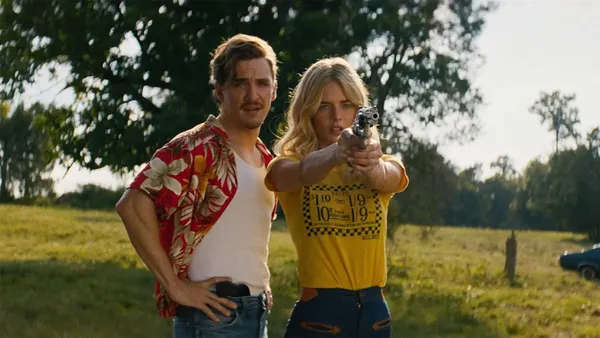
American director Adam Rehmeier’s romantic crime thriller Carolina Caroline, written by Tom Dean, follows a young woman, Caroline Daniels (Samara Weaving), who falls for Oliver (Kyle Gallner), a charismatic grifter passing through her small hometown. Taking flight, she leaves with him, saying goodbye to her father (Jon Gries) and the only home she has ever known.
At first, Oliver teaches Caroline smalltime tricks, like a magician misdirecting their audience’s attention, but then Caroline ups the stakes when she suggests they start robbing banks. Together, the pair leave a trail of crime and passion in their wake across the American Southeast, while searching for Caroline’s estranged mother (Kyra Sedgwick).
Rehmeier made his feature début in 2011 with the horror, The Bunny Game. His sophomore feature, Jonas, told the story of a sinful man, who after washing up on a desolate coastline, travels to Los Angeles with the intention of delivering a profound message. Rehmeier’s third feature, Dinner In America, starred Gallner as a punk rocker who finances his home music album recordings by volunteering for medical trials. When he’s forced to take refuge with a socially awkward young woman and her religiously conservative family, he discovers a shared passion for music that blossoms into a burst of creativity. Then there’s the comedy Snack Shack, set in Nebraska City in the early Nineties about two friends who turn the local pool’s snack shack where they work into a stage for their coming-of-age antics.
In conversation with Eye For Film, Rehmeier discussed his desire to combine the nostalgia of Seventies road movies with the early Aughts, needle drops, patiently upping the emotional stakes, opening his filmmaking up to themes, and how he keeps on rolling.
The following has been edited for clarity.
Paul Risker: From speaking with filmmakers, the period between finishing and starting their next film can be a challenging, even surreal experience. Being on set is a hive of activity, which is followed by the pressure of postproduction. Then, suddenly, you’re in a kind of limbo. Is this an experience you're familiar with?
Adam Rehmeier: I was not done with Carolina Caroline before I went to South Africa to shoot my next one. When I got back home, I finished Carolina Caroline, and then, after our TIFF premiere, I went straight into postproduction on the new movie.
Sometimes you get a lot of time in between, but in this particular situation, on my next film, I had a window to shoot it, and we just went for it with no break whatsoever between movies.
PR: Creatively speaking, is it important to be able to compartmentalise, and juggle multiple things at once?
AR: Having done this for many years, that is the key. In my job, I need to compartmentalise because I might need to be writing the next film while I'm still editing this other one. So, there are layers and layers to my day, and sometimes you can spread yourself too thin, and yes, it's exhausting.
What I do now is when we wrap one movie and I go into post, I'll be writing the next film or teeing up another project that I've already written. You try to glide right into the next thing once the other one is done, because the key to all of this is staying employed — you can't have these big gaps. I have a family, I have kids, and I need everything to keep rolling.
PR: What was it about this story that grabbed you, and motivated you to want to tell it now?
AR: I think, because I didn't write the script, I was attracted to the fact that it was outside my wheelhouse, and something that I wouldn’t come up with myself. I looked at it as an incredible opportunity to do a Seventies retro throwback movie set against the early Aughts backdrop and to not be precious. When you write something yourself, you can get precious with the words because of the time you’ve spent designing it. With this, I could throw things out, and we could redesign things that maybe didn't work as well as I wanted them to. I was just less precious with all of it.
So, that was cool to learn because I hadn't done that yet, but everything else I generated myself. And this was an opportunity to work with somebody else, which I really enjoyed. I didn't know if I would, but working with Tom and just being the director, I felt I could bring my thing to the table and not have to worry as much about the writing side of things.
PR: Given our present-day reality, is it an opportune time for cinema to draw on the gritty cynicism of Seventies films, even if only subtly?
AR: When I got the script, it was set in 1993. Oliver was described as a Kennedy. He wore a Rolex, a fancy suit and drove a Mercedes. The movie was more of a heist crime thriller than it was a love story. I saw the opportunity to do more of a timeless love story, to give it a nostalgic framework of this bygone era of Seventies road movies, but to push it up on the timeline a little bit and make it the early aughts. And for me, it was all about setting it pre-9/11. I wanted to do that because I feel it has become exponentially harder to rob banks since 9/11 because there are now cameras everywhere, and so, it's hard to get away.
It felt like it had a specific place in time that it needed to exist, and the way that the dialogue was written, I wanted it to perform like a Seventies road movie. Part of the design was how do we meet halfway between a Secenties design and the present day? And so, we set it in 2000-2001. This means it has a retro feel for people that were kids in the early Aughts. It's that same nostalgic touch that you would have with movies like Stand By Me if you grew up in the Eighties, and you’re watching them 25 years later. I guess I'm trying to fish around for that same nostalgic feeling with this.
PR: Theme wise, there’s a sense of entrapment, with characters trying to escape where fate has placed them. The film also acts as a cautionary tale about how people can ensnare us in traps that become like prisons. For you, what’s the film’s thematic engine?
AR: There’s a lot about fate in this movie, and primarily for Caroline, there's a secondary journey, which is wanting to know the answer to the question: Am I a bad person like my mom?
In her storyline with Oliver, she makes her own choices, and in the first half of the movie, the petty crimes that will eventually escalate into bank robberies are portrayed as a lot of fun — there’s a lightness to it all. But there's no romanticising her mom when she finally meets her. She is pretty awful, and that scene is important because we have these other scenes about fate and whether Caroline is just the product of her parents, of her genetics? The scene when she meets her mom is the catalyst for the whole film to spiral out of control in the back half, where we feel differently about the robberies, and it's no longer fun.
The rest of my body of work doesn't explore themes in that way. In Dinner In America, the theme was food and eating across a series of dinners, and how you felt in each one of those was different. Carolina Caroline is more traditional in the sense of how films act and behave. So, for me, it was a chance to do a throwback type of film and lean into films from the Seventies that were frequently exploring these types of themes.
It just felt like a really fun space to work in from a design standpoint, and that's really what I did. I designed the movie, the textures and all of that. And it was fun to do something like this where you have a classic and an iconic good-looking girl, a good-looking guy and a gun and a muscle car.
PR: Being someone that is inspired by music, which has shone through in your films, Carolina Caroline’s soundtrack is no exception. Looking at how the music exerts its presence, how did you go about constructing the soundtrack to not only complement the story, characters, and aesthetic, but to become more of a character itself?
AR: When my editor, Justin Crone, and I were cutting Snack Shack, I was super specific about the music because it was the summer of my own coming of age story. Justin had put in just a few tracks that he really liked, whereas on this one, he was going nuts. He curated the entirety of the soundtrack, and he found some wonderful deep cuts that I'd never heard. The soundtrack in particular in this movie has such a life and personality. It's almost like another character, and it's kind of wall-to-wall music. There are like 24 needle drops and there's just a lot going on with the soundtrack.
While I’d love to take credit, he was the one behind the music. He also found a lot of female-driven country music too, which was really exciting, and felt right with a title like Carolina Caroline, where you're following this young woman, whose journey it really is. I love his curation and subliminally, it holds your hand in a lot of places and gives the film a feel.
PR: Throughout our conversation, it’s clear you value collaboration. It feels appropriate to discuss the collaboration with your two leads, and how that shaped what Carolina Caroline became.
AR: This movie is such a two-hander, that the whole thing hinges on the chemistry between Caroline and Oliver. And if you don't have this electric chemistry between the two leads, you'd be dead in the water within the first 10—15 minutes — you’d have people walking out. So, there's a certain electricity that both Samara and Kyle bring to these characters that makes it so convincing.
I might have even extended the amount of time in-between the first half of the movie, where it’s all lighthearted, fun and romantic, and the second half, when things start to get hairy. In the first half, you have a lot of time to develop their rapport, and I think what sets it apart is that we do take that time to develop it organically on screen. It’s not just something you’re thrown into. Instead, you fall in love with them as they fall in love on screen, and that's unique because a lot of films rush it and by not rushing it, we create higher emotional stakes as we tee things up for the spiral in the back half. And on the macro side of things, that reminds me of what great cinema in the Seventies did. It was character more than plot driven, and characters could linger and take their time with each other.
And Kyle and Samara are going to bring a lot to the table — there's no hand holding with them. As a director, you're super appreciative of that. My requirements are that you know your lines inside and out and that you come with a positive attitude and ready to play with your scene partners. And for both of them, that was a given every single day.
We did the entirety of the movie in 25 days, and we had almost 100 locations to cover. It was a really hard and crazy schedule. The scene with Kyra Sedgwick, for instance, that's a 12-page day. For the crew to see that on the call sheet, it could make your heart sink. But when you bring in actors like Kyra and Samara for something like that, you don't feel it at all. Instead, you feel like you're watching this amazing dance, and I think the crew had a lot of respect for these actors. The crew knew they were making something special when they were working on this film.
Carolina Caroline is in US theatres on 5th June.