 |
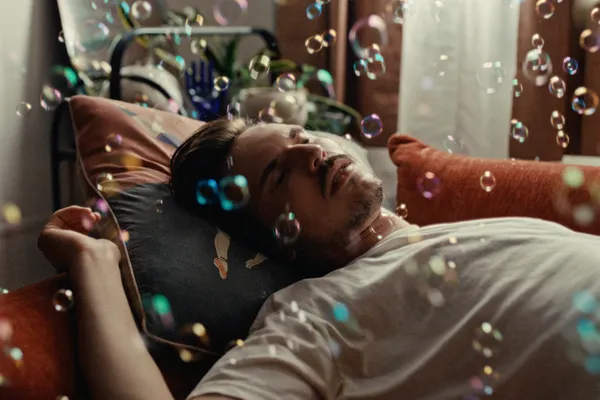
| Sunday's Children Photo: Mélanie Akoka |
Director Reuben Hamlyn’s short film, Sunday’s Children, follows Dennis (Maximilian Isaacs), who is desperate to have children and falls in love with Kasia (Blu Hunt), who believes her miscarriage was a sign that she’s not supposed to be a mother. These two polarising attitudes implant a tension in their seemingly idyllic courtship that leads to philosophical debate and an unforgivable action.
Hamlyn has previously directed the short films, Roger, about a domestic service application in human form that goes against her remit and seeks to strike up a connection with her client, Litvinov’s Fall, which revolves around a neighbour’s good deed uncovering a secret, and Bitter Tears, in which a grandson caring for his grandmother is mistaken for his philandering grandfather. He has also directed the deepfake feature documentary Another Body.
In conversation with Eye For Film, Hamlyn discussed cinema’s appeal, being particular, and the tonal mix of Sunday’s Children, which brings levity to a dark story. He also spoke about the moral grey of having children, condemnation, empathy and understanding, and not wanting to morally wag his finger too much.
The following has been edited for clarity.
Paul Risker: How would you describe your relationship to cinema?
Reuben Hamlyn: I feel like I have a one-track mind. I'm such a nerd. I love film so much that I live and breathe it. And I feel lucky to be living a life where I'm able to commit so much of my time to it. The medium itself is a confluence of so many different crafts, more so than any other medium, and it's that synthesis that I love. It’s something I marvel at when I'm watching movies.
Now, when you're actually making movies, and you’re collaborating with all the different artists and when you’re navigating all the different considerations when conceiving the film, it’s a question of how do you generate the tone of that world? But you’ll have so many things on your palette to play with and bring a coherence to, that it’s just wonderful.
PR: Is the filmmaking process a journey of discovery, and are you open to the actors revealing aspects of their characters and the story?
RH: Yes, although you could ask my actors that, and they might say something different. Most actors I work with think I'm quite particular, and that being said, I’m still discovering when we're going through the process. But that’s at every phase, from conception to every draft and breakdown of the script, and every conversation with the actors. I'll still be exploring and trying to find the tone that I'm looking for, which I'm trying to find up until the point that we're making the DCP (Digital Cinema Package). And because I like playing with tone, that’s my favourite part of the filmmaking process.
There’s a little bit of risk and generating that tone is a collaboration. Trying to get the actors to perform or work in a way that harmonises, is a wonderful thing to do as a director.
PR: What was the seed of the idea for Sunday’s Children?
RH: I’d just turned 31 and [the subject of] children was in the air amongst my friendship group. A friend of mine said he wanted to become a dad imminently, and I thought it was a really bad idea. And that just made me think about the type of people that are deciding to have children now and what is influencing them to make that decision, and how they narrate that decision to themselves and to other people. So, that was something that I thought was a fascinating and pertinent topic for people my age, and also in part because of the state of the world right now.
I knew I wanted to do something which was formally playful, that would play with tones, and this film does adopt some of the tropes and tones of a romantic comedy, even though it is quite dark. It felt like an interesting avenue to explore these things.
PR: I’m not going to say having children isn’t a wonderful thing, but equally, choosing to have children and condemn them to suffer is questionable. I found your film interesting because trying to have this conversation, I often experience fierce backlash, whereas you’re embracing it.
RH: The interesting thing for me is I kind of agree. First of all, I'm not someone who has a very strong desire to have children, at least at this point in my life. I will be honest; I'm not a massive optimist about the way the world is going, and I don't know about the morality of, as you say, condemning someone to live in what could become a very painful world. That being said, I don't know if I could advocate for every person not to have children — the human race would go extinct. But actually, more than that, it's a set of people who have a more moral outlook on life or at least have politics that are more aligned with mine, who are the ones questioning whether to have children right now. And as we know, people tend to vote in the same way or share the same politics as their parents. So, if it's only the people on the right-wing having loads of children and all the people on the left aren’t because it’s all going to shit, then we're going to have a generation dominated by people influenced by right-wing voices in their household.
So, I don't know what the right thing is. But people’s individual decision about whether to have children is always more than the political, and sometimes people will couch their own personal desires into this political argument as well, which is something that I wanted to explore in the film.
PR: From a young age we are pre-programmed with an idea of how our lives should unfold: dating, marriage, kids and work. The two characters in Sunday’s Children represent opposing points-of-view. Kasia might have wanted children, but after her miscarriage she has made peace with the fact that maybe being a mother is not part of her journey, whereas Dennis is still adhering to his programming. Here there’s independence versus a reliance on what we’ve been told, and the friction it creates is thematically fascinating.
RH: Totally, and that's something I wanted to go with. I'm taking a line that my script consultant at the Torino Lab told me (thank you, Hannah, but I'm stealing it): “Cinema is a medium of opposites, particularly in short films because you have such a small amount of time, and you have to clarify your character through their foil or whoever it is.” While I wanted to do that with Sunday’s Children, I didn't want to create what was only an awful character in Dennis, although I did want him to lack the faculties of a good father. Whereas, on the other hand I wanted Kasia to be someone who would have been a good mother if she so desired. But that didn't mean that she had to, just because she’d make a good mother.
Some of these opposites are a bit more obvious, and the big one for me is that Kasia is an introspective and thoughtful person. Even though she has her blind spot, she has really thought through what has motivated and influenced this decision. Whereas Dennis is hollow in that regard. As you say, he has been pre-programmed by his parents, and it’s not until the end of the film that he has to reckon with whether he should be a father and why he wants to be.
PR: There’s an intriguing moment in the film when something happens, but it doesn’t feel like you’re steering us to wholly condemn Dennis. Yes, you condemn the action, but at the same time you don’t frame it in a way that the action is the totality of who he is.
RH: It’s a good question and an important one in the film. My intention is that the action is condemned. At the same time, I think films on the whole should try and take a bit more of an objective stance rather than wagging their finger too much. I don't like films where the good intentions of the director are too tangible, because that's when a sense of engagement with reality breaks down, and I like films that challenge the audience. If you just watch movies that totally align with your worldview, then that's too comfortable. They don't make you think; they don't unsettle you. Cinema has a real power because it is an empathy-generating medium, and for a moment, it can align you with someone who does something bad. That being said, Dennis is punished by the end of the film, and he at least reckons with his innate selfishness. And I wanted him to reach this point where he's forced to see his mistakes because I didn't want to condone that action at all, but I am interested in films that take the point of view of people who do bad things.
[…] I do think we're living in a time when people are struggling to extend empathy to people that they view as not worthy of it. And it's an important project to attempt to extend even a little bit of empathy to everybody, no matter their crimes, because otherwise we end up in a position where we can easily dehumanise others, which is dangerous. So, we should make efforts to understand people no matter what they've done.
PR: What Dennis longs for is a common desire, and as I say, the film doesn’t see the action as the totality of who he is. As much as he’s capable of doing something horrific, there’s still a sensitivity to him. When we talk about opposites in cinema, it’s not necessarily two characters, but opposing forces within one person. It’s important to try and take this approach because it’s a more open and honest reflection on human nature.
RH: I completely agree, and the reality of the situation is people that commit sexual assault and sex crimes are everywhere. It's not just these obviously malevolent people. There are those that seem perfectly lovely, like people I’ve hung out in social situations with for many years, and there was no indication that they would be capable of that behaviour. I then find out they have done that to a friend of mine, and it's shocking — they walk among us.
I thought that was an interesting part of the character as well — someone who is obviously not presented as this perfect guy at the beginning, but he's not presented as malevolent by any means throughout the course of the movie, and yet he is still capable of doing something like this. And so that's something I wanted to explore.
I do want to be clear that my position is that I want the film to condemn Dennis' behaviour outright. But the film is about more than that and how this is an action of a whole character rather than just a film about a stealther, to be specific with the language.
PR: If we talk about where cinema needs to go to remain relevant, and also what audiences need from cinema, could characters like Dennis help the medium resonate more with our present-day reality? I suppose this is an extension of an earlier part of our conversation about the moral grey being more open and honest about human nature.
RH: Well, it’s similar to how I love arguing with my cinematographer, because by the end of it I feel more certain in my own beliefs if I've argued and dug my heels in and stuck with my original intention. When I watch a film which challenges my worldview, I leave it feeling more certain about how I view the world than ever because it's actually been tested. And that's a really powerful thing. I do feel bored when I feel a film was made to preach to the choir, and that's something I want to avoid.
I do think cinema is lacking. A lot of good literary fiction and contemporary fiction takes more risks and puts the reader into the perspective of someone who is morally complicated, and those books do well. But cinema is playing it safe at the moment, and I understand that there are constraints in terms of the market and people are risk-averse. But maybe if there’s a part in more films where the audience are embodying someone who's doing something bad, you'll reach people that have ultimately become a little bored with contemporary cinema. But I'm a filmmaker, I'm not a producer or a market analyst, so I have no idea. But I can hope.
PR: Despite being a dark story, Sunday’s Children exhibits a sense of humour and playfulness, including a Bohemian quality when the couple are frolicking around naked in the woods. So, it becomes quite the tonal mix.
RH: Totally, and that's something I really wanted to look into because that's how we live our lives. We go out, we chat with our friends, we have a laugh, and then we suddenly talk about this big dilemma, like whether we’re going to have children. And then we carry on and something bad happens to us or one of our friends, and again, we just have to carry on. So, these are the sorts of spaces, environments and tones that are approximate to horrific events that happen in people's lives. I felt like that was true to life in a way.
Secondly, my family loves dark humour. I’ve grown up in that way and being able to turn something that was horrible into something capable of producing a laugh or [feeling of] joy is actually a beautiful thing, from my perspective. I understand some people don't like serious issues being treated with levity and need the due reverence, which I totally respect. But for me, I actually think there's a beauty to it that I have tried to generate in the film and in my work as a whole. I hope I'm not getting it wrong, because I'm not a provocateur and I'm not trying to offend anyone.
If someone is offended, I will not apologise for the work, but if you let me know, I’ll be happy to have a discussion with you — I'd love to hear how I got it wrong. And maybe I will apologise if I feel you've convinced me that I've really messed up. But I went in with the best of intentions, and most people are responding to it in the way that I intended. I've had one or two people that have had different reactions to it, but I’ve spoken with them and ultimately managed to communicate what my intentions were and, more importantly, heard where they were coming from. And those were rewarding conversations.
PR: Is film a transformative experience?
RH: I don't know. Maybe it’s impossible to identify. I don't think a film can change you, but at the same time, watching seven films a week for 50 years of your life will change you. And so, these films do have a creative effect on you. But it's not just the films, it’s all culture and all experiences. Ultimately, you introject what you're encountering and that includes art and cinema. So, yes, I guess film does change you in such a minute way, and that's what is so beautiful.
As a filmmaker, I don't expect anything I ever do to have a significant effect on the world, but I love being part of the body of the world's works that someone is going to encounter, and in a very tiny microscopic way, is going to leave an impression, an imprint on them. And, yes, I'm proud to be that molecule in someone's broader cultural experience.
Sunday’s Children premièred at the 2026 Cannes Film Festival.