





Eye For Film >> Movies >> Forty-Two (2026) Film Review


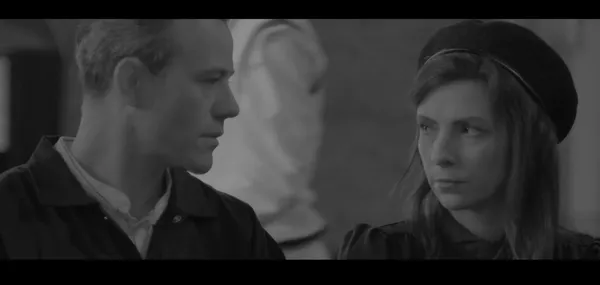

Back in 2021, Manchester’s Eric Steele wowed Frightfest with his feature début, downbeat vampire tale Boy #5 (since renamed Bad Blood). Now he’s back with an alternate history take on World War Two which is considerably broader in scope and ambition. It’s not entirely successful, but in scaling up he has taken on new challenges offering plentiful opportunities to learn.
The film begins with some nice compositing work using archive footage to tell a different story about the end of the war. Introduced using straightforward textual exposition, later embellished by snippets of fictional news reports, this sets up the scenario cleanly and lets him get straight into the action. Siegfried’s Funeral, despite being one of the most charismatic bits of Wagner’s work, feels a little out of place given the subject matter, though not nearly as much so as in a later reprise.

Although Hitler himself forbade the use of biological weapons, it has been conclusively established that the Waffen-SS explored the possibility of using fleas and mosquitos as offensive weapons, so the notion of a biological agent being used to force British surrender is a reasonable one. It works very nicely as a plot device, setting up a scenario in which people feel reliant on German vaccinations and therefor compelled to cooperate with their conquerors. The twist in this narrative is rather less successful – viruses simply don’t behave as described, or at least not to any reliable degree, as anyone paying attention to the new ebola outbreak in Congo can see. A reference to oppressive mask mandates just feels silly in the context of Nazi atrocities, and all the more so because we never see anybody wearing one. Taked together with the line ‘take back control’ by one plucky Britich upstart, it suggests a secondary agenda for the film which diminishes its impact as fiction.
There’s good attention to period detail, aided by the fact that many English towns have changed little since the 1940s, as we see a group of neighbours rounded up and sent to the local church for interrogation. Their captors make various claims about Communist propaganda and hidden fugitives, but it soon becomes clear that they’re looking for something else. We remain with the primary group of prisoners as individuals are led away for interrogation, which helps to build up tension and establish the fear felt within the community without the need for grisly torture sequences. Most of the drama emerges from their different ideas about how best to respond to the situation. The bigger picture emerges only in snippets, with observations about geopolitics, the royal family and control of the press which fit neatly into the historical context but may surprise younger viewers kess familiar with that.
The quality of the acting is variable. An eight day shoot means there was little time for reshoots, which is painfully apparent in places, but this being the case, Steele and his team deserve credit for having managed to pull the whole thing together. Despite its shortcomings, it’s a coherent story with worthwhile observations to make about the pettiness underscoring most authoritarian regimes.
Reviewed on: 18 May 2026



Director: Eric Steele
Writer: Eric Steele
Starring: Kimberley Barrett, Laura Montgomery Bennett, Nick Stefan Brown, Kerry Corcoran, Sebastian Derby, Oliver Devoti, Stacey Jackson, Joseph Jordan
Year: 2026
Country: UK
Festivals:
Search database:
